
$1.07M
Australia's mean dwelling price
80%
LVR where LMI often applies
$700–$2,500
Typical conveyancing cost
Sources: ABS “Total Value of Dwellings, December Quarter 2025” Moneysmart “lenders mortgage insurance (LMI)” NAB “What are the upfront costs of buying a house?”
Buying a home is one of the biggest financial decisions most Australians will ever make. And for many, the focus during the buying process sits almost entirely on the mortgage, the deposit, the repayments, the interest rate. What tends to get far less attention is everything else.
Homeownership carries a long list of ongoing costs that sit well and truly outside the loan repayment. Some are predictable and annual. Others surface without warning and demand immediate attention. Taken together, they can add thousands of dollars a year to the real cost of owning a property, and for buyers who have not built these expenses into their budgets, the surprise can be financially destabilising.
Planning makes all the difference. Here is a practical breakdown of the costs every homeowner should account for, and how to approach budgeting for each one.
Worried about hidden costs before you buy?
A pre-purchase building and pest inspection can uncover defects, pest activity and repair risks before they turn into expensive surprises.
Inspection Guide
Why Buyers Underestimate the Real Cost of a Home
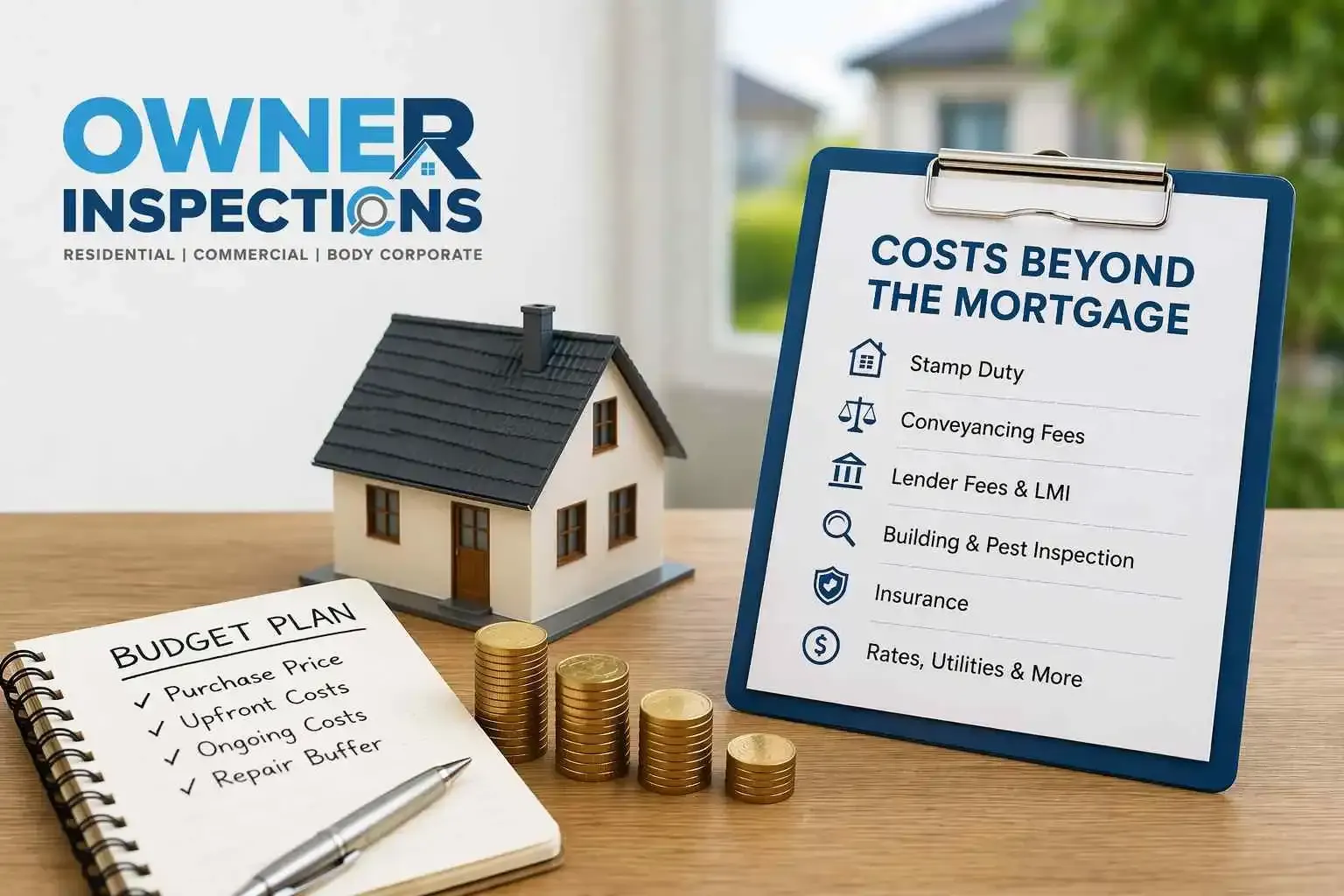
A lot of buyers start with borrowing power because that is what lenders, calculators and property ads put in front of them. The trouble is that borrowing power does not equal full affordability. NSW Government’s buyer guidance lists duty, LMI, inspections, conveyancing, mortgage registration, title registration and loan application fees as upfront buying costs outside the loan itself.
That means cost beyond mortgage is not one hidden fee. It is a stack of one-off and ongoing costs. Some hit before settlement. Some start on day one of ownership. Some only appear when an inspection picks up defects, or when a body corporate raises a special levy, or when an older hot water system stops working in your first few months.
For cautious buyers, this is not a small admin detail. It is a financial stability issue. When your emergency cash is swallowed by buying costs you did not plan for, you have less room to handle rate rises, urgent repairs or job changes. That is one reason a careful pre-purchase budget matters as much as the loan approval itself.
Upfront Costs Beyond the Mortgage
Before you even pick up the keys, there are several costs that can change the true price of the property. These are the expenses buyers most often leave out of early budgeting, especially when they are focused on winning the property first and sorting out the details later.
Stamp duty and transfer duty
For many buyers, duty is the biggest extra cost after the deposit. The amount depends on the state or territory, the value of the property, the buyer’s status and whether a concession or exemption applies.
In NSW, transfer duty is based on the sale price or market value, whichever is higher, and must generally be paid within three months of signing, or earlier if settlement happens first.
Victoria’s calculator factors in first home buyer help and principal place of residence concessions, and
Queensland’s estimator directs buyers to home concession rates. The practical lesson is simple: do not guess duty. Use your state revenue office calculator early, before you decide what you can comfortably offer.
A property that looks affordable on the mortgage alone can feel very different once duty is added.
Conveyancing and legal fees
Conveyancers and property solicitors do more than shuffle paperwork. They review the contract, check the title, prepare settlement documents and help manage duty and transfer steps. NAB says buyers can typically expect conveyancing or legal fees of about $700 to $2,500, depending on complexity and whether the work is done by a conveyancer or solicitor. The Australian Institute of Conveyancers NSW also points buyers to title searches, council inquiries, settlement agency fees, loan and mortgage document work, and registration fees as part of the transaction.
This is not an optional add-on. It is a standard cost of buying properly, and it can save you from signing a contract you do not fully understand.
Lenders Mortgage Insurance (LMI)
LMI is one of the most misunderstood buying costs in Australia. Moneysmart defines it as insurance that protects the lender, not the borrower, and says it is usually a one-off cost when the amount borrowed exceeds 80% of the property’s value. NSW Government gives the same practical rule of thumb: buyers borrowing more than 80% of the purchase price may need to pay it.
That means a buyer with a smaller deposit might face thousands in extra cost beyond the mortgage itself. Not every buyer pays LMI, and some government guarantee schemes can help eligible buyers avoid it, but it should be checked early, not after the offer is accepted.
Loan setup, valuation and registration fees
These costs are usually smaller than duty or LMI, but they still count. NSW Government includes mortgage registration fees, registration of title, loan application fees and independent valuer fees in its upfront buying list. AIC NSW also flags fees and charges for obtaining a loan, attending to mortgage documents and registration costs.
On their own, these charges may not look dramatic. Together, they can still add another layer to the amount you need in cash before settlement.
Building, pest and strata inspection costs
This is where many buyers treat an inspection as just another line item, when it is often one of the smartest cost-control steps in the whole purchase.
A pre-purchase building inspection looks for visible defects and areas of concern in the structure and condition of the home. Owner Inspections notes that a building inspection is carried out to Australian Standard AS 4349.1 and records defects in reasonably accessible areas. A combined building and pest inspection adds a timber pest assessment for termites, termite damage and termite risk conditions.
Owner Inspections’ current buyer guidance also points to faults such as roof issues, leaking ceilings, cracked walls, foundation problems, mould, waterproofing failures and drainage issues as the kinds of defects that can materially change what a property will cost you after settlement. For apartments and some townhouses, a strata report or strata records review matters too. NSW Government includes strata reports in the upfront buying costs list because shared-property issues, low sinking funds or unresolved maintenance can become your problem after settlement.
The real value is not just finding defects. It is turning unknown costs into known costs. Owner Inspections’ guidance says a building inspection report can support price negotiation when it uncovers defects or risks that affect value, safety or repair costs. That gives buyers a better shot at adjusting the price, renegotiating terms or deciding not to proceed before the hidden bill becomes theirs.
Need to budget for inspection costs too?
See what goes into pre-purchase inspection pricing in Australia so you can plan for the full cost beyond the mortgage.
Cost Guide
Settlement adjustments, moving and connection costs
Settlement day brings its own smaller but real costs. AIC NSW flags adjustments of rates and taxes for the period you own the property, and NAB notes that property-related charges such as rates and taxes are adjusted on settlement day.
On top of that, buyers still need to cover removalists, cleaning, utility setup and internet connection. Those costs are easy to ignore in a spreadsheet because they do not feel as formal as duty or legal fees, but they still come out of the same savings pool.
Ongoing Costs That Start After Settlement
The mortgage is only one part of owning a home. Once settlement is done, the regular bills begin. This is where buyers who stretched to get across the line can feel caught out, because the mortgage payment is now sitting beside rates, insurance, levies, utilities and repairs.
Council rates, water and utilities
These costs sit outside the mortgage and they affect monthly affordability straight away. AIC NSW notes that rates and taxes are part of settlement adjustments, and Australian lenders also remind buyers to factor in ongoing costs such as council rates and insurance. Utility connection and internet setup costs are another common move-in expense.
Before committing, ask for the latest rates notice, check water charges where relevant and price the practical move-in costs, not just the loan repayment.
Home insurance and contents insurance
Home insurance sits among the most important ongoing costs of homeownership, and one of the most frequently underestimated in terms of what adequate cover actually costs.
Two categories of cover matter here.
- Buildings insurance protects the physical structure of your home such as walls, roof, floors, and permanent fixtures.
- Other structures on the property, against events like fire, storm, flood, and theft.
Contents insurance protects the belongings inside:
- furniture
- electronics
- appliances
- clothing
- everything else you own
Policies that combine both under a single product, such as NRMA home and contents insurance, cover the full asset (the structure and its contents) with the convenience of a single policy and a single renewal date.
The cost of a combined policy varies based on your property's location, construction type, claims history, and the sum insured you nominate for both buildings and contents. Getting those sums right matters.
Many homeowners insure their buildings based on the original purchase price rather than the current cost to rebuild, which, given rising construction labour and material costs in recent years, can leave a significant gap between what a claim pays out and what full reinstatement actually requires. Reviewing both figures annually, rather than simply accepting automatic renewal amounts, is one of the most valuable insurance habits a homeowner can develop.
Strata or body corporate fees
If you are buying an apartment, townhouse or property in a managed community, strata or body corporate fees can be a major part of the real cost beyond mortgage repayments. In NSW, all owners in a strata scheme are charged yearly levies, usually paid quarterly. In Victoria, annual owners corporation fees cover administration, maintenance, insurance and other ongoing costs. In Queensland, body corporate contributions fund regular maintenance, insurance, common property renewal and, where needed, extra special contributions.
A very low levy is not automatically good news. That can be a sign the scheme is collecting less for maintenance or future common property work, which may raise the chance of special levies later. That is an inference from how NSW, Victorian and Queensland schemes fund administration, insurance, maintenance and sinking or maintenance works.
Maintenance, repairs and emergency buffer
Even a tidy property can cost money soon after settlement. Building inspections commonly cover roofs, subfloors, wet areas, drainage, structural elements, doors, windows, retaining walls and safety items, and a quality report will classify defects and recommend repairs or further specialist investigation. Owner Inspections also says its reports cover issues across plumbing, structural condition and other defects that affect the property’s quality and integrity.
That is why older homes usually need a bigger year-one repair buffer than newer homes, and why a well-presented property should never be assumed to be low risk. Roofing work, plumbing faults, drainage problems, repainting, electrical issues or a failed hot water system can all land quickly, especially if they were already brewing before purchase. A pre-purchase inspection does not remove those costs, but it gives you a better chance to budget for them before they hit.
How an Inspection Helps Prevent Budget Blowouts
Open homes are built to sell the property, not diagnose it. You might notice layout, light and street appeal, but you will not usually get a clear view of roof void issues, subfloor problems, drainage concerns, termite evidence or whether a crack is cosmetic or a sign of movement. A licensed inspector looks at the property differently and documents the defects in a way a buyer can actually use.
That report can help a buyer do four practical things. It can show which repairs are urgent and which can wait. It can help estimate near-term maintenance spend. It can support negotiation when defects affect value, safety or repair cost. And it can help a buyer walk away from a property that no longer fits the budget or the risk appetite. That is why inspections are better thought of as a decision-support tool, not just a transaction cost.
Four Buyer Scenarios that Change the Total Cost
First-home buyer purchasing a house
A first-home buyer often focuses on the deposit and the monthly repayment, then gets hit by duty, legal costs, lender fees and inspection costs. If the deposit is below 20%, LMI may be part of the bill too. The smart move is to price duty with the state calculator, check concession eligibility and book the inspection before your cash buffer is spoken for elsewhere.
Apartment buyer dealing with strata costs
Apartment buyers often underestimate levies and overestimate how much “the building” will take care of for them. In reality, strata or body corporate fees fund insurance, administration, common property maintenance and future works, and special contributions can be raised when budgets fall short. A strata report matters because the sticker price of the unit is only part of what you are signing up for.
Buyer considering an older home with repair risks
Older homes can still be great buys, but they usually deserve a wider margin for repairs. Roof issues, subfloor problems, drainage defects, cracking, leaks, outdated wet areas and termite risk can all turn a “character home” into a much more expensive first year than expected. This is where a detailed building and pest report gives buyers a more honest ownership budget.
Auction buyer who needs inspection timing sorted early
Auction buyers have less room for delay and far less room for mistakes. NSW, Victoria and Queensland all make the same practical point in different ways: there is no cooling-off period for a successful auction purchase. In Queensland, the government states plainly that you still have to settle even if the house does not pass inspections. That is why inspections, finance checks and contract review need to happen before bidding, not after.
A Practical Checklist Before You Make an Offer
Treat this as a short buying process, not a loose list.
- Estimate transfer duty or stamp duty with the correct state calculator and check whether any first-home or principal place of residence concession applies.
- Get a conveyancing quote and ask what searches, registration fees and settlement tasks are included.
- Confirm lender fees and LMI exposure before you make the offer, not after.
- Book a building inspection, and a pest inspection where relevant, before exchange where possible, or before auction day if the property is going to auction.
- Review strata records or body corporate information for units, apartments and townhouses.
- Get insurance estimates for the building and contents so the ongoing budget is real, not assumed.
- Check council rates, water charges and move-in setup costs such as utilities and internet.
- Keep an emergency repair buffer for defects the inspection flags or for items likely to need work in year one.
Want clearer numbers before you commit?
Book a building and pest inspection to uncover hidden defects, estimate likely repair priorities and make a more informed offer.
Inspection
Frequently Asked Questions
What costs do buyers pay besides the mortgage in Australia?
Buyers usually pay duty, conveyancing or legal fees, lender fees, valuation and registration charges, inspections, insurance, settlement adjustments, moving costs and ongoing ownership expenses such as rates and strata levies.
How much extra should I budget on top of the purchase price?
There is no one number that fits every buyer because the total depends on state duties, deposit size, lender fees, property type and whether repairs are needed. A better approach is to build a line-by-line budget using duty calculators, legal quotes, inspection costs and a repair buffer rather than relying on a rough percentage.
Is stamp duty the biggest cost beyond the mortgage?
Often, yes. For many buyers, duty is the largest upfront cost after the deposit. But it is not the only one, and a buyer who focuses only on duty can still be caught by LMI, legal fees, inspections and early repair work.
Do first-home buyers still pay stamp duty?
Sometimes yes, sometimes no, and sometimes they get a reduced amount. It depends on the state, the property value and whether the buyer qualifies for the relevant concession or exemption, which is why official state calculators are the safest place to check.
How much does conveyancing cost in Australia?
NAB says buyers can typically expect about $700 to $2,500, depending on the complexity of the purchase and whether the work is done by a conveyancer or solicitor. That figure usually sits on top of search fees, registration fees and some transaction-related costs.
How much does a building and pest inspection cost?
Pricing varies by property size, location and scope, but recent Australian lender and publisher guidance commonly puts a combined building and pest inspection around the hundreds, not thousands. The bigger point is that the fee is small compared with the cost of buying a property with hidden defects or termite damage you did not know about.
Are building and pest inspections worth it before buying?
Yes, in most cases they are. They help uncover structural issues, pest activity and likely repair costs, and they can support negotiation or a decision not to proceed. Owner Inspections’ guidance also notes that a report can strengthen a request for a fair price reduction when defects affect value, safety or repair cost.
What ongoing costs start after settlement?
Common ongoing costs include council rates, water charges, utilities, building insurance, contents insurance, strata or body corporate levies and general maintenance. These costs start affecting real affordability as soon as ownership begins, even though none of them are part of the mortgage repayment itself.
Do apartments cost more because of strata fees?
They can. Apartments may have lower maintenance inside the lot than some houses, but owners still pay strata or body corporate fees for administration, insurance, common property maintenance and future capital works. Special levies can also be raised where the normal budget is not enough.
Can a building inspection help me negotiate a lower price?
Yes. Owner Inspections states that buyers can negotiate price after a building inspection when the report uncovers defects or risks that affect value, safety or repair costs. The report gives documented evidence to support the conversation, although it does not force the seller to agree.
Should I get an inspection before bidding at auction?
Yes. Auction purchases in NSW, Victoria and Queensland do not come with the usual cooling-off protection, so buyers need their inspections, finance checks and contract review done before they bid. Waiting until after the hammer falls is usually too late.
How much emergency buffer should buyers keep after settlement?
There is no official fixed amount because the right buffer depends on the property’s age, condition, type and the defects identified before purchase. The safer approach is to keep separate cash for immediate repairs, moving costs and the first run of ownership bills, rather than spending every available dollar on deposit and settlement.