
A termination that is not valid, or an agreement with the builder to simply walk away, is not one of the ways the scheme recognises a contract as ended, so get advice before you end anything. Everything after that depends on evidence of what had actually been built and paid for on the day work stopped.
Important
This is general information written by building inspectors, not legal advice. Questions about terminating your contract, the insolvency itself and your claim need a solicitor.
What happens to my building contract when a Queensland builder goes broke?
On site, work stops and the subcontractors leave. That is a fact about the site, not a contract event, and it is the day to start writing things down.
An administrator takes control of the company to decide whether it can be saved. It may end in a deal with creditors or in liquidation.
A liquidator winds the company up, sells what it owns and deals with creditors. Do not plan on a company in liquidation finishing your house.
A receiver is appointed, usually by a secured lender, to recover that lender's money. The receiver acts for the lender, not for you.
Under general contract law, the appointment of an administrator or liquidator does not by itself usually end a domestic building contract. Whether and how it ends depends on the contract's wording. For the general sequence of who to notify and when, see what happens if my builder goes into liquidation.
The Home Warranty Scheme has its own test. Under the Queensland Building and Construction Commission Regulation 2018, a fixed-price residential contract ends for the scheme if:
- it is validly terminated because of the builder's default
- the builder dies
- the builder is a company that no longer exists
- the builder is bankrupt or insolvent and the builder's licence has been cancelled
Insolvency on its own is only half of that last test. Until the licence is cancelled, or the contract is validly terminated for the builder's default, the contract has not ended for the scheme.
What does the QBCC Home Warranty Scheme cover if my builder can't finish?
The scheme covers non-completion and defective residential building work, and the QBCC administers it. According to the QBCC, most residential building work in Queensland valued above a set minimum, counting materials, labour and GST, must have cover. Its page on what work requires insurance gives the current threshold.
A non-completion claim is only available under a fixed-price contract. Developers, anyone building three or more residences, and licensed contractors building on their own land are excluded.
What the scheme pays is capped. The QBCC's maximum home warranty entitlements set one maximum across non-completion, defects, accommodation, vandalism and theft. The maximum is higher if optional additional cover was taken out, it includes a smaller allowance for alternative accommodation and removal and storage costs, and a duplex has lower limits per unit before completion. Check the current figures on that page before you assume the claim will cover the whole cost of finishing.
It is a safety net that responds to defined events, not a promise that your house will be finished, and its conditions are strict. Do not assume your home and contents insurance fills the gap; check its wording with your insurer.
How do I make a non-completion claim with the QBCC, and how long do I have?
Confirm the insolvency
Get the name and contact details of the liquidator or administrator. Appointments are published on ASIC's published notices website.
Find out whether the contract has ended for the scheme
Ask the QBCC whether the builder's licence has been cancelled. If it has not, the contract has not ended under the insolvency test, and termination for default is a question for your solicitor.
Find your cover paperwork
If you never received it, ask the QBCC whether cover was taken out for your property.
Lodge with the QBCC
Lodge the non-completion claim within 3 months of the day the contract ends.
Keep the evidence record going
Keep adding to it until the claim is decided.
The QBCC's home warranty page for non-completion claims says a claim must be lodged within 3 months from the date the contract ends. There is a second limit behind it: the contract must end within 2 years of the day work started, or within 2 years of the contract date if work never started. The QBCC sets both out in its time limits for cover and claims.
Do you have to terminate the contract first? Not if the builder is insolvent and the QBCC has cancelled their licence, because the contract has then ended for the scheme. If the licence has not been cancelled, you may need to validly terminate for the builder's default before the contract counts as ended. Whether that is open to you depends on your contract, so get advice before you send any notice.
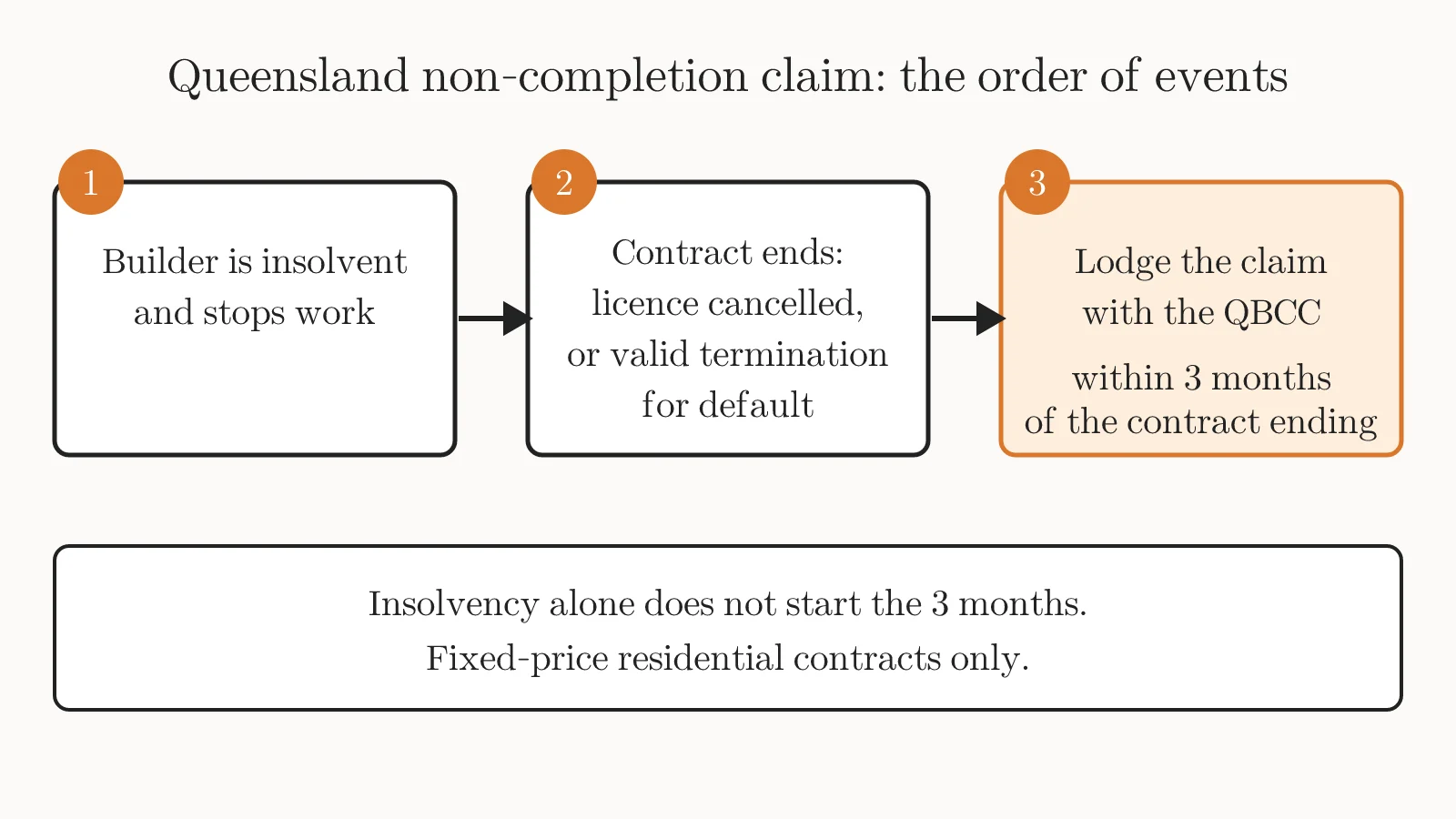
The diagram shows where owners lose time. Work stopping is the first box, but the 3 months is counted from a later one.
Should I keep paying the builder, the administrator or the liquidator?
Do not pay anything until you know who is entitled to receive it and that the work it claims has actually been done. That is different from simply refusing to pay. Our guide to withholding payment from your builder explains why holding money back without written notice, or in the wrong amount, can put you in breach.
Money paid to a company in administration or liquidation for work that was never done is often lost, because an owner usually ranks as an unsecured creditor.
How do I prove what stage the build had reached?
The QBCC, the liquidator and any builder who quotes to finish will all ask this, and each will want evidence rather than recollection. A builder's last progress claim is not proof of stage: it is what the builder said had been done.
A useful record separates what is complete from what is merely on site. A pallet of roof tiles in the driveway is not a roof.
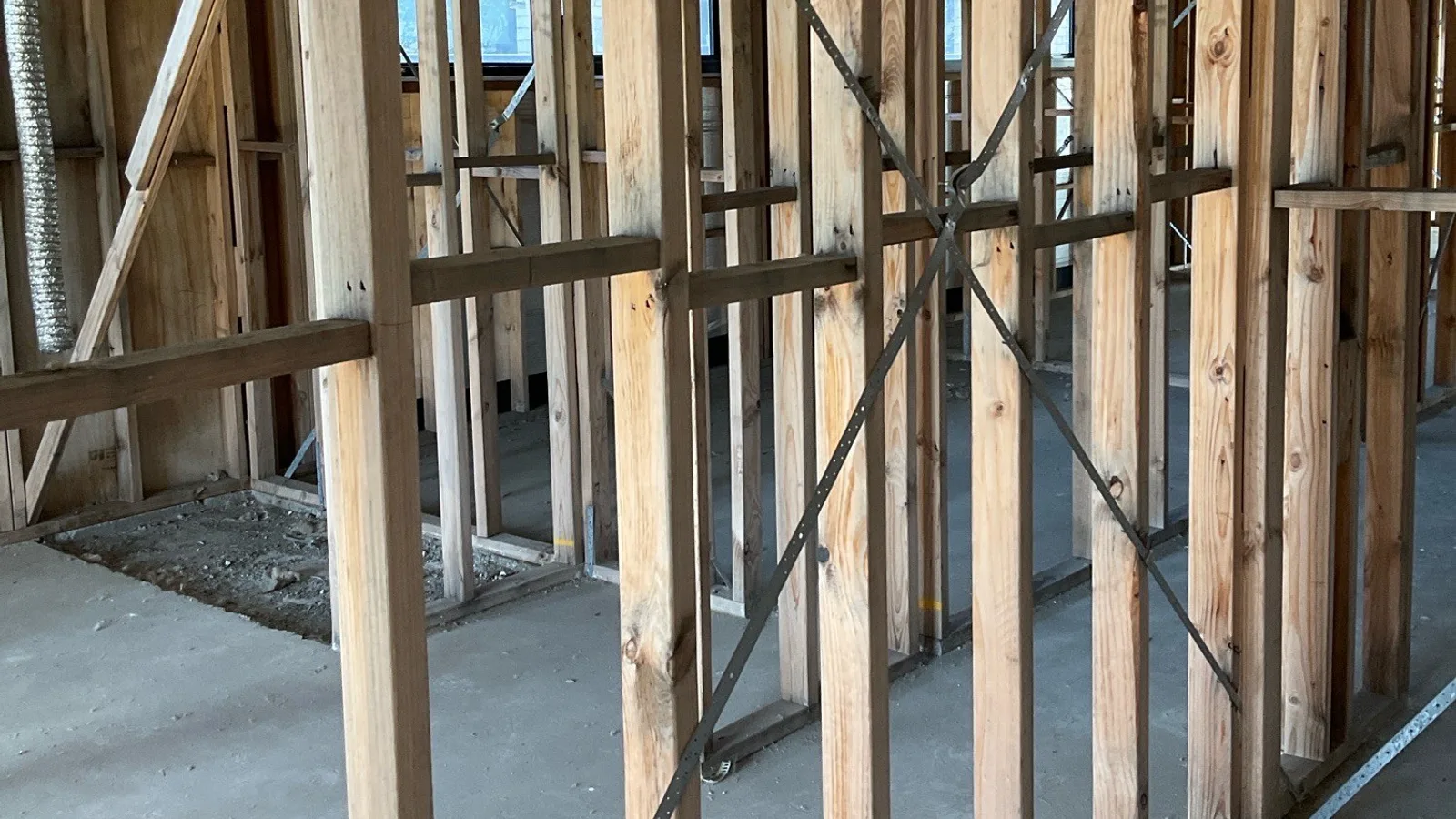
Each stage covers the one before it as soon as the next trade arrives: slab steel goes under concrete, framing goes behind lining, and the shower membrane goes behind tiles. A record made during the build is worth far more than one reconstructed afterwards.
A stage inspection report from Owner Inspections lists each item against the contract stage with a dated photograph and where it was taken, which is the form a claims assessor can compare with what was paid. If no stage record exists, an independent defect investigation report can document the work as it stands now, before anyone else touches it.
Record the Stage Before It Is Covered
An independent stage inspection fixes the condition of the work on a date, before the next trade covers it.
What about defects in work the builder already did?
Defects in work that was completed are a separate claim from non-completion, with their own clocks. The QBCC's page on home warranty for defective work claims sets them out:
- Structural defects. You must become aware of the defect, or ought reasonably to have become aware of it, within 6 years 6 months of the cover commencement day. The QBCC describes that day as the earliest of the contract date, payment of the premium or work starting. It is not 6 years 6 months from completion, and the start can move where work is not substantially complete within 6 months of cover starting. You must then claim within 3 months of first becoming aware, or of when you ought reasonably to have become aware.
- Non-structural defects. You must become aware of the defect within 6 months after the work is substantially complete, and claim within 7 months after the work is substantially complete.
Before a defect claim, an owner normally has to give the builder written notice and a chance to fix the work. The QBCC says that step is not required if the contractor is bankrupt, liquidated, deregistered or deceased.
Other states run different schemes with different limits. For a comparison, see how defect claims work after a builder becomes insolvent.
Can I get another builder to finish the job, and who chooses them?
Talk to the QBCC before you sign anyone. The scheme may have its own process for completing the work, and engaging a new builder first can affect the claim.
A new builder will price the job from what is already there, and will usually decline to warrant work they did not do. An independent record of the stage and any defects is what separates the old builder's work from the new builder's. For the stages still to come, see our guide to arranging independent stage inspections.
Related Articles
What happens if my builder goes into liquidation?
A builder entering liquidation mid-build does not usually end your contract on its own. This guide covers who to tell, what to do with the next progress claim, and how to prove how far the build had got.

Builder insolvent, can I still claim for defects?
A builder in liquidation cannot be made to come back and fix anything, but the defect claim usually survives them. This guide explains which state insurance responds, what it pays, and the deadlines that quietly close the door.

What Issues Should You Look for After Each Construction Stage?
Every construction stage hides the one before it, so the defects that matter are the ones about to become invisible.