

Owner Inspections is an inspection company, not a law firm. Whether a particular defect justifies withholding a particular progress claim turns on your contract wording, so take that question to your state building authority or a construction solicitor. What follows is how the process usually runs and what evidence decides it.
Can I Withhold Payment From My Builder if Work Is Incomplete?
Your contract governs this, not a general sense of fairness. A stage claim is only payable once the work described for that stage has actually been done. In NSW, section 8A of the Home Building Act 1989 requires progress payments to be for a specified stage or for work actually performed. Victoria is more prescriptive: the Domestic Building Contracts Act 1995 caps the deposit at 5 per cent on contracts of $20,000 or more, and for a standard new home the regulations set maximum stage claims of 10 per cent at base, 15 at frame, 35 at lock-up and 25 at fixing, with the balance on completion. A claim that asks for more than its stage allows is worth querying on its own, separately from any argument about quality.
The safe position is proportionality. Holding back an amount that matches the value of the unfinished work, or the cost of rectifying the defect, is something you can explain in writing. Holding the whole claim because the site is messy and you have lost confidence is not, and it exposes you to a suspension of works notice or termination.
Do not simply stop paying. Withholding without written notice, or withholding more than the value of what is outstanding, can put you in breach rather than the builder. Put the reason and the amount in writing before the due date, every time.
What Should I Do if the Builder Wants Final Payment Before Completion?
Compare the claim against the contract before you do anything else. Take the stage description, walk the site with it, and list what is not there. Final claims often arrive when the house looks finished from the driveway but the cabinetry is unfinished, the balustrade is missing, or the waterproofing certificate has not been issued.
Handover is a paperwork event as much as a physical one. Before the final claim is paid you would normally expect the occupancy permit or final inspection certificate, waterproofing and termite protection documentation, electrical and plumbing compliance certificates, and the home warranty insurance certificate. Missing paperwork is a legitimate reason to hold the final claim, and it is far easier to prove than a disputed finish.
Write the objection the way an inspector would write it: item, location, what the contract or the standard requires, and the amount held against that item. "Ensuite, waterproofing to AS 3740 not installed, $3,200 withheld" can be tested by somebody else. "The bathroom isn't finished" cannot. Going silent is the worst option, because unexplained non-payment looks like repudiation, while an itemised objection sent with payment of the undisputed balance looks like a homeowner exercising a contractual right.
What Counts as Incomplete Work Versus Defective Work?
The two are treated differently, and the distinction changes the number you are entitled to hold.
| Test | Incomplete work | Defective work |
|---|---|---|
| What it means | Contract scope that has not been done yet | Scope that has been done, but not to the required standard |
| Measured against | The contract scope and stage schedule | The contract, the National Construction Code and the relevant Australian Standards |
| What you can hold | The value of the unfinished work | The cost of rectification, which can exceed the item's contract value |
That last row is the part people get wrong. A shower might be worth $2,500 in the contract, but if the waterproofing membrane beneath it has failed in a second storey bathroom, rectification means lifting tiles, screed and sometimes the sheeting below, which commonly runs to $8,000 to $15,000. For a defect, the argument is about rectification cost, not the line item.

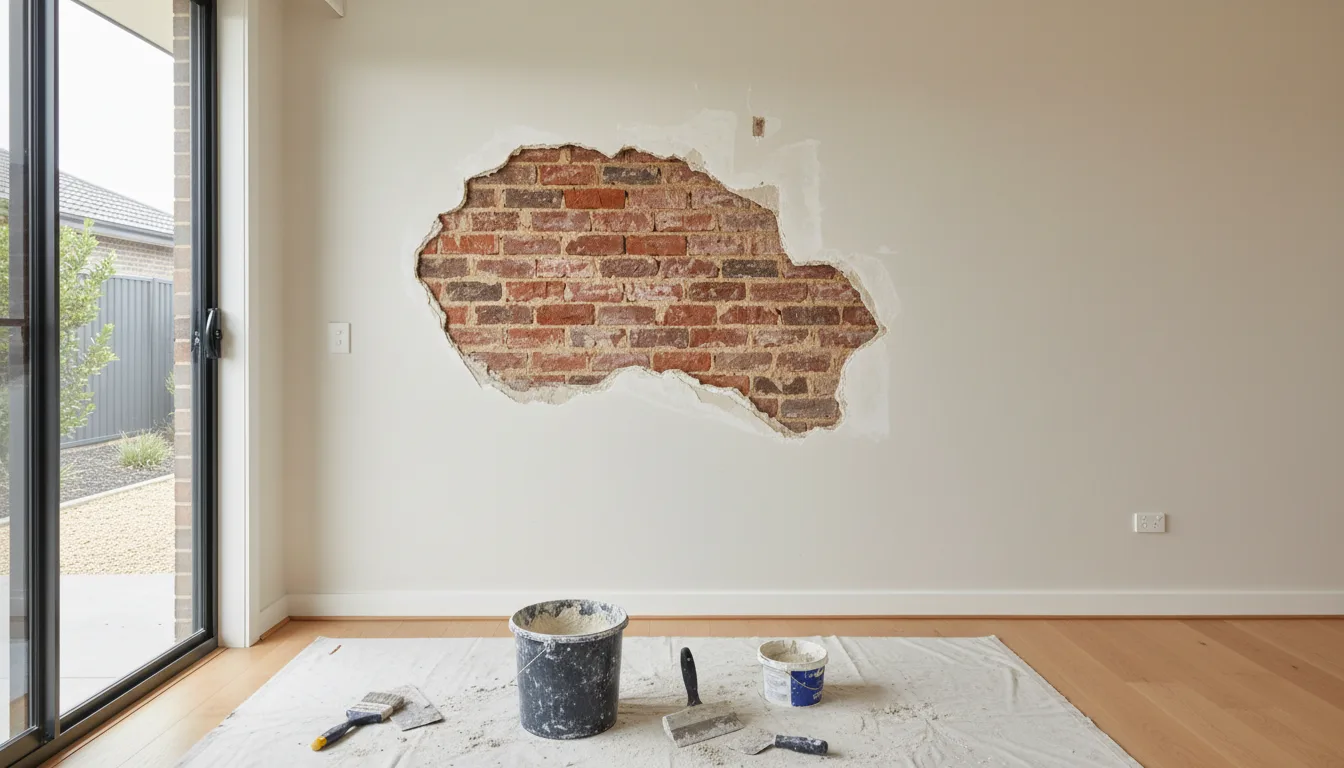
Work at this stage is incomplete rather than defective: nothing here has failed a standard yet, because most of it has not been finished. A construction stage defect assessment separates the two categories item by item, while the trades are still on site.
What to Do if a Tradesman Does a Bad Job in Australia
The escalation ladder is the same whether it is the builder or a subcontractor.
- Raise it directly and in writing, with photographs, locations and a reasonable deadline to respond
- Send a formal notice of defect if the first request is ignored, referencing the contract clause or standard you say has not been met
- Lodge a complaint with the state building authority, which in most states must happen before a tribunal will hear the matter
- Apply to the tribunal as the last step, with your evidence already assembled
Australian Consumer Law guarantees also apply to trade services: work must be carried out with due care and skill and be fit for purpose. The ACCC sets out these consumer rights and guarantees. Keep everything in writing from here on, because verbal-only complaints are the most common reason a homeowner arrives at a tribunal with nothing to show.
How Long Is a Builder Liable for Their Work in Australia?
It depends on the state and on whether the defect is structural. Broadly, structural or major defects sit around six to ten years and non-structural defects around two years. NSW gives six years for major defects and two for other defects. In Victoria, action can generally be brought for up to ten years from the occupancy permit or final inspection date. In Queensland, the QBCC generally accepts complaints about structural defective work up to six years and six months after completion and about non-structural work within twelve months, with the home warranty scheme running to its own separate cover periods. The clock usually runs from completion, not from the day you noticed the problem, so confirm the current period with your state authority before relying on it.
That window is a different clock from the payment dispute. A six year warranty does not mean you can hold a progress payment for six years. The payment argument is decided on the contract and on notice, and normally has to be resolved in weeks.
What Should You Not Say to a Builder During a Payment Dispute?
- "I'm not paying." Said verbally, with no notice and no itemised reason, that is closer to repudiation than to a defensible withholding
- "It's just not good enough." Vague complaints cannot be tested, cannot be costed, and are unusable as evidence later
- Anything that reads as a threat or an ultimatum. Every message you send is discoverable and may be read out at a tribunal
Keep the tone factual and specific: the item, the location, the clause or standard, the amount.
How an Independent Defect Report Is Used as Evidence
This is the part the legal explainers skip. Everyone tells you that you have a right to withhold. Almost nobody tells you how to prove the work is incomplete.

An independent report is not an email with a few phone photos attached. It sets out each item against the contract scope and the applicable standard, with dated photographs and locations, and gives a rectification cost. That turns "the kitchen isn't finished" into a schedule and a dollar figure a builder's insurer, a conciliator or a tribunal member can act on. It also fixes the condition of the work at a date, which matters when the builder later argues the damage happened after they left. To start the record yourself, our guide on how to document building defects for a legal claim covers the photography and correspondence side.
Document the Work Before the Payment Falls Due
An independent defect investigation gives you an itemised, dated, costed record of what is incomplete or defective, which is the evidence a payment dispute turns on.
Where to Lodge the Dispute in Your State
NSW. Lodge a building defect complaint with Building Commission NSW, which took over the Fair Trading process. Most home building disputes must go through that process before NCAT will hear them.
VIC. Use the free domestic building dispute resolution service now run by the Building and Plumbing Commission, previously DBDRV. Consumer Affairs Victoria explains the pathway for disputes, defects and delays. Conciliation comes before VCAT in most cases.
QLD. Lodge a defective work complaint with the QBCC, which publishes what it treats as defective work and can issue a direction to rectify. QCAT is the step after that.
Frequently Asked Questions
Can a builder sue me for withholding payment?
Yes. If the withholding was not justified, not notified in writing, or larger than the value of the outstanding work, the builder can claim the unpaid amount and may also claim for suspension or termination. It is a real risk, which is why the amount you hold and the notice you give both matter.
Does Security of Payment legislation protect me as a homeowner?
Generally no. It exists so contractors and subcontractors can recover progress payments up the contractual chain, and residential owner occupiers are largely excluded. Your rights come from your building contract and your state's domestic building legislation instead.
Do I need a lawyer to withhold payment?
Not necessarily to withhold a disputed amount correctly, provided your contract allows it and you give itemised written notice. Get legal advice before terminating a contract, before any tribunal application, and any time the disputed amount is large enough that being wrong would hurt.
What Should I Do if the Builder Wants Final Payment Before Completion?
Compare the claim against the contract before you do anything else. Take the stage description, walk the site with it, and list what is not there. Final claims often arrive when the house looks finished from the driveway but the cabinetry is unfinished, the balustrade is missing, or the waterproofing certificate has not been issued.
How Long Is a Builder Liable for Their Work in Australia?
It depends on the state and on whether the defect is structural. Broadly, structural or major defects sit around six to ten years and non-structural defects around two years. NSW gives six years for major defects and two for other defects. In Victoria, action can generally be brought for up to ten years from the occupancy permit or final inspection date. In Queensland, the QBCC generally accepts complaints about structural defective work up to six years and six months after completion and about non-structural work within twelve months, with the home warranty scheme running to its own separate cover periods.
Related Articles
Builder won't fix defects: what are your options in NSW and Victoria?
When your builder ignores defect complaints or refuses to carry out repairs, you are not without options, from formal written notices through to NCAT and VCAT.

What Are the Types of Construction Disputes?
Construction disputes can stall projects and cause significant financial loss. This guide covers the most common types and how each one is usually resolved.

How to Dispute a Defect Investigation Report in Gold Coast
If you disagree with a defect investigation report, here is how to review the findings, request clarification, and escalate the dispute if needed.