
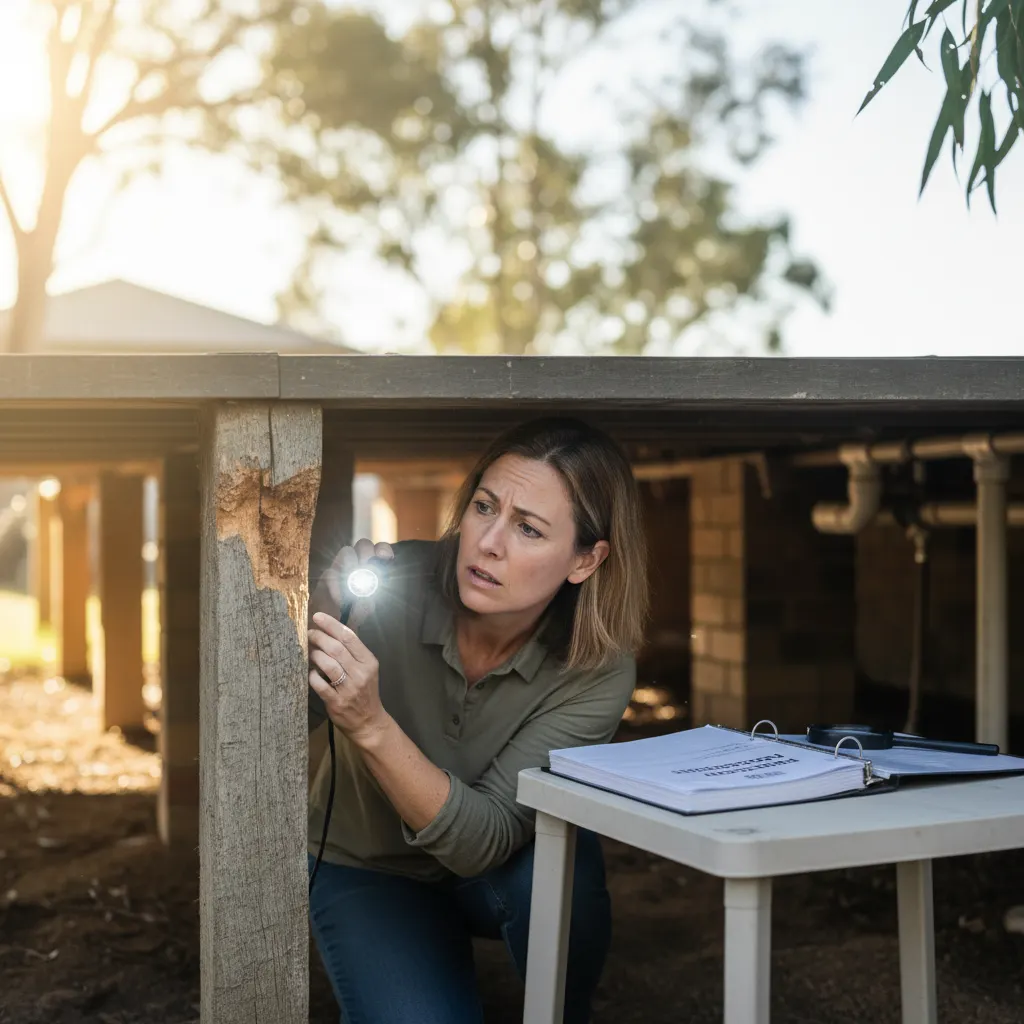
That last point is the one people get wrong, and it is the one that costs them. The moment a pest controller drills a barrier or a carpenter cuts out a damaged stud, the evidence of how long the termites had been there goes in a skip bin. The age of the damage is the hinge of everything that follows.
What happens if a building inspector misses something?
Before you do anything else, find the scope and limitations pages of your report and read them properly. Most people read the findings and skip the rest, and the rest is where the answer lives.
Australian timber pest inspections are carried out to AS 4349.3, the standard for timber pest inspections. It is a visual, non-invasive inspection of accessible areas. The inspector does not cut open wall linings, lift floor coverings or dismantle built-in cabinetry. If your report recorded the subfloor as restricted access, noted a room full of stored boxes, or recommended further investigation of an area, that is a documented exclusion rather than a miss, and a claim built on it will be hard work.
The opposite pattern is the one that matters. If the second inspector photographs active mud leads on an accessible pier, or damaged skirting in a room that was empty and open on the day, in an area the original report did not flag at all, that is the fact pattern a claim needs. Under the Australian Consumer Law, services must be supplied with due care and skill, and an inspection that misses something plainly visible can fall short of that guarantee.
The mechanics of proving it, the elements you have to establish and the limitation periods that quietly close the door, are covered in our guide to pursuing a negligence claim against the inspector. What matters today is sequence.
- Photograph what you can see, with dates, before anyone touches it.
- Arrange an independent second inspection, and ask specifically for an opinion on the likely age and duration of the activity.
- Write to the original inspector, factually, setting out what was found and where. Keep it short and keep a copy. Professional indemnity insurance is usually claims-made, so putting the matter in writing while their policy is live matters more than most people realise.
- Then decide whether to pursue their insurer, lodge a fair trading complaint, or file at your state's tribunal or court. The right forum differs by state, as do the monetary limits, so check yours before lodging anything.
If a tradesperson has already opened the area up, that is not fatal. Photograph the opened work immediately and keep every offcut of damaged timber. Our write-up of a renovation that uncovered termite damage shows what that documentation looks like when it is done well.
Do building inspectors check for termites?
Not by default, and this catches people out after settlement. A standard pre-purchase building inspection is carried out to AS 4349.1 and covers structural and safety defects. Timber pests are a separate scope under a separate standard, delivered either as a combined building and pest inspection or as a standalone timber pest inspection.
So the first thing to check is what you actually bought. If you paid for a building inspection only, there was never a termite scope to miss.
A timber pest report from Owner Inspections records which areas were accessed and which were not, area by area, precisely so this question can be answered later from the document rather than from memory.
Where the inspection did include timber pests, the question becomes what it could reasonably reach. What a professional timber pest inspection actually covers is the subfloor, roof void, interior and exterior, plus the timber structures, fences and trees on the property up to about 50 metres from the main building, using moisture meters and often thermal imaging. It does not include the inside of a closed wall cavity.
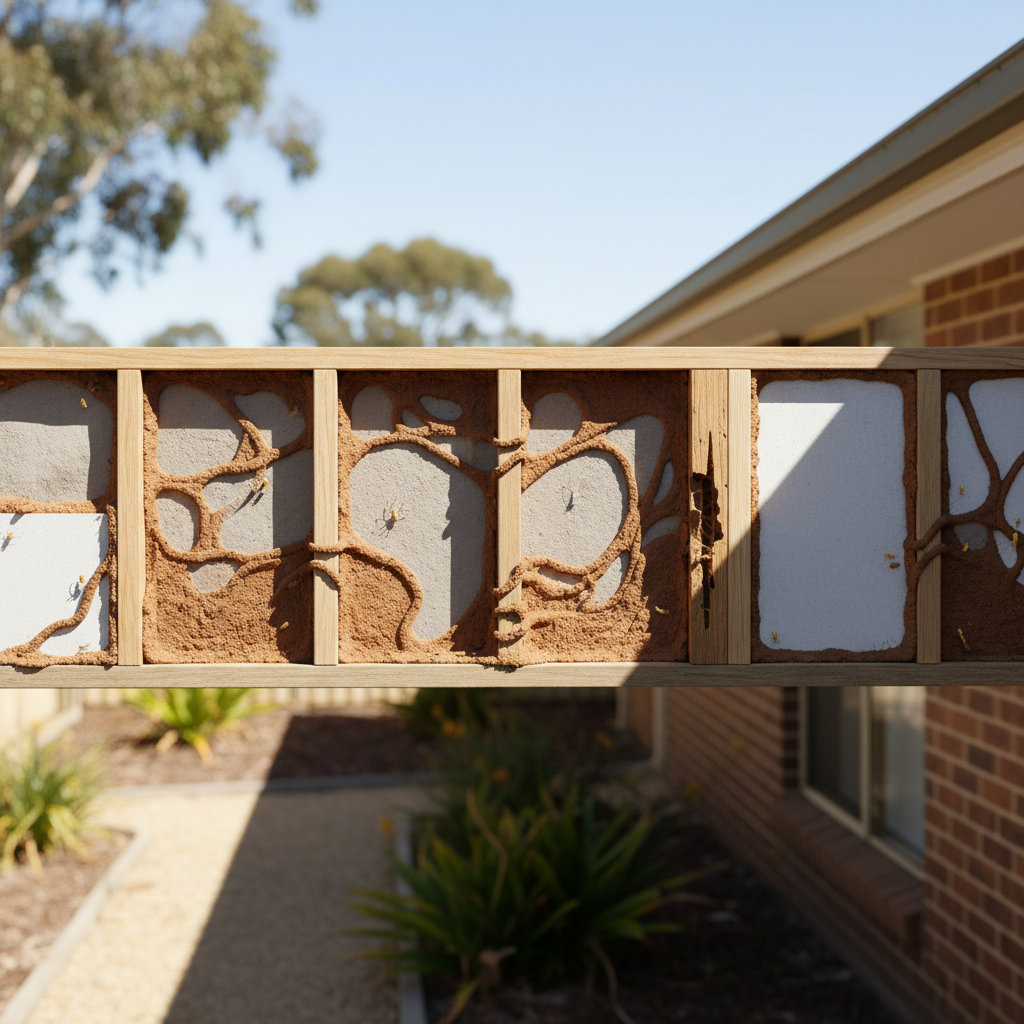
Need a Second Opinion on a Pest Report?
An independent timber pest inspection documents the activity, the damage and the areas accessed, before treatment or repair changes what can be established.
Do you have to disclose termites when selling a house in Australia?
There is no single national answer, and anyone who gives you one is guessing. Vendor disclosure duties are set state by state, and what counts as a defect you knew about turns on what you actually knew and when.
What is safe to say is that a known, active infestation is not something to leave out of a conversation with your conveyancer or solicitor. Ask them what your state's disclosure regime requires in your situation, before the contract is drafted. This article is general information rather than legal advice, and disclosure is exactly the question that needs the advice.
What are the first signs of termites in a house?
The early signs are subtle and easy to explain away.
- Mud tubes or leads running up piers, stumps, foundation walls or the inside of a subfloor.
- Rippled, blistered or bubbling paint over skirtings and architraves.
- A hollow or papery sound when timber is tapped, and skirting that gives under thumb pressure.
- Doors or windows that have suddenly started sticking.
- Discarded wings around window sills after warm, humid weather.
None of these prove termites on their own. Blistered paint is just as often moisture, and a sticking door is just as often seasonal movement in the frame. That is why an inspection reads the signs together with moisture readings and the building's construction type, rather than treating any one of them as a verdict. For telling termite damage apart from rot and borer damage, see what termite damage actually looks like.
Will termites go away on their own?
No. An established colony keeps foraging outward into new timber, and nothing about a house makes it decide to leave. Activity can appear to stop if the colony shifts to a food source you cannot see, which is not the same thing at all.
Which smell do termites hate?
Some essential oils, orange oil and clove oil among them, show mild repellency in laboratory conditions. There is no reliable field evidence that any of them control an established colony inside a structure, and repelling termites from one timber member simply moves them to another.
What kills termites immediately?
Nothing you can buy over the counter kills a colony immediately. Effective treatment means a licensed pest controller applying a termiticide registered with the APVMA, as a chemical soil barrier or through a baiting system, and both work through the colony over weeks. Spraying an accessible nest yourself tends to scatter the colony into parts of the house you cannot see.
What is a termite's worst enemy?
Not predators. Some ant species raid termite workings, but nothing in the garden meaningfully controls a colony already inside a house. What keeps termites out of a building is unglamorous: fixing leaking taps, shower recesses and downpipes, keeping garden beds and mulch below the weep hole line, clearing stored timber from under the house, and maintaining the barrier at the intervals its installer specifies.
Do coffee grounds repel termites?
There is no good evidence for it. Coffee grounds appear in informal tests as a possible mild deterrent at best, and a deterrent is not a treatment.
If you are searching for household remedies, you almost certainly have activity worth a professional opinion. The path has not changed: document it, get an independent inspection that speaks to the age of the damage, notify the original inspector in writing, and only then treat and repair.
Frequently Asked Questions
My pest inspector said it was nothing three months ago. Is it too late?
Should I get the termites treated before or after the second inspection?
Does a termite management proposal count as an inspection report?
What should I ask the second inspector to address?
References and Resources
- AS 4349.3-2010, Inspection of buildings, Part 3: Timber pest inspections, the standard that sets the non-invasive, accessible-areas scope
- AS 4349.1-2007, Inspection of buildings, Part 1: Pre-purchase inspections, the separate standard a building-only inspection is carried out to
- ACCC, consumer rights and guarantees, including the guarantee that services be supplied with due care and skill
- ACCC, where to go for consumer help, the per-state list of fair trading bodies and tribunals
- Victorian Department of Health, pest control: termites, on colony behaviour, baiting systems and chemical barriers
- APVMA, the regulator that registers termiticides for use in Australia
Related Articles

Can I Sue a Building Inspector for Negligence?
What negligence actually means, the evidence that decides these cases, and the time limits that quietly close the door.
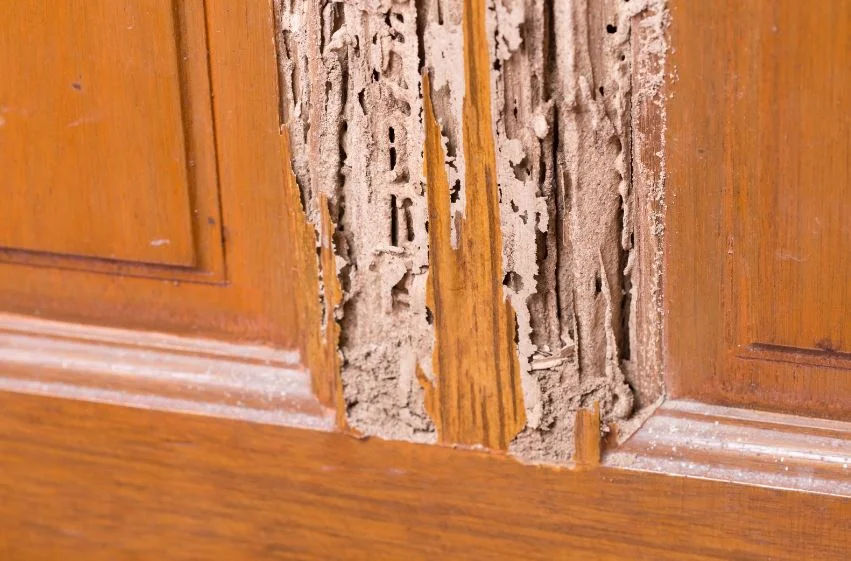
What does termite damage look like?
What termite damage actually looks like on doors, walls, subfloors and roof timbers, and how to tell it apart from rot or borers.
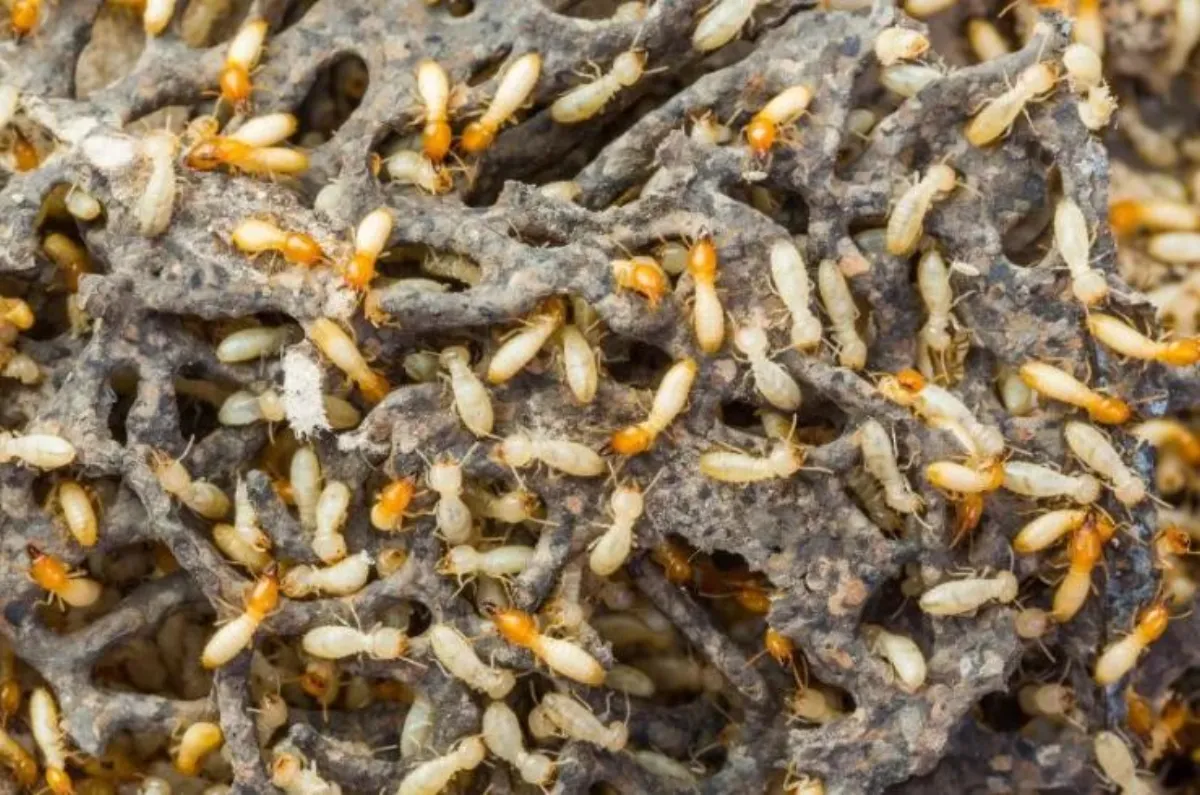
DIY vs Professional Timber Pest Inspections
Compares what a DIY check can catch against what a licensed inspector finds with thermal imaging and moisture meters.