
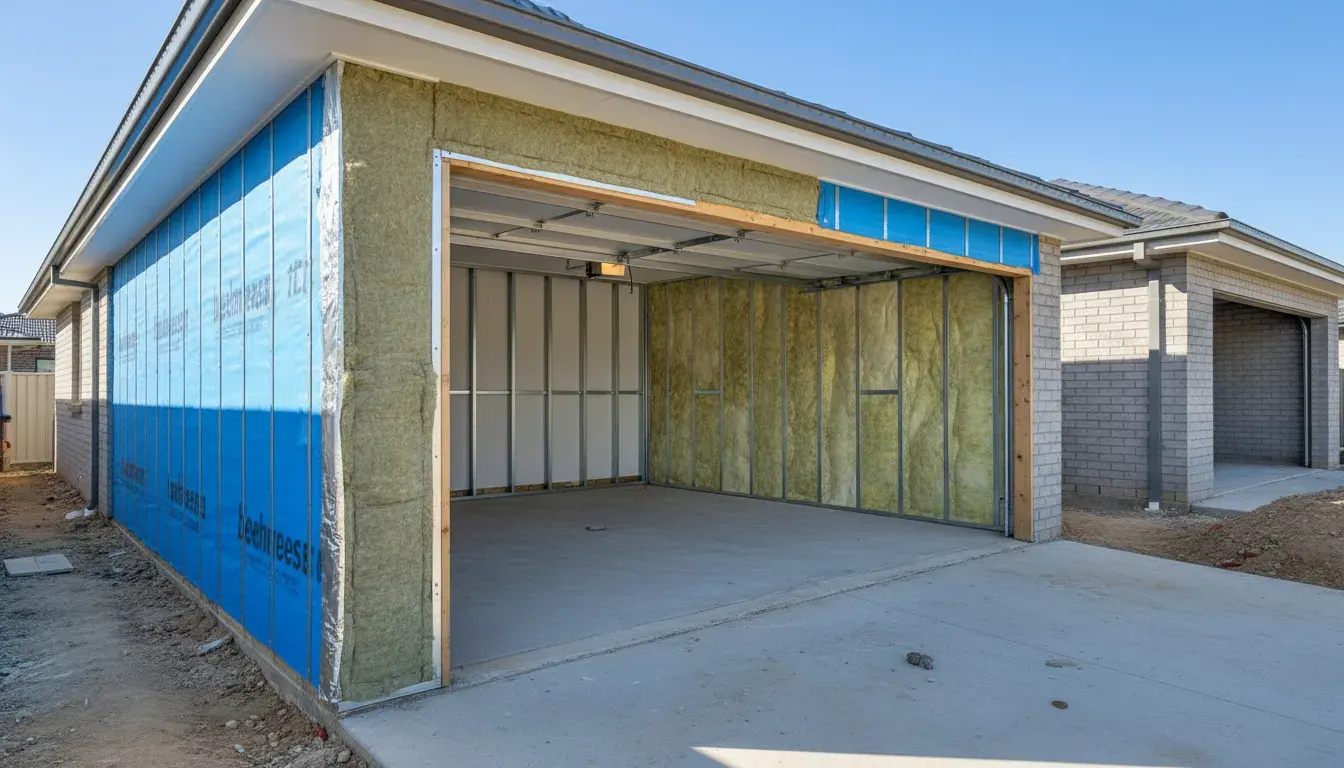
Under the NCC, a private garage is a Class 10a building, which means it is non-habitable. Once it is attached to a Class 1 home, it must not reduce the home's thermal performance, and since NCC 2022 new homes must reach a 7 star NatHERS rating or an equivalent pathway. In NSW, BASIX is the main residential sustainability pathway for new homes and alterations and additions costing $50,000 or more.
Quick Summary: Attached Garage Insulation Rules
- Garage class: a private garage is Class 10a (non-habitable); the house is Class 1.
- The rule: an attached garage must not reduce the house's thermal performance (Housing Provisions 13.2.7).
- Option A: insulate the wall, ceiling and any floor between garage and house to the house's standard.
- Option B: bring the garage inside the envelope by insulating its external walls, roof and floor to the house's standard.
- R-values: set by climate zone and wall or roof type in Part 13.2, not one national garage figure.
- Fire rating: a 60/60/60 wall is required against a garage that belongs to a neighbouring dwelling, not usually against your own garage.
- NSW: check the BASIX certificate, which sets the thermal commitments for the home.
That point matters because many online articles reduce the issue to one question: “Do I need insulation in the wall between the garage and the house?” or simply "Do garages need insulation?". Sometimes yes, but not always as a stand-alone answer. In some designs, the shared wall and adjoining floor or ceiling form the thermal boundary. In others, the garage’s own external walls and floor are brought into the thermal envelope instead.
7 stars
Minimum NatHERS rating for new homes under NCC 2022
45%
Possible heating and cooling saving from roof and ceiling insulation (YourHome)
40%
Share of household energy used for heating and cooling (YourHome)
Understanding NCC Classifications for Garages
Under the NCC, a private garage is a Class 10a building: non-habitable, and not part of the house's conditioned space. The house it is attached to is a Class 1 building. Because the two touch, the NCC requires the attached Class 10a garage not to reduce the thermal performance of the Class 1 house.
A private garage is normally Class 10a, which means it is not a habitable part of the home. That is why a detached garage is usually treated very differently from a bedroom, study or living room. But the moment a garage is attached, it becomes part of the thermal discussion because it touches the dwelling and can transfer heat, cold air and fumes.
- Class 10a Structure
A non-habitable building including private garages, carports, and sheds. These have reduced requirements compared to habitable spaces.
- Thermal Envelope
The boundary separating conditioned (heated or cooled) space from unconditioned space or the outside environment.
- R-Value
A measure of thermal resistance. Higher R-values indicate better insulating properties.
The key distinction depends on how your garage connects to the dwelling:
| Garage type | Typical classification | What it means for insulation |
|---|---|---|
| Detached garage used for parking | Class 10a | Usually outside the home’s thermal envelope |
| Attached garage with shared wall | Class 10a attached to Class 1 home | The garage must not reduce the home’s thermal performance |
| Garage with room above | Class 10a below habitable space | Ceiling or floor insulation usually becomes a key issue |
| Garage converted to living space | May need Class 1 assessment | New insulation, ventilation, ceiling height and approval checks may apply |
That last row is where many owners get caught out. A garage used as a room has different requirements from a garage used to park cars and store tools. Habitable rooms need higher minimum ceiling heights, and councils commonly require approval or a building permit for garage-to-room conversions.
Building a home with an attached garage?
Book an independent stage inspection to catch insulation, sealing and compliance issues before plaster goes on and defects get harder to fix.
Inspections
Do Garages Need Insulation Under the NCC?
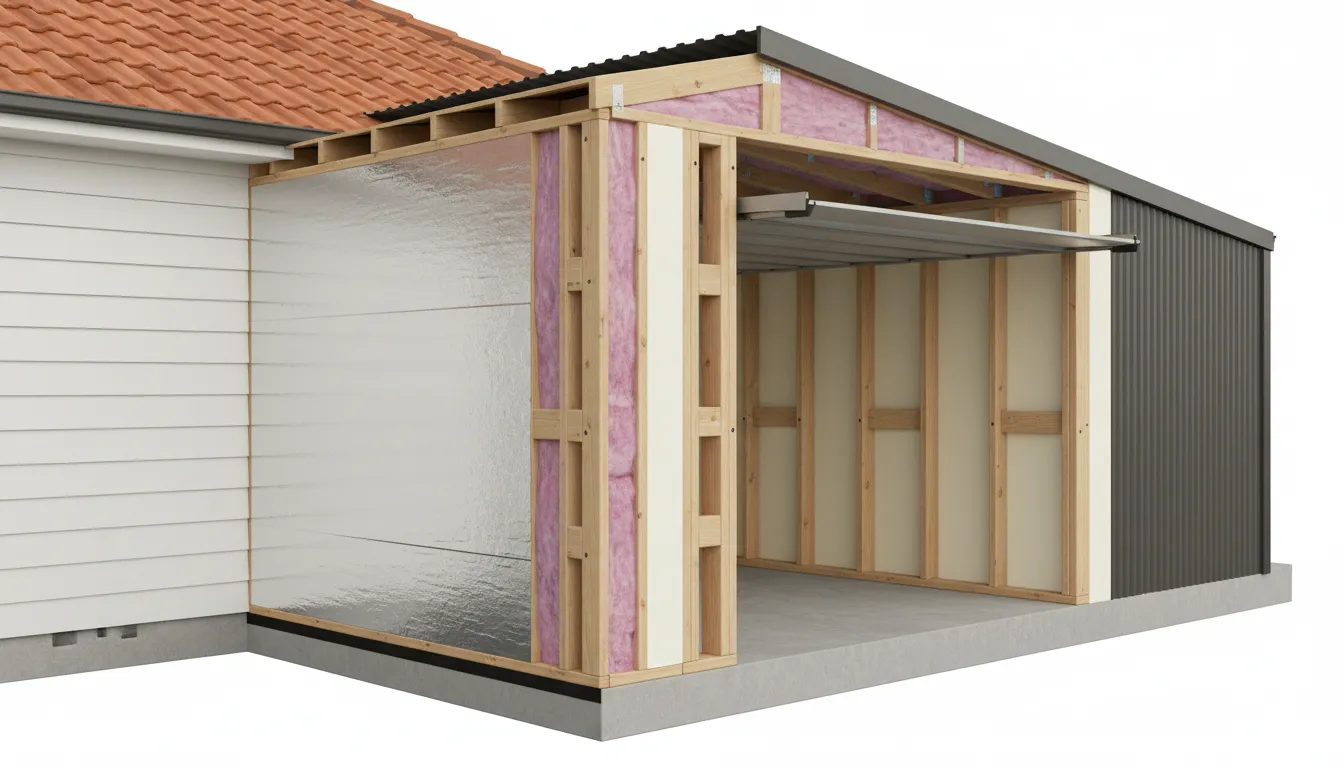
Attached garages need insulation under the NCC in one of two places. Either the garage's external walls, roof and floor are insulated to the house's standard, or the wall, ceiling and floor separating the garage from the house are. A detached garage that is not heated or cooled is generally outside the energy efficiency rules.
The NCC housing energy efficiency requirements sit in NCC Volume Two and the ABCB Housing Provisions. The ABCB Housing Energy Efficiency Handbook shows both options for attached garages, based on Explanatory Figure 13.2.7 of the Housing Provisions.
The garage should not become the weak point that lets heat, cold air or drafts affect the living area.
| Question | Practical answer |
|---|---|
| Does a garage need insulation if it is detached? | Usually not for energy compliance if it remains a non-habitable Class 10a garage |
| Do you need to insulate garage walls if the garage is attached? | Often yes, unless the garage’s external walls and roof are treated as part of the thermal envelope |
| Does the wall between garage and house need insulation? | Usually yes if that wall forms the thermal boundary |
| Does garage ceiling insulation matter? | Yes if there is a room above, shared ceiling space or heat transfer into the home |
Does Insulating a Garage Make a Difference?
Yes, insulating an attached garage makes a real difference to the rooms beside and above it. An uninsulated garage runs close to outdoor temperatures, so heat moves through any uninsulated shared wall or ceiling. YourHome estimates wall insulation typically saves around 15% on heating and cooling costs, and roof and ceiling insulation 45% or more.
Heating and cooling account for around 40% of household energy use in the average Australian home. Insulation works by slowing heat flow, which helps keep a home warmer in winter and cooler in summer. YourHome's insulation guide says internal walls only need insulating if they adjoin an uninsulated or unconditioned space, and names garages as an example: insulate those walls to the same standard as external walls.
That is why attached garages matter even if you never heat or cool the garage itself. A garage can act like a buffer zone, but it can also become a weak spot. The biggest trouble areas are often the large garage door, the ceiling or roof over the garage, the internal door linking the garage to the home, perimeter gaps, and any wall or floor that forms part of the home’s thermal boundary. Australian garage door manufacturers also lean heavily on door insulation and weather seals because the garage door is such a large moving panel and a common source of heat gain, heat loss and drafts.
There is also an indoor air quality angle. The door between an attached garage and the house should be well fitted and sealed, because vehicle exhaust contains very fine particles and toxic gases that can otherwise leak into living areas.
What Insulation Is Best for Garage Walls?
For most framed garage walls, bulk batts (glass wool, polyester or rockwool) fitted snugly between studs are the practical choice, with rigid foam board where cavity depth is limited. Reflective foil only works with a still air gap beside it. The right product is whichever reaches the required R-value in that wall without compression or gaps.
Bulk insulation uses pockets of trapped air to resist conducted and convected heat, while reflective insulation mainly resists radiant heat flow and needs an air layer beside the shiny surface. All insulation materials sold in Australia must meet AS/NZS 4859, Materials for the thermal insulation of buildings.
| Insulation type | Best use in attached garages | Notes |
|---|---|---|
| Glass wool batts | Common wall insulation for garage cavities | Cost-effective and widely used |
| Polyester batts | Wall insulation where low-irritant handling is preferred | Good option for renovations |
| Rockwool batts | Garage walls needing acoustic and fire-performance benefits | Useful near noisy or higher-risk areas |
| Rigid foam board | Continuous insulation to reduce thermal bridging | Often used where space is limited |
| Reflective sarking or foil | Radiant heat control and wall or roof wrap systems | Needs correct air gap and installation |
The right product is not enough on its own. YourHome warns that gaps, compression, dust on reflective insulation and missing air gaps can reduce total R value.
Garage Ceiling Insulation and Garage Roof Insulation
Garage ceiling insulation matters most when there is a room above the garage or when the garage roof space connects to the house roof space. In those layouts the garage ceiling, or the floor of the room above, is part of the house's thermal boundary and needs the house's R-value. Over a separate garage roof, insulation is mainly for comfort.
YourHome says installing roof and ceiling insulation can save 45% or more on heating and cooling costs. In attached garages, ceiling insulation for garage areas matters when heat moves through the ceiling into the house or when the garage roof space connects with the home’s roof space. Garage ceiling insulation can also work together with heating, cooling and ducting details, so owners of new homes may also want to check the guide on air conditioning installation in new builds.
| Garage layout | Insulation focus |
|---|---|
| Room above garage | Garage ceiling insulation or floor insulation above garage |
| Shared roof space with house | Ceiling line, roof space barriers and air sealing |
| Exposed garage roof | Garage roof insulation and reflective membrane details |
| Raked garage ceiling | Higher-detail insulation due to limited cavity space |
Is Insulation Mandatory in Australia?
Yes, for new homes and approved residential building work. Since NCC 2022, new homes must reach a 7 star NatHERS rating or meet the equivalent deemed-to-satisfy insulation provisions, which set minimum R-values for roofs, walls and floors by climate zone. In NSW, BASIX applies instead to new homes and to alterations and additions costing $50,000 or more.
For attached garages, the exact pathway depends on the state or territory, the design, the climate zone and the assessment method used. BASIX thermal standards rose on 1 October 2023 from an average of 5.5 to 6 stars to 7 stars, to align with NCC 2022, except in climate zones 9, 10 and 11 in north-eastern NSW.
For an existing garage that stays a garage, there is not a simple Australia-wide rule that every owner must retrofit insulation tomorrow. The bigger compliance triggers are new construction, major additions, and change-of-use work such as converting a garage into a habitable room. That is where approvals, new thermal targets and habitable-room requirements usually come into play.
What R-value Should I Insulate my Garage With?
There is no single Australia-wide garage R-value. Insulate the garage's separating wall and ceiling, or its external walls and roof, to the R-values required for the house in your climate zone. In the ABCB's worked examples that meant R2.0 wall insulation in an Adelaide house and R2.5 in a Melbourne house, both brick veneer.
The NCC does not work like a one-line "all attached garage walls must be R2.0" rule. Your Home explains that NCC minimum insulation levels depend on your location and other building features, and that total R-value is the best guide because it reflects the whole assembly, not just one product in isolation. BASIX in NSW also varies standards by location and building type, and aligns newer thermal standards with higher star-rating expectations.
A better way to answer the question is this:
-
If the shared wall, ceiling or floor is acting as the thermal boundary, that construction needs to achieve the home’s required thermal performance.
-
If the garage exterior is being treated as part of the home envelope, the garage’s outside walls, and sometimes the garage floor, need to do that job instead.
-
The right specification depends on climate zone, wall type, roof type, glazing, assessment path and state variations.
Climate Zones Australia: Why Location Changes Garage Insulation
The NCC divides Australia into eight climate zones, from hot humid zone 1 in the north to alpine zone 8, and the minimum insulation R-values for roofs, walls and floors change with the zone. A garage separating wall in Melbourne (zone 6) or Canberra (zone 7) therefore needs more insulation than the same wall in Brisbane (zone 2).
Find your zone on the ABCB climate zone map. The table below gives examples.
| NCC climate zone | Climate | Example locations |
|---|---|---|
| Zone 1 | High humidity summer, warm winter | Darwin, northern Australia |
| Zone 2 | Warm humid summer, mild winter | Brisbane, coastal Queensland |
| Zone 3 | Hot dry summer, warm winter | Northern central Australia |
| Zone 4 | Hot dry summer, cool winter | Mildura, Broken Hill, Tamworth |
| Zone 5 | Warm temperate | Sydney, Adelaide, Perth |
| Zone 6 | Mild temperate | Melbourne, Ballarat, Albany |
| Zone 7 | Cool temperate | Canberra, most of Tasmania |
| Zone 8 | Alpine | Alpine areas of Victoria, NSW and Tasmania |
The ABCB Handbook gives an example of a climate zone 5 house with an attached Class 10a garage and an example of a Melbourne climate zone 6 house with an attached Class 10a garage.
In the climate zone 5 example (Adelaide, steel-framed brick veneer), the handbook arrives at R2.0 wall insulation and R3.6 ceiling insulation after adjustments for the steel frame and downlights.
In the climate zone 6 example (Melbourne, timber-framed brick veneer), it arrives at R2.5 wall insulation and R4.0 ceiling insulation. Because that garage does not share the house roof, the handbook applies the separation option: the wall between garage and house is insulated to the house's standard.
Climate Zone Requirements for Garage Insulation
Garage insulation requirements follow the house's climate zone: the separating wall and ceiling, or the garage's external walls and roof, must reach the R-values the Housing Provisions set for the house in that zone. Those minimums come from tables in Part 13.2 and change with wall type, colour, eave overhang and wall height, so no one figure per zone is reliable.
| What changes with the zone | Where it is set |
|---|---|
| Minimum ceiling and roof insulation R-value | Housing Provisions 13.2.3 |
| Minimum external wall insulation R-value | Housing Provisions 13.2.5 |
| Floor and slab edge insulation | Housing Provisions 13.2.6 |
| Attached garage options | Housing Provisions 13.2.7 |
| Roof space ventilation for condensation (zones 6 to 8) | Housing Provisions 10.8.3 |
NCC 2025 Changes
NCC 2025 did not change the housing energy efficiency rules. Building ministers decided residential energy efficiency changes would not be introduced, which keeps the NCC 2022 standards, including 7 star energy efficiency, in place. Homes built before NCC 2022 may still fall short of current requirements if you are renovating or extending, so check the edition your state has adopted.
External Wall Wrap, Sarking and Internal Garage Wall Insulation
External wall wrap and internal garage wall insulation do different jobs. Wrap (a pliable building membrane) on the outside of the frame manages water and moisture, while bulk insulation in the wall slows heat flow. A garage wall that forms the thermal boundary needs the insulation; whether it also needs wrap depends on the wall system.
A pliable building membrane is treated in the NCC as a water barrier classified by AS 4200.1. NCC referenced documents include AS 4200.1 for pliable building membranes and underlays, and AS 4200.2 for installation requirements.
Internal insulation between the garage and living space deals with heat flow through the shared wall. External wrap helps with wall system performance, weather resistance and moisture control when it forms part of the specified wall system.
| Area | What to check |
|---|---|
| Garage external wall | Correct membrane, cladding cavity and wall insulation detail |
| Wall between garage and house | Bulk insulation, air sealing and service penetrations |
| Garage ceiling | Batts, roof space separation and access disturbance |
| Garage door | Weather seals and panel insulation where comfort is a goal |
| Internal garage access door | Sealing around frame and threshold |
External Wall Wrapping Requirements
The NCC does not require every garage wall to be wrapped. Under Part 10.8 (condensation management), where a pliable membrane is installed in an external wall it must meet AS 4200.1, be installed to AS 4200.2 and sit outside the primary insulation, with minimum vapour permeance in climate zones 4 to 8. Without a membrane, many wall types need a drained cavity instead.
For attached garages, check the wrap on:
Wall wrap does not:
- Replace bulk insulation where the wall must reach an R-value
- Fix air leaks at the internal access door, ceiling line or service penetrations
The type of wrap matters. Reflective sarking with appropriate permeability ratings must be installed according to manufacturer specifications. We often find wrap installed incorrectly during new construction stage inspections, with gaps at junctions or incorrect tape sealing.
Not sure if the garage insulation was installed properly?
Use our construction stage inspections guide to understand when insulation, wall wrap, doors and junctions should be checked during the build.
Stage Guide
Do You Need External Wrap, Internal Wall Insulation, or Both?
Most attached garages need internal wall insulation where the shared wall is the thermal boundary, and wrap only where the external wall system calls for it. If the garage is brought inside the envelope instead, its external walls need insulation to the house's R-value plus whatever membrane or drained cavity that wall type requires.
If a pliable building membrane is installed in an external wall, the NCC says it must comply with AS 4200.1, be installed to AS 4200.2, and sit on the exterior side of the primary insulation layer. In climate zones 4 to 8, membranes on the outside of the primary insulation layer also need minimum vapour permeance. Where there is no membrane in many wall types, the primary water control layer must still be separated from water-sensitive materials by a drained cavity.
That means “wrap” is not a magic yes-or-no box. The correct detail depends on the wall system and condensation risk, not just on the word “garage”.
Internal wall insulation is also not the whole story. If the shared wall forms the thermal boundary, then yes, that wall matters. But so do the junctions, penetrations, door frames, ceiling line and any floor or slab edge that sits on the same boundary. The NCC says insulation must butt or overlap adjoining insulation and form a continuous barrier. Your Home adds that corners, wall junctions, and door and window frames are common heat-leak points.
Internal Wall Insulation Between Garage and House
The wall between an attached garage and the house needs insulation whenever it is the thermal boundary, which is the usual design when the garage is not insulated like the house. It must reach the same R-value as the house's external walls in that climate zone, and YourHome gives the same advice for any internal wall next to a garage. A well-built shared wall also helps with:
- Air sealing against draughts from the garage
- Fume and odour isolation from vehicles and stored chemicals
- Comfort in the rooms beside the garage
Fire Rating Requirements
The Housing Provisions require a 60/60/60 Fire Resistance Level (or 90mm masonry) for a wall separating a home from a Class 10a garage that is not associated with it, such as a neighbour's garage in attached housing. The wall to your own attached garage does not usually need that rating, but boundary setbacks and garage-top dwellings have their own rules. Confirm the wall system with your building surveyor or certifier before choosing insulation.
Standard insulation options for the shared wall include:
| Insulation Type | Installation Notes |
|---|---|
| Glass wool batts | Most common; must fit the stud depth without compression |
| Polyester batts | Low-irritant handling, useful in renovations |
| Rockwool batts | Dense, with good acoustic and non-combustible properties |
| Rigid foam board | Thin continuous layer to reduce thermal bridging |
Check the R-value printed on the product against the required R-value for the wall, and confirm the product meets AS/NZS 4859.
If you suspect insulation defects in your property, a defect investigation report can identify compliance gaps and recommend remediation.
Where Do Garages Lose the Most Heat?
Attached garages lose and gain the most heat through the large garage door, the ceiling or roof, the internal door into the house, and air gaps around frames and services. A garage door is a big, thin, moving panel, and a bare garage roof space heats up quickly in summer. The main weak points are usually:
- The garage door, because it is large, thin and often poorly sealed
- The ceiling or roof over the garage
- The internal door between the garage and the home
- Gaps and penetrations around edges, services and frames
- Any shared wall or floor that forms part of the home’s thermal boundary
This is why insulating only one surface can disappoint owners. A nicely insulated shared wall will not fix a hot garage if the roof space above is bare, the garage door is uninsulated and the perimeter is leaking air.
Do Garage Walls Need to Be Fire Rated?
Usually not between a house and its own attached garage. Under the NCC Housing Provisions, a 60/60/60 fire rated wall (or 90mm masonry) is required where a home adjoins a Class 10a garage that is not associated with it, such as a neighbour's garage in attached housing, and where a dwelling sits above someone else's garage. Walls near a boundary have separate rules.
Part 9.3 covers walls between a Class 1 building and a Class 10a building not associated with it, Part 9.4 covers garage-top dwellings, and Part 9.2 covers external walls less than 900mm from an allotment boundary, including Class 10a buildings between the house and the boundary.
For a standard attached garage beside a Class 1 dwelling, do not assume a single fire rating applies in every state and every layout. Boundary setbacks, dwelling-above-garage layouts, wall type, penetrations and local approval conditions can change the answer.
Common Garage Insulation Mistakes We See in Inspections
The most common garage insulation mistakes are missing or compressed batts in the shared wall, gaps around pipes and cables, poor ceiling coverage over the garage, and reflective foil installed without its air gap. Behind most of them is the assumption that the garage does not matter because it is "only a garage". During a new construction stage inspection, these issues can often be checked before wall linings, ceiling linings or insulation defects are hidden.
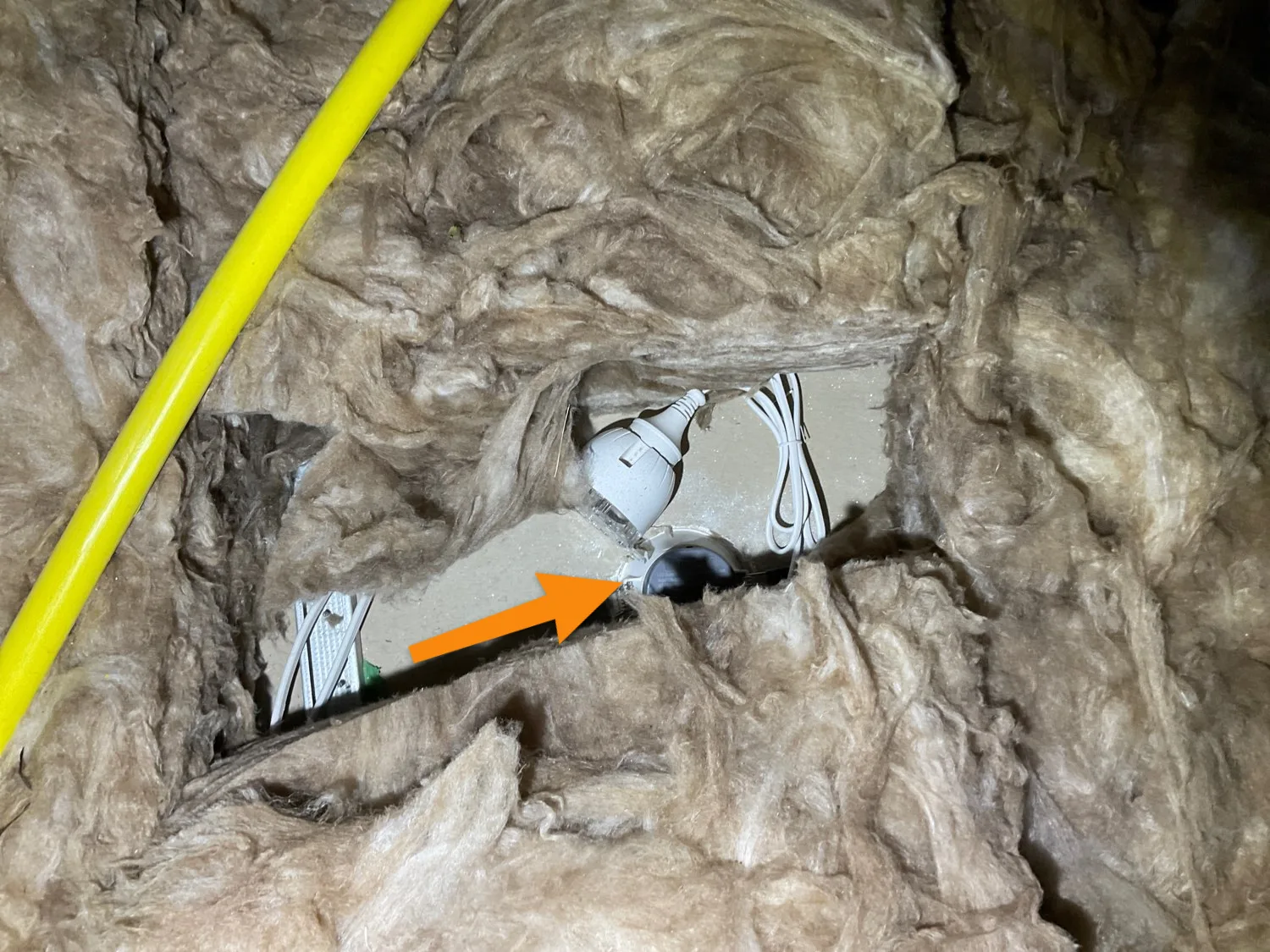
Other common issues include:
| Defect | Why it matters |
|---|---|
| Missing batts in the shared wall | Creates a weak point beside habitable rooms |
| Compressed insulation | Reduces insulation performance |
| Gaps around pipes and cables | Allows air leakage and heat transfer |
| Poor ceiling coverage | Affects rooms above or nearby roof spaces |
| Incorrect reflective foil installation | Reflective insulation needs the right air gap |
| No check before plasterboard | Defects become harder and more expensive to fix |
Common Compliance Issues We Find
The compliance issues we find most often in attached garages are batts that are missing or compressed, unsealed penetrations through the shared wall, wrap installed with gaps or the wrong orientation, and no insulation at the ceiling where garage and house share a roof space. Each is easy to fix before linings go on and costly after.
Missing or Compressed Batts
Insulation batts squashed into cavities lose part of their rated R-value, because compressing bulk insulation reduces its effectiveness. Each batt must be cut to size and fit snugly without compression or gaps.
Gaps at Penetrations
Electrical boxes, pipes, and ducts through the shared wall create thermal bridges. These require sealing and insulation packing around penetrations.
Incorrect Wrap Installation
External wrap installed with the reflective side facing the wrong direction, with unsealed joints, or damaged during construction. Reflective products only reach their R-value facing a still airspace; the Housing Provisions set at least 20mm for reflective insulation under roofs, and wall products specify their own airspace.
No Insulation to Ceiling Space
Where the garage shares ceiling space with the house, thermal separation at the ceiling level is often forgotten. This creates significant heat transfer and is hard to fix once the ceiling is lined.
Do You Need a Permit to Insulate a Garage?
Adding insulation to an existing garage without other work often does not need a permit, but rules vary by state and council. Converting the garage into a habitable room, changing a fire-rated wall, recladding or structural work usually does need approval. Ask your council or a private building surveyor or certifier before starting.
In Victoria, a building permit sets out whether an occupancy permit or certificate of final inspection is required when the work is complete.
In Queensland, building certifiers assess and approve plans for new, altered and existing building work, inspect mandatory stages and give final approval for occupation.
If the garage is being converted into a bedroom, study, rumpus room or other habitable space, treat it as an approval issue before work starts.
Pros and Cons of Proper Garage Insulation
Properly installed garage insulation keeps the rooms beside and above the garage more comfortable and lowers heating and cooling costs. The downsides are mostly cost and access: insulating an existing garage wall usually means opening up linings, which is why the best time to check it is during construction.
Pros
- Wall insulation typically saves around 15% on heating and cooling costs, and roof and ceiling insulation 45% or more (YourHome)
- Proper installation improves acoustic separation from garage noise
- Rooms beside and above the garage stay closer to the temperature of the rest of the house
- Correctly detailed insulation and membranes reduce condensation risk in wall cavities
Cons
- Retrofitting insulation costs more than installing it during construction
- Accessing existing wall cavities may require partial wall removal
- Defects are hard to see once plasterboard is on
NSW BASIX and Garage Insulation
In NSW, garage insulation for new homes is set through BASIX rather than the NCC's general energy provisions. BASIX applies to all new dwellings and to alterations and additions costing $50,000 or more, and since 1 October 2023 its thermal standards align with 7 stars. The BASIX certificate shows the insulation commitments the builder must deliver.
BASIX sets standards for water use, energy use and thermal performance in NSW residential development. BASIX also sets thermal performance requirements to help homes stay cool in summer and warm in winter without using a large amount of energy.
For NSW projects, check the BASIX certificate, NatHERS report and construction drawings before deciding whether the garage wall, ceiling or garage exterior is part of the required thermal boundary.
Getting the Most Value from Your Home and Building Investment
The way to get value from garage insulation is to have it checked before the linings go on. For attached garages, the wall and ceiling between garage and house affect the home's energy performance, its compliance with the approved plans, and how comfortable the rooms beside the garage are for years to come.
Before plasterboard goes on, check the wall between the garage and house, garage ceiling insulation, garage roof insulation, external wrap, service penetrations and the internal access door.
Owner Inspections can assess garage insulation, thermal boundary defects, construction stage issues and visible compliance risks before they become expensive rectification work.
Frequently Asked Questions
Do garages need insulation?
Does a garage need insulation if it shares a wall with the house?
Do you need to insulate garage walls?
What insulation is best for garage walls?
What R-value insulation for garage ceiling?
Does garage door insulation count towards NCC wall insulation requirements?
Do garage walls need to be fire rated?
Do I need a permit to insulate my garage?
Key Takeaways
- An attached Class 10a garage must not reduce the thermal performance of the Class 1 house (Housing Provisions 13.2.7)
- Either insulate the wall, ceiling and floor between garage and house, or insulate the garage's own external walls, roof and floor, to the house's standard
- R-values depend on climate zone and construction type; the ABCB examples used R2.0 walls in Adelaide and R2.5 in Melbourne
- Where a pliable membrane is used it must meet AS 4200.1 and AS 4200.2, with vapour permeance limits in zones 4 to 8
- A 60/60/60 wall is required against a garage belonging to another dwelling, not usually against your own
- NCC 2025 left the housing energy rules unchanged, so NCC 2022's 7 star standard still applies
- In NSW, BASIX sets the thermal commitments for new homes and larger alterations
- The best time to check garage insulation is a stage inspection before plasterboard goes on
Concerned About Garage Insulation Compliance?
Our building inspectors can check your garage insulation against the approved plans and current NCC requirements before plasterboard goes on, and identify any defects or compliance gaps.
Related Articles
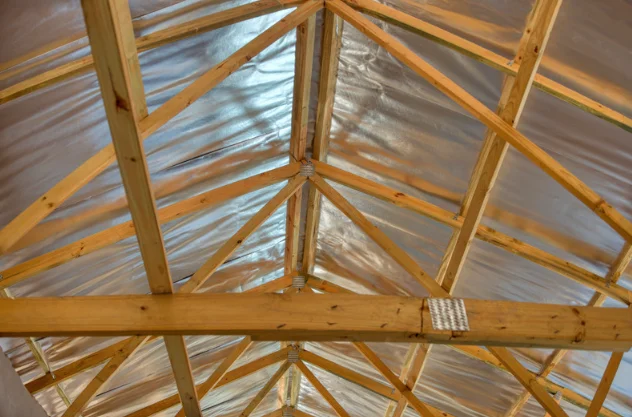
The Importance of Sarking in Building Construction
Why the pliable membrane under roof tiles or sheeting matters for water, dust, airflow and moisture.

How to Build a Resilient Home for Extreme Weather in Australia
Construction methods that help protect homes from bushfires, floods, storms and other climate-driven hazards.
Can a Builder Refuse Private Inspectors During Construction? Your Rights by State
Your rights to bring an independent inspector on site during construction stages, state by state.