
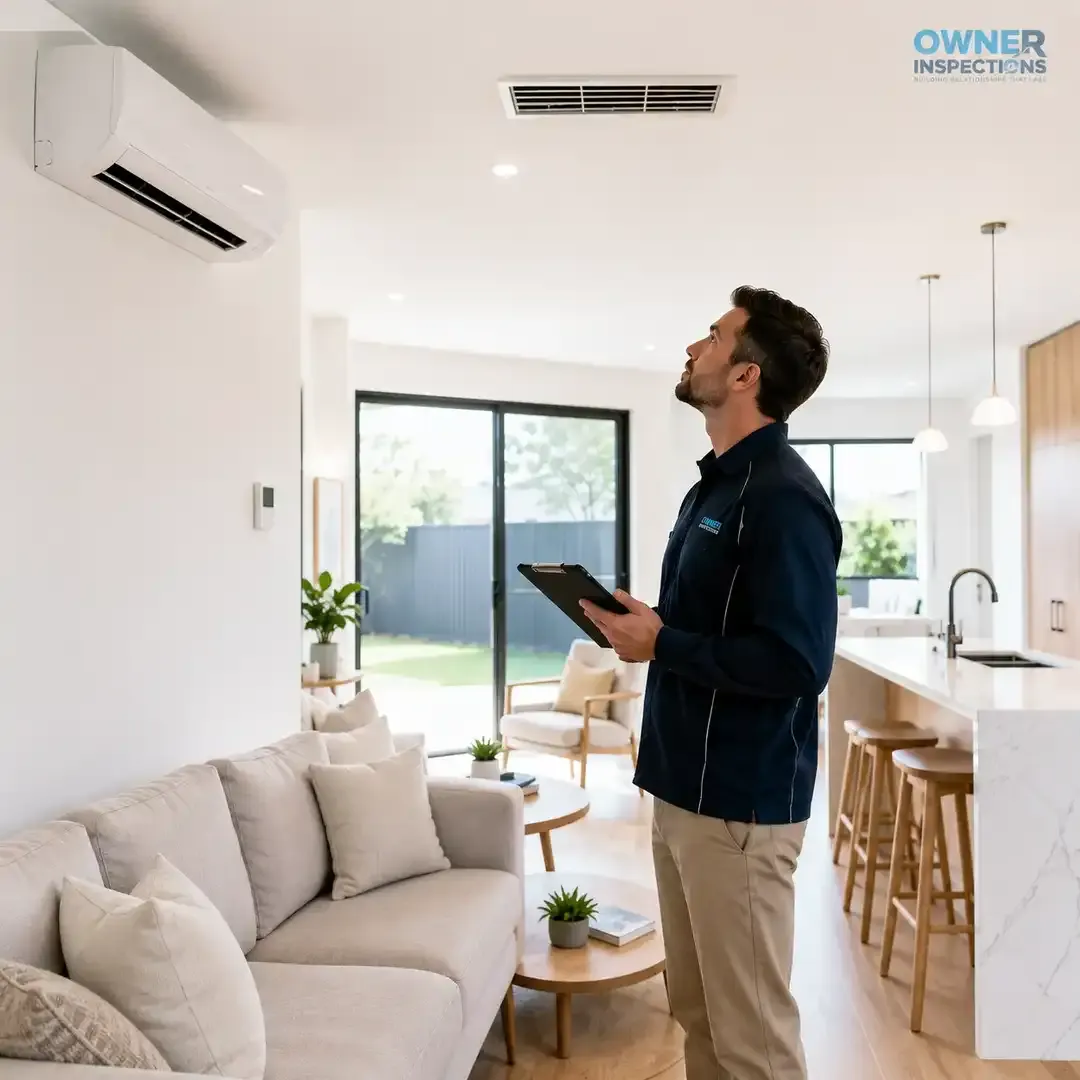
But before you accept practical completion, your air conditioning installation in new builds should do more than switch on. It should cool and heat properly, drain safely, operate across all zones, sit in a suitable location, and come with the right compliance paperwork.
40%
Household energy used for heating and cooling
5–10%
Extra energy use per degree of heating or cooling
Reference: YourHome: Heating and cooling
For new homeowners, property investors, and owner-build clients, handover is one of the best times to find air conditioning defects. Once the final payment clears and furniture moves in, roof spaces, ceiling cavities, ductwork, pipework, and drains become much harder to check.
Why Air Conditioning Gets Missed During New Home Handover
Most buyers check what they can see. Paintwork, benchtops, tiles, doors, windows, cabinetry, and flooring usually get the most attention.
Air conditioning is different. Many defects sit above ceilings, inside walls, behind bulkheads, in roof spaces, or around the outdoor condenser. A system may turn on during a quick walkthrough and still have poor airflow, noisy operation, incorrect zoning, drainage faults, or missing paperwork.
HVAC work also depends on several trades working in the right order. The builder, electrician, air conditioning installer, plasterers, roof space trades, insulation workers, and sometimes smart home contractors may all affect the finished result.
Common handover issues include:
- Poor rough-in coordination before plasterboard goes up
- Ductwork that is kinked, crushed, or poorly sealed
- Outdoor condenser units placed in tight or noisy areas
- Condensate drains with poor fall or unclear discharge points
- Weak airflow in bedrooms or living areas
- Missing commissioning records, warranty documents, or licence details
That is why a new home handover checklist should include air conditioning, not just visible finishes.
Book a Pre-Handover Inspection Before You Sign Off
Before practical completion, get your air conditioning installation, drainage, zoning, airflow, and other new build defects checked by an independent inspector.
Inspection
What a Quality Air Conditioning Installation Should Look Like
Start with a visual check. You are not servicing the system or opening sealed components. You are looking for signs that the installation is neat, stable, complete, and ready for normal use.
The outdoor condenser should sit level and stable. It should have enough clearance for airflow and service access. A unit squeezed into a tight corner, boxed against fencing, or placed too close to bedroom windows can cause comfort, noise, and maintenance problems.
Wall penetrations should be sealed and weatherproof. Pipework insulation should be neat and continuous, with no exposed copper between insulation sections. Indoor grilles should sit flush with the wall or ceiling, without gaps, loose fixings, or damaged plaster around the edges.
Condensate drains need attention too. Air conditioners remove moisture from the air. That water needs to drain safely to an approved point. A poor drain fall or hidden discharge can lead to ceiling stains, plasterboard damage, or moisture issues that only become clear months later.
| Item | Good Sign | Possible Defect |
|---|---|---|
| Outdoor unit | Level, stable, ventilated, serviceable | Cramped, vibrating, poor clearance |
| Pipework | Fully insulated and neatly clipped | Exposed copper, torn lagging, loose runs |
| Drainage | Visible fall or clear discharge route | Pooling, leaks, unclear outlet |
| Grilles | Flush, secure, balanced airflow | Gaps, weak airflow, noisy outlet |
| Wall penetrations | Sealed and weatherproof | Cracked sealant, gaps, water entry risk |
Functional Air Conditioning Testing Checklist Before Handover
Visual checks only catch part of the problem. Functional testing helps you find faults that only appear when the system runs.
You are not trying to repair, service, or adjust refrigerant, wiring, or sealed components. You are checking whether the installed system performs as promised and whether any issue needs to be listed for builder rectification.
Cooling mode
Turn on each indoor unit or the ducted system. Set the system to cooling mode and allow it to run long enough for cool air to be felt at the outlets.
Walk through each room. Check that supply air reaches every area that should be serviced. If one room feels much weaker than the others, write it down.
Heating mode
Reverse cycle systems should also be tested in heating mode. Warm air should come through clearly after the system has had time to change mode.
A system that cools but does not heat, or that gives weak heating in certain zones, should be raised before sign-off.
Ducted zones
For ducted air conditioning, test each zone by itself. Do not rely on a single whole-house test.
Check bedrooms, living areas, studies, media rooms, and any upstairs or downstairs zones separately. Poor zone balancing is common in new homes, especially where duct runs are long or squeezed through tight ceiling areas.
Airflow and return air
Stand near each supply outlet. Feel whether air is moving evenly.
Then check the return air grille. It should pull air back to the system without obvious blockage or rattling. YourHome notes that ducted systems need suitable duct sizing and return air paths to work well.
Noise and vibration
Listen near the outdoor unit, indoor units, grilles, and return air. Watch for rattling, knocking, buzzing, grinding, or vibration through the wall or frame.
Noise near bedrooms matters. A condenser placed beside a bedroom wall may be tolerable for five minutes during a walkthrough but frustrating at night.
Controllers and smart features
Test every controller, remote, wall panel, Wi-Fi setting, app connection, timer, and schedule function included in your contract.
Make sure the zone names make sense. A controller that labels the bedroom as the living room may sound minor, but it can point to wiring or commissioning issues.
Air Conditioning Handover Checklist
| Check Area | What to Look For | Why It Matters |
|---|---|---|
| Cooling | Cool air from each indoor unit or supply outlet | Confirms basic cooling performance |
| Heating | Warm air in reverse cycle mode | Confirms seasonal operation |
| Zoning | Each zone opens, closes, and responds correctly | Helps find duct or controller faults |
| Airflow | Even air movement across rooms | Weak airflow may indicate poor ducting |
| Return air | Strong pull at return air grille | Poor return air can reduce performance |
| Outdoor unit | Level, stable, clear, accessible | Helps airflow, noise control, and service access |
| Pipework | Insulated, clipped, protected | Exposed or damaged insulation can affect efficiency |
| Drainage | Clear fall and approved discharge route | Poor drainage can cause hidden water damage |
| Noise | No rattling, grinding, buzzing, or frame vibration | Noise can point to poor mounting or faulty parts |
| Controls | Remotes, wall panels, apps, timers, and schedules work | Confirms handover readiness |
| Paperwork | Manuals, warranties, licences, and commissioning records | Supports warranty and future maintenance |
Documents and Warranty Paperwork to Request Before Final Sign-Off
Good installation should come with good records. Missing paperwork can make warranty claims, maintenance, and future troubleshooting harder.
Ask the builder or installer for:
- Manufacturer warranty documents or registration details
- Operating manuals for indoor and outdoor units
- Controller and remote-control guides
- Installer business details
- ARC licence details where refrigerant handling occurred
- Electrical compliance certificate where required
- Commissioning record
- Model and serial numbers
- As-built layout or zone diagram for ducted systems
- Maintenance requirements
Important
Refrigerant handling is regulated in Australia. The Department of Climate Change, Energy, the Environment and Water says a Refrigerant Handling Licence is needed for work with regulated refrigerant that could cause leakage, including installing, commissioning, servicing, maintaining, or decommissioning RAC equipment.
NSW also has specific licensing rules. NSW Government says a licence or certificate is required before carrying out air conditioning and refrigeration work in NSW, including associated electrical wiring that would otherwise be done by an electrician. It also says unlicensed air conditioning and refrigeration work breaches the Home Building Act 1989.
| Document | Why You Need It | Who Provides It |
|---|---|---|
| Manufacturer warranty | Supports future warranty claims | Builder, installer, or supplier |
| Operating manuals | Helps the owner use and maintain the system | Builder or installer |
| Controller guide | Explains zones, timers, and modes | Builder or installer |
| ARC licence details | Confirms licensed refrigerant handling | Installer |
| Electrical compliance certificate | Supports electrical compliance records | Licensed electrician or builder |
| Commissioning record | Shows testing and setup were completed | Installer |
| Model and serial numbers | Needed for warranty and servicing | Installer or supplier |
| Zone diagram | Helps owners understand ducted layouts | Builder or installer |
| Maintenance requirements | Helps protect system performance | Installer or manufacturer |
Catch Build Issues Before They’re Covered Up
New construction stage inspections help check key stages of your build, including frame, lock-up, fixing, waterproofing, and pre-handover, so defects can be raised before the next stage begins.
Stage Inspection
Common Air Conditioning Defects Found in Brand-New Homes
Brand-new does not always mean defect-free. Air conditioning problems can come from design, product selection, installation, builder coordination, or poor commissioning.
The most common defects include wrong-sized equipment, weak airflow, ducting faults, poor zoning, condensate leaks, noise issues, inadequate service clearance, exposed pipe insulation, missing paperwork, and smart controller faults.
Air conditioners must meet Minimum Energy Performance Standards, and non-ducted household air conditioners must carry a Zoned Energy Rating Label. The label helps compare performance across hot, average, and cold climate zones.
| Defect | Warning Sign | Possible Consequence | Who to Raise It With |
|---|---|---|---|
| Wrong-sized system | Rooms do not cool or heat properly | Higher running costs, poor comfort | Builder and installer |
| Poor airflow | One room feels weak or stagnant | Duct kink, collapse, poor balance | Builder and installer |
| Ducting fault | Airflow drops in one zone | Comfort issues and energy waste | Builder and installer |
| Poor zone balancing | One zone works better than another | Uneven comfort | Builder and installer |
| Condensate leak | Staining, dripping, damp smell | Plasterboard or insulation damage | Builder |
| Outdoor unit noise | Compressor heard inside bedrooms | Ongoing sleep and noise complaints | Builder and installer |
| Missing acoustic mounts | Vibration through frame or wall | Rattling and structural noise transfer | Builder and installer |
| Poor clearance | Unit boxed into a tight area | Overheating, poor service access | Builder and installer |
| Exposed pipe insulation | Copper visible or insulation split | Efficiency loss and pipe wear | Installer |
| Missing commissioning record | No proof of final setup | Warranty and maintenance problems | Builder and installer |
| Smart controller fault | App, Wi-Fi, or zones not responding | Poor usability and possible wiring fault | Builder and installer |
When Should You Bring in an Independent Inspector?
A builder’s walkthrough is not the same as an independent pre-handover inspection. The builder is checking their project. An independent inspector is checking the home for you.
Owner Inspections can help identify visible defects, record them with photos, and present findings in clear language that can be given to the builder. This is useful when defects involve systems that most buyers do not feel confident assessing, such as ducted air conditioning, condensate drainage, roof space installation, or outdoor condenser placement.
An independent pre-handover inspection can provide:
- Photographic evidence
- A written defect list
- Plain explanations for the builder
- Wider checks across the home, not only air conditioning
- Reinspection support after rectification
- More confidence before final sign-off
A construction stage inspection can also help earlier in the build. Refrigerant pipework, duct routes, penetrations, and drainage paths are easier to correct before plasterboard and finishes cover them.
Sydney homeowners who reject a builder's substandard install, or who want to replace base-spec equipment after moving in, often bring in dedicated HVAC specialists for the rectification work.
Choosing a licensed Sydney installer such as Alliance Climate Control means your replacement install comes with ARC-licensed refrigerant handling, full compliance paperwork, and a lifetime workmanship warranty backing every joint, mount, and termination.
What to Do If You Find Air Conditioning Defects at Handover
Finding defects does not mean the whole build has failed. It means issues need to be documented and rectified before you accept everything as complete.
Use this process:
- Photograph each issue clearly.
- Record short videos for noise, vibration, weak airflow, leaks, or controller faults.
- Note the room name, zone name, and controller setting.
- Ask for installer details, warranty records, ARC licence details, and commissioning documents.
- Submit the defect list to the builder in writing.
- Ask for rectification before final payment where your contract allows.
- Arrange a reinspection once the builder says the issues are fixed.
This is general information, not legal advice. Always check your building contract and seek legal advice for payment disputes or formal claims.
State warranty timeframes differ
In NSW, Building Commission NSW says homeowners have statutory warranties of 6 years for major defects and 2 years for minor defects.
In Victoria, Consumer Affairs Victoria says statutory building warranties apply for up to 10 years after the occupancy permit or certificate of final inspection was issued.
In Queensland, QBCC says structural defect cover applies where the owner first becomes aware of the defect within 6 years and 6 months after the cover commencement day, while non-structural defects must be noticed within 6 months after substantial completion and claimed within 7 months.
How Owner Inspections Checks Air Conditioning at Handover
Owner Inspections looks at air conditioning as part of the wider property condition. The aim is not to service the system or replace the role of a licensed HVAC technician. The aim is to identify visible and functional defects that should be raised before handover.
A pre-handover inspection may include:
- Checking visible indoor and outdoor components
- Testing cooling and heating operation where safe and accessible
- Checking zone operation and airflow concerns
- Looking for poor clearances, loose grilles, gaps, and rough workmanship
- Checking visible condensate drainage concerns
- Listing missing documents that should be requested
- Recommending specialist HVAC review where needed
This gives the homeowner a clear defect report before practical completion sign-off.
Air Conditioning Handover Checklist
Visual checks
- Outdoor unit is level, stable, and clear of obstructions
- Unit has service access and is not boxed into a tight corner
- Pipework is neat, clipped, and insulated
- No exposed copper is visible
- Wall penetrations are sealed
- Indoor grilles sit flush with walls or ceilings
- No cracked plaster, loose vents, or gaps around outlets
- Condensate drainage route is visible or explained
- No signs of water staining or dampness
Performance checks
- Cooling mode works
- Heating mode works
- Each ducted zone works
- Each indoor unit works
- Airflow feels even across rooms
- Return air grille has clear pull
- No unusual rattling, buzzing, grinding, or vibration
- Outdoor unit noise is reasonable for its location
- Timer and schedule settings work
- Smart home or app controls work where included
Paperwork checks
- Manufacturer warranty documents
- Manuals and controller guides
- ARC licence details
- Electrical certificate where required
- Commissioning record
- Installer contact details
- Model and serial numbers
- Ducted zone diagram or as-built layout
- Maintenance instructions
Found Air Conditioning Defects at Handover?
Owner Inspections can document defects with photos and clear reporting, giving you a practical defect list to raise with your builder before final sign-off.
Defect Report
Frequently Asked Questions
What should I check on air conditioning before new home handover?
Check cooling, heating, airflow, zoning, drainage, outdoor unit placement, noise, controls, manuals, warranties, and compliance paperwork. Handover testing should include visual checks, functional checks, and paperwork checks because many defects stay hidden until the system runs under load.
Should air conditioning be tested before practical completion?
Yes. Air conditioning should be tested before practical completion so defects can be listed before final sign-off. This is often the best time for owners to raise issues with the builder before the final stages of payment and move-in.
What paperwork should I receive for a new air conditioning system?
Ask for warranty documents, operating manuals, commissioning records, installer details, ARC licence details, and electrical compliance certificates where required. Missing documentation can make future warranty claims and servicing harder.
Does an air conditioning installer need an ARC licence in Australia?
Anyone handling regulated refrigerant must hold the correct licence. The Australian Government says a Refrigerant Handling Licence is needed for work with regulated refrigerant that could cause leakage, including installation and commissioning.
How do I know if ducted air conditioning has poor airflow?
Compare airflow room by room, test each zone separately, and check whether some rooms stay warmer or cooler than others. Possible causes include kinked ducts, collapsed ducting, poor balancing, poor return air design, or undersized equipment.
What are common air conditioning defects in new builds?
Common defects include weak airflow, poor zone balancing, condensate leaks, noisy outdoor units, missing acoustic mounts, exposed pipework, and missing commissioning paperwork. These issues can affect comfort, running costs, warranty claims, and future repair costs.
Why is condensate drainage important?
Poor condensate drainage can cause leaks, ceiling damage, mould risk, and plasterboard staining. Air conditioners remove moisture from indoor air, so that water needs to drain safely to an approved discharge point.
Can I hold final payment for air conditioning defects?
It depends on your contract and state rules, but defects should be documented in writing before sign-off. Check your building contract and get legal advice for payment disputes. Keep photos, videos, emails, and inspection reports.
How long are new home defects covered in NSW?
NSW statutory warranties are generally 6 years for major defects and 2 years for minor defects. Building Commission NSW recommends trying to resolve the matter with the contractor or builder before making a complaint.
How long are building defects covered in Victoria?
In Victoria, statutory building warranties can apply for up to 10 years after the occupancy permit or certificate of final inspection was issued. Consumer Affairs Victoria says the warranties apply even if the property sells several times.
Related Articles
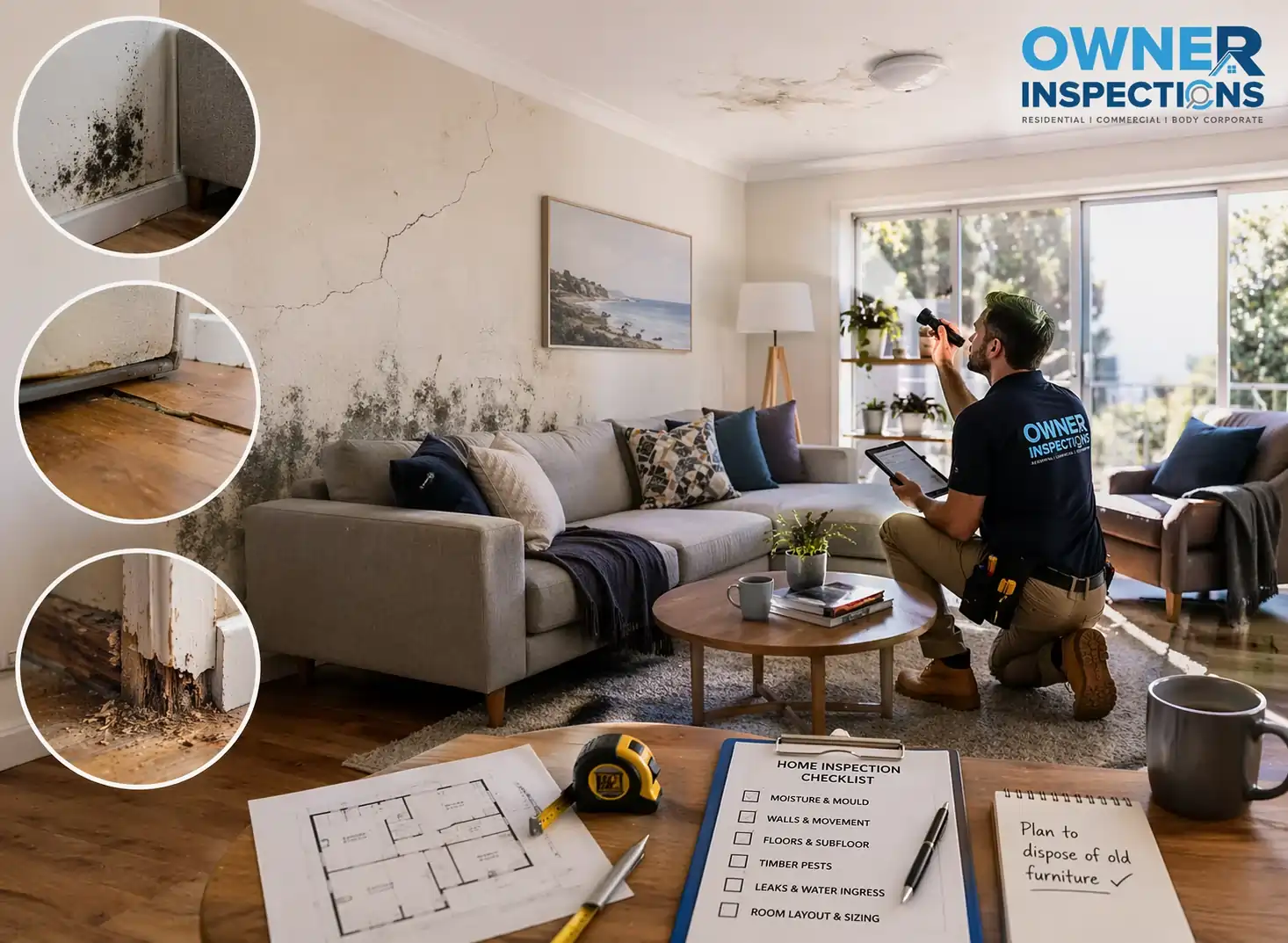
6 Hidden Home Issues to Check Before Replacing Your Living Room Furniture
Before replacing your living room furniture, check whether the real problem is hidden in the room itself. This guide explains how to spot damp, mould, cracks, uneven floors, leaks and termite damage, then decide whether you need an inspection, a repair, or simply a better furniture plan.
Building Defect Identification to Prevent Costly Repairs
Building defect identification helps property owners, buyers, and developers detect structural, plumbing, electrical, and waterproofing issues before they become expensive problems. This guide covers the most common defects found in Australian properties and how to address them.

Maintaining Indoor Air Quality: Tips for a Healthier Home
Australians spend up to 90% of their time indoors, making indoor air quality a significant health concern. This guide covers common indoor pollutants, practical ventilation strategies, cleaning techniques, air purifier recommendations, and when to schedule a professional mould inspection.