
33–50%
Australian homes affected by indoor mould
50%
Australians reporting mould or dampness at home in the last 12 months
2.8M
Australians with asthma in 2022
Source: WA Health, Asthma Australia Housing Survey Report, and Australian Bureau of Statistics
Why Poor Ventilation Becomes a Building Problem
Poor ventilation becomes a building problem when moisture-laden air cannot escape. Repeated dampness settles on colder surfaces such as windows, external walls, ceiling linings and poorly insulated corners. Over time, that moisture can move beyond what you can see and affect insulation, timber, plasterboard and floor areas. Condensation is the mechanism, mould is the visible symptom, and concealed deterioration is the bigger risk.
Australian guidance treats condensation as more than a comfort issue because it can lead to damp, mould, rot and loss of amenity, which is why the NCC includes condensation management provisions aimed at removing internal moisture from buildings.
Why Ventilation Matters in Australian Homes
Homes create moisture every day. Showering, cooking, drying clothes indoors and even breathing all add water vapour to the air. That is normal. The problem starts when the home does not get enough air exchange to move that moisture out before it settles on cooler surfaces.
This matters even more in newer or upgraded homes. Better insulation, draught sealing and tighter construction can improve comfort and energy performance, but they can also reduce unintended air leakage. If that tighter envelope is not balanced with proper ventilation, indoor humidity can rise and stale air can build up. A home can feel warm and dry in winter while condensation is still forming behind a wardrobe, inside a window reveal, or in a roof void.
Australian rules reflect that balance. The NCC requires ventilation to habitable rooms, bathrooms, laundries and other occupied rooms, and its condensation provisions are intended to reduce illness or loss of amenity caused by excessive internal moisture.
Seeing mould, window condensation or a musty smell?
Get an independent inspection to find out whether the cause is poor ventilation, hidden damp or a building defect before repair costs grow.
Inspection
How Poor Ventilation Turns Into Condensation and Mould
Warm air, cold surfaces and the dew point
The chain is simple. Warm indoor air holds moisture. When that moist air meets a colder surface, the air can no longer hold the same amount of water vapour, so liquid water forms. That temperature threshold is the dew point. You do not need a roof leak for this to happen. It can happen from normal household moisture if the home has high indoor humidity, cold internal surfaces, thermal bridging, or weak airflow.
Why condensation is often the first visible sign
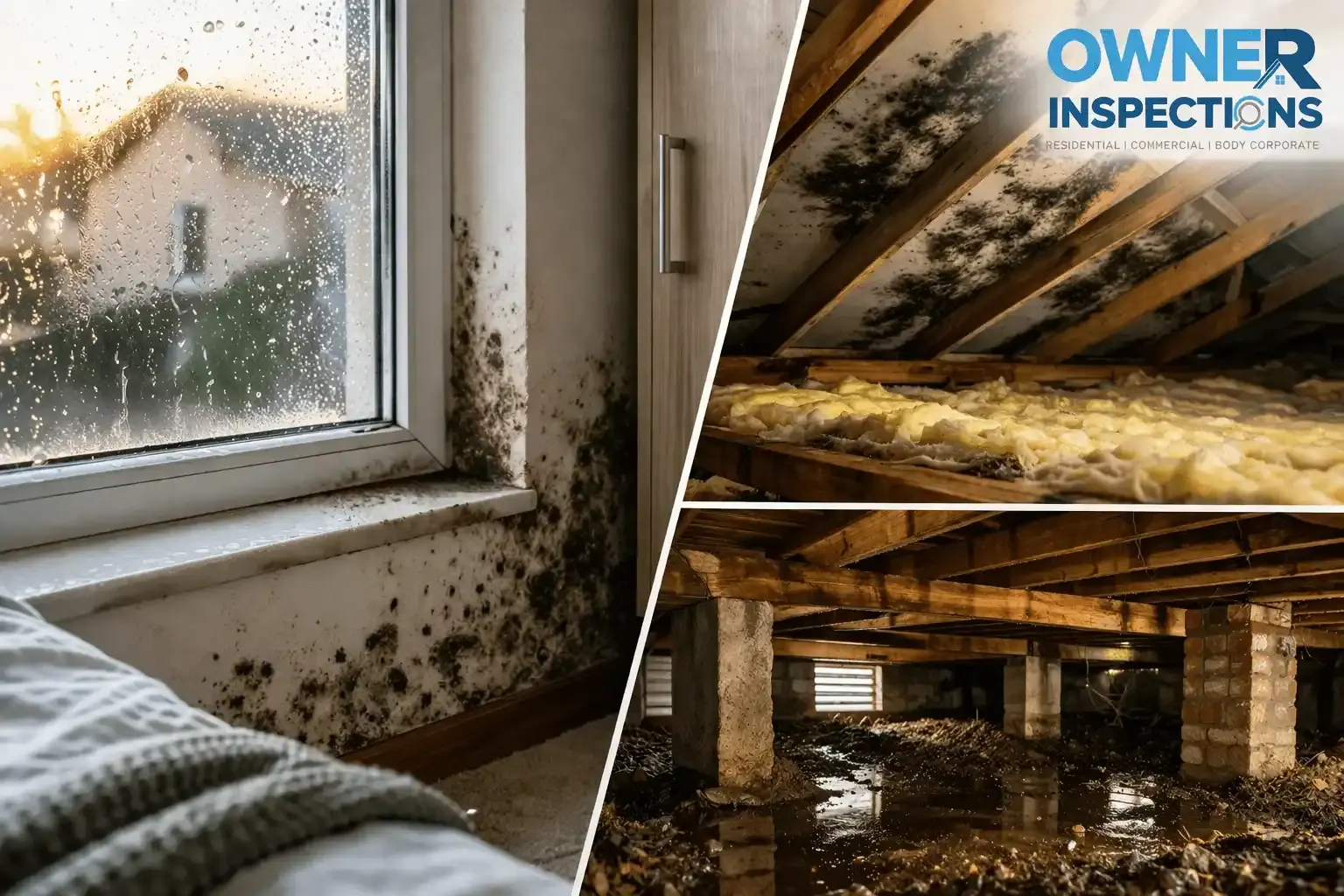
Condensation on windows in winter is often the first clue. It may also show up as damp wardrobe walls, black spotting in room corners, water beads on aluminium window frames, or mould on the wall behind furniture pushed against an external wall. These are usually the coldest and least ventilated parts of the room. Because the moisture event happens over and over, the same areas keep showing the same symptoms.
Why mould is often not the first problem, but the second
Mould usually follows moisture. It is rarely the starting point. NSW Health notes that mould needs moisture to grow, and Better Health Victoria lists condensation from cooking, showering, indoor clothes drying and poor air circulation among common indoor causes.
Where Hidden Defects Usually Form
Roof spaces
Roof spaces often hide ventilation-related moisture problems because they are out of sight and rarely checked by owners. Warm moist air can move upward from bathrooms, laundries and living areas, then condense on colder framing, sarking, metal roof sheets or insulation. Damp insulation loses performance, timber can stay wet for too long, and mould can establish before there is any obvious stain on the ceiling below. NCC water and moisture rules exist because both external water entry and internal moisture build-up can damage building elements.
Subfloors
Subfloors are another common trouble spot. Ground moisture, blocked vents, poor clearance, plumbing leaks and stale air can all keep the area damp. YourHome notes that underfloor and wall cavity moisture may be caused by poor subfloor ventilation, excess moisture, leaking plumbing or condensation build-up, while NSW Health says poor sub-floor ventilation can worsen damp problems. That means a musty smell indoors may be coming from below the floor, not from the room where you notice it.
Wall cavities and window reveals
Wall cavities and window reveals are where moisture becomes expensive because the damage is easy to miss. YourHome warns that condensation can occur inside walls, ceilings and floors as interstitial condensation. WA Health also notes that mould can be present behind walls or under carpets even if nothing obvious is visible. In practice, that is why bubbling paint, recurring mould near skirtings, or a damp smell from a built-in robe should not be brushed off as surface grime. Those clues may be pointing to hidden damp inside the wall system or around the window opening.
Warning Signs Homeowners and Buyers Should Not Ignore
If you are seeing one of these signs once, monitor it. If you are seeing several of them together, or the same sign keeps returning, it is time to treat it as a moisture problem instead of a cleaning problem. NSW Health, ACT guidance and WA guidance all focus on reducing moisture, improving ventilation and fixing building faults, not just wiping mould away.
Watch for:
- recurring mould in the same spot
- condensation on windows most mornings in cooler weather
- a musty smell in closed rooms or wardrobes
- bubbling paint or peeling plaster
- damp wardrobe walls or mould behind furniture
- mould near skirting boards, ceiling edges or window reveals
- stale air that lingers after showering or cooking
- staining around vents, air returns or ceiling penetrations
When several of these signs appear together, there is a fair chance the home has an underlying moisture source, inadequate roof space ventilation, poor subfloor ventilation, water ingress, or a mix of those issues.
Need to know if moisture is hiding behind walls or ceilings?
Moisture testing and thermal imaging can help identify hidden damp, roof space moisture and other concealed issues that a surface clean will not solve.
Testing Services
Symptom, Likely Cause and What to Do Next
| Symptom | Likely cause | What to do next |
|---|---|---|
| Condensation on windows | High indoor humidity, cold glazing, weak airflow | Check daily moisture sources, use exhaust fans, inspect ventilation and insulation |
| Musty smell in a bedroom or robe | Hidden damp, poor air circulation, wall cavity moisture | Move furniture, inspect external walls, test for hidden moisture |
| Bubbling paint or peeling finish | Repeated condensation, water ingress, trapped moisture | Check for leaks and moisture behind the surface |
| Recurring ceiling mould | Bathroom steam, roof space moisture, poor exhaust or roof ventilation | Check whether exhaust fans vent outside and inspect the roof void |
| Damp smell from floors | Subfloor moisture, blocked vents, plumbing leak | Inspect subfloor ventilation and moisture sources |
This table reflects the way Australian guidance approaches mould: look for moisture, airflow and building faults together, not as separate issues.
How Heating, Cooling and Ventilation Systems Can Worsen the Issue
Heating and cooling systems can help or hurt, depending on the type of system, how the home is built, and how well everything is maintained. YourHome notes that ducted air systems may recirculate indoor air without introducing fresh outdoor air or removing pollutants. It also says evaporative cooling systems can increase indoor humidity and may increase mould or dust mite levels.
Maintenance matters too. Better Health Victoria says mould linked with damp buildings can worsen asthma and allergic conditions, while YourHome recommends regular cleaning of ducts and filters in ducted systems and reverse-cycle air conditioners. That does not mean servicing alone solves the problem. A cleaned system cannot fix hidden damp in a wall cavity or a wet subfloor.
Annual professional maintenance including checking ventilation pathways, cleaning filters, and inspecting ductwork is essential. For Canberra homes with Bonaire ducted systems, Bonaire servicing in Canberra by licensed technicians covers exactly these checks: gas pressure testing, carbon monoxide assessment, duct inspection, and airflow performance.
All of these components directly affect how well the system manages moisture and ventilation throughout the home.
Area of Home, Common Ventilation Issue and Hidden Defect Risk
| Area of home | Common ventilation issue | Hidden defect risk |
|---|---|---|
| Bathroom | Weak or absent exhaust, steam not vented outside | Ceiling mould, damp insulation, wet framing |
| Roof void | Limited roof space ventilation, warm moist air entering void | Condensation on framing, mould, reduced insulation performance |
| Subfloor | Blocked vents, trapped ground moisture, stale air | Timber decay, odours, damp flooring |
| Wardrobes and cupboards | Low airflow against external walls | Hidden damp, mould behind stored items |
| Bedrooms | Condensation on windows, furniture against cold walls | Mould in corners, window reveal damp, plaster damage |
These are the places inspectors pay attention to because they are common moisture traps and often show the first signs of concealed building defects.
Why This Matters Before You Buy a Property
A property can present well at an open home and still have a moisture problem. Fresh paint, open windows, good weather, or temporary cleaning can hide the pattern. Interstitial condensation inside walls, damp insulation in the roof void, or mould beneath carpets will not always show up in a quick walk-through. That is not guesswork. Australian guidance recognises that condensation can occur inside construction systems and that mould may be hidden behind walls or under carpets.
For buyers, the big risk is misreading the clue. A small patch of mould in a corner may be minor, but it can also be the visible edge of a broader problem involving indoor humidity, blocked subfloor vents, water ingress or poor exhaust. Repeated condensation on windows can point to a building-performance issue rather than a housekeeping issue, especially in a tightly sealed or poorly balanced home. That is an inspection question because repair costs rise fast once framing, plasterboard, insulation or floor materials stay wet for too long.
A good pre-purchase inspection does more than note “mould present”. It helps separate cosmetic staining from signs that deserve closer moisture testing before exchange or settlement. That gives buyers clearer risk, better questions for the agent or seller, and a stronger basis for deciding whether to proceed, negotiate, or investigate further. This is an inference from how concealed moisture behaves in buildings and why the NCC and health guidance focus on moisture control rather than surface cleaning alone.
How a Professional Inspection Finds What You Can’t See
A professional inspection starts with the visible pattern. That includes staining, window condensation, mould location, odours, cracked or bubbling finishes, and clues around bathrooms, laundries, subfloors and roof spaces. The goal is not only to see mould. It is to work out why that mould or dampness is there.
From there, an inspector may use moisture meter readings to compare suspect areas with drier parts of the home and look for hidden damp behind walls, near skirtings, around window reveals, or below wet areas. Thermal imaging can also help identify temperature anomalies linked to water leaks, shifted insulation and other issues, which makes it useful for spotting areas that need closer checking. A thermal image does not diagnose the cause on its own, but it can show where moisture or missing insulation may be affecting the building fabric.
Buyer vs Homeowner, Best Next Step
| Situation | Best next step |
|---|---|
| Homebuyer seeing mould or condensation before purchase | Pre-purchase building inspection with moisture testing and thermal imaging where needed |
| Homeowner with recurring mould in the same room | Maintenance inspection focused on moisture source and ventilation |
| Homeowner with musty odour but no visible mould | Hidden moisture investigation of roof void, subfloor, wall cavities and wet areas |
| Buyer seeing bubbling paint or damp wardrobe walls | Inspect for concealed damp, water ingress and ventilation issues before committing |
| Occupant with one-off small mould spot after a known spill | Dry and clean the area, then monitor for recurrence |
The dividing line is recurrence, hidden symptoms, or purchase risk. Once those are present, inspection is usually a better next step than cosmetic cleaning alone.
Fix the Cause First, Then the Mould
The order matters. Cleaning visible mould before you deal with the moisture source often leads to the same patch returning. NSW Health says mould is likely to come back unless the cause is treated, and ACT guidance says reducing mould growth means improving ventilation, fixing leaks and cleaning condensation as well as cleaning mould itself.
A sensible sequence looks like this:
- Identify the moisture source
- Improve ventilation, or fix leaks, drainage, exhaust or system issues
- Dry affected areas properly
- Assess concealed damage in roof spaces, subfloors, wall cavities and around openings
- Remediate mould and replace materials that cannot be dried or cleaned properly
That sequence fits Australian health and building guidance. Moisture control comes first. NSW Health, ACT Government and WA Health all focus on preventing and controlling moisture, maintaining the building envelope and dealing with water damage quickly. When water ingress is involved, NCC provisions are aimed at preventing outside water and internal moisture accumulation from damaging building elements and creating musty, damp and unhealthy conditions.
Buying a home with recurring mould or damp signs?
A pre-purchase inspection can help you spot ventilation problems, condensation risks and hidden defects before you commit to the property.
Inspection
Frequently Asked Questions
How does poor ventilation cause mould?
How does poor ventilation cause mould?
Poor ventilation traps moist air indoors, which raises humidity and allows water to settle on colder surfaces. If those surfaces stay damp, mould can grow. That is why mould is often a moisture and airflow problem rather than a simple dirt problem. Daily activities like showering, cooking and drying clothes all add water vapour, and Australian guidance points to ventilation and moisture control as the main prevention steps.
Is window condensation a sign of a bigger problem?
Is window condensation a sign of a bigger problem?
Sometimes yes. Regular condensation on windows can be an early sign that indoor humidity is too high or that ventilation is not keeping up. A one-off fogged window on a cold morning is not always serious, but repeated condensation, especially with mould, odours or damp finishes, can point to hidden moisture elsewhere in the home.
Can mould grow without a roof leak?
Can mould grow without a roof leak?
Yes. Mould can grow from condensation and trapped indoor moisture even when there is no roof leak. Poor airflow, high indoor humidity, cold surfaces and weak exhaust can all create the damp conditions mould needs. Water ingress is one cause, but it is not the only one.
Where does hidden moisture usually build up in a house?
Where does hidden moisture usually build up in a house?
Hidden moisture often builds up in roof voids, subfloors, wall cavities, window reveals, wardrobes and under carpets. These are the parts of a home where airflow is weaker and dampness can sit unnoticed. Australian guidance also notes that mould may be hidden behind walls or under carpets even when there is little to see on the surface.
Can poor subfloor ventilation damage timber?
Can poor subfloor ventilation damage timber?
Yes. Poor subfloor ventilation can keep the area damp and increase the risk of timber deterioration over time. NSW Health notes that poor sub-floor ventilation can worsen damp problems, and YourHome links underfloor moisture to poor subfloor ventilation, excess moisture and leaks. Persistent dampness below the floor can also create odours that drift into living spaces.
Does ducted heating or cooling make mould worse?
Does ducted heating or cooling make mould worse?
It can, depending on the system and the moisture conditions in the home. YourHome says ducted systems may recirculate indoor air without removing pollutants, and evaporative cooling can increase indoor humidity. Poorly maintained systems can also spread dust and keep stale air moving without fixing the real moisture source.
Can mould be hidden behind walls or under carpets?
Can mould be hidden behind walls or under carpets?
Yes. Mould can be present behind walls, wallpaper, panelling and on the underside of carpets. That is one reason musty odours, repeated staining or damp finishes matter even when you cannot see heavy mould growth. Hidden mould is often a clue that moisture has been present for some time.
What is the difference between condensation and water ingress?
What is the difference between condensation and water ingress?
Condensation is moisture that forms when humid indoor air meets a colder surface. Water ingress is water entering from outside or through a building fault. Both can cause damp, mould and damage, but they have different sources. Condensation is driven by temperature, humidity and airflow. Water ingress is driven by leaks, failed waterproofing, defective cladding, drainage issues or other openings in the building envelope.
Should I get a mould inspection before buying a house?
Should I get a mould inspection before buying a house?
Yes, if mould is recurring, widespread, paired with damp smells or condensation, or appears in suspicious areas such as wardrobes, skirtings, ceilings or subfloors. The point is not just to confirm mould. It is to find out whether the cause is poor ventilation, water ingress or a concealed defect before you take on the repair risk. That is especially useful when open-home conditions may hide the full pattern.
What tools are used to find hidden moisture?
What tools are used to find hidden moisture?
Inspectors commonly use visual checks, moisture meter readings and thermal imaging. YourHome says a thermal imaging camera can help detect water leaks, shifted insulation and other issues, while WA guidance points to investigating hidden mould where moisture persists or odours exist without obvious signs. The tool matters, but the method matters more: the findings still need to be interpreted in context.
Will cleaning mould fix the problem permanently?
Will cleaning mould fix the problem permanently?
Not if the moisture source is still there. Cleaning removes the visible growth, but it does not fix the reason the area stayed damp. NSW Health says mould is likely to return unless you also treat the cause. That is why the right order is source first, drying second, mould removal after that.
When should I call a building inspector instead of a cleaner or handyman?
When should I call a building inspector instead of a cleaner or handyman?
Call a building inspector when mould keeps returning, when you smell damp but cannot see the source, when paint bubbles or plaster softens, or when you are assessing a property before purchase. At that point, the job is no longer just surface cleaning. It is about finding whether the cause is condensation, water ingress, poor ventilation, subfloor moisture or another hidden defect in the building fabric.