
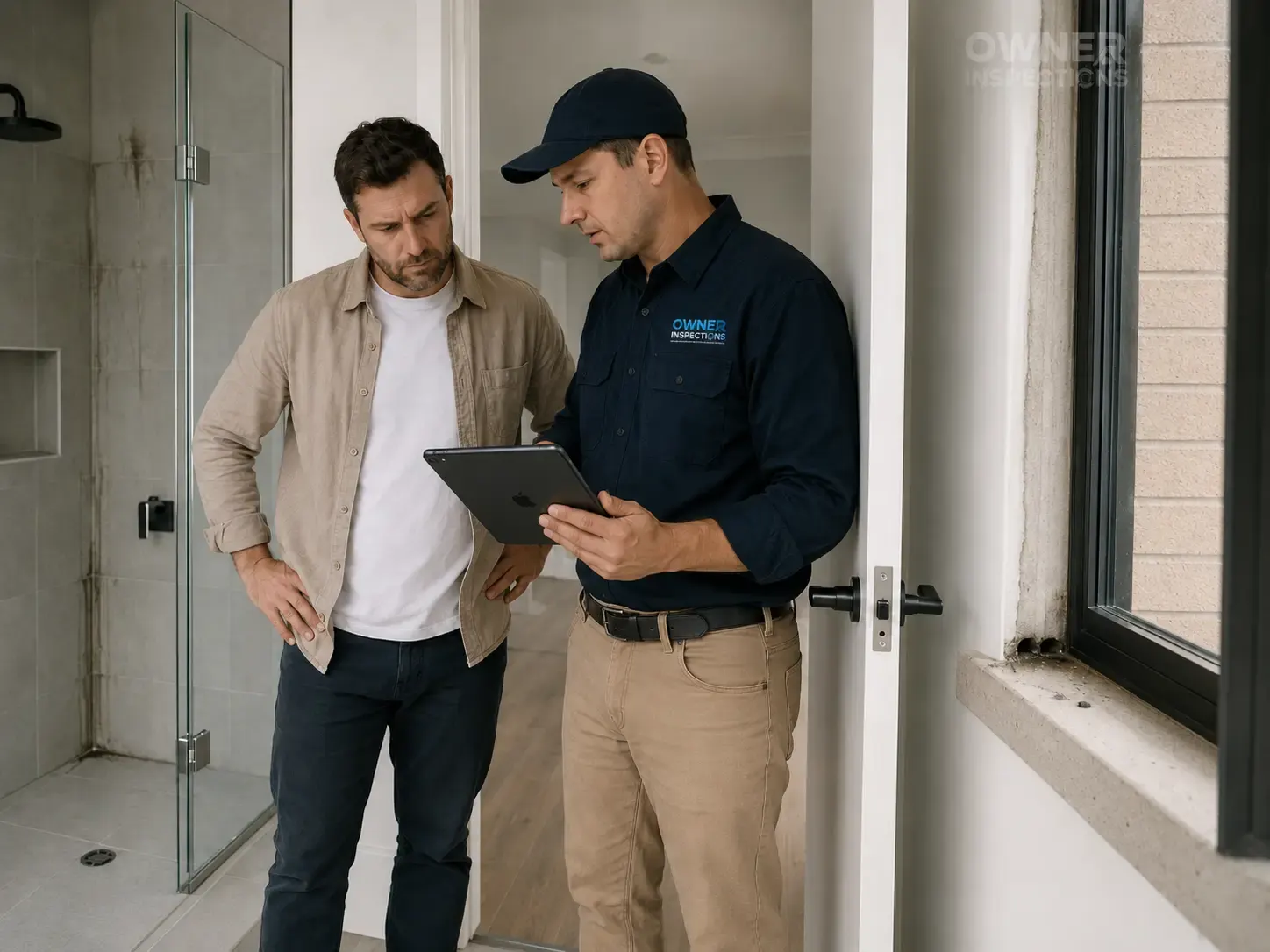
What happens if you turn up to your Practical Completion Inspection (PCI) and the builder’s defects list is missing items from your independent inspector report? Do you sign anyway, pay the final invoice, and hope it sorts itself out later?
This is a high-stakes moment for homeowners and investors because PCI often links to handover, final payment, and the start of key timeframes. If a defect is missing from the builder’s defect list (snag list, punch list, defects schedule), it can become harder to enforce later, even when the issue is real and clearly documented.
This guide is for owners at PCI or handover who already have an independent report, or who are preparing for a pre-handover inspection, and want a practical way to protect their position before signing paperwork or making final payment.
Need a clear record before you sign at PCI?
Learn how to record building defects with photos, dates, locations, and written notices so missing items are easier to raise with the builder.
Documentation Guide
What is a Practical Completion Inspection (PCI) and What Gets Signed?
PCI is the handover-stage inspection where the builder says the home is complete enough to meet the contract standard for “practical completion” (wording varies by contract). In Queensland, the QBCC describes practical completion as work completed to the contract, plans and specifications, with only minor defects or omissions, and suitable for habitation and compliant with statutory requirements.
At PCI, the builder usually presents paperwork such as:
- Notice of Practical Completion (or similar contract notice)
- Builder’s defect list (often a short checklist)
- Handover pack items (manuals, warranties, keys, compliance certificates)
- Final payment claim (or confirmation of the balance due)
PCI vs Final Completion (Why defects still exist at PCI)
Practical completion does not mean perfect finish. It usually means the home can be used for its intended purpose, with remaining items limited to minor defects or minor incomplete work. That is why paint touch-ups, silicone gaps, door adjustments, or hardware alignment often appear on PCI lists.
The risk is not that defects exist. The risk is that your independent inspector has flagged defects that are not recorded anywhere in the builder’s defect list, and the builder later treats them as “new”, “out of scope”, or “not raised at PCI”.
Why a Builder’s Defect List Can Miss Items From an Inspector Report
Missing items do not always mean the builder is acting in bad faith. Common reasons include scope differences, admin shortcuts, and version mismatches.
Different definitions (defect vs finish vs tolerance)
Independent reports often describe issues using building terms that can be argued about:
- Defect (non-compliant or not per contract/spec)
- Finish issue (cosmetic, but still contract-relevant if the specification sets a standard)
- Within tolerance (builder may argue it is acceptable)
The fix is to tie each item back to something objective: the contract, drawings, specifications, manufacturer installation requirements, or a clear functional issue (water ingress risk, safety, operation).
Admin Process (Builder uses a short checklist)
Many builders run PCI using an internal checklist designed for speed. It may miss room-by-room details that a thorough independent inspection captures, especially when the inspector uses a structured report format with photos, location notes, and risk-based wording.
Timing/Version Mismatch
Your report might be:
- Completed earlier than the builder’s current version of works
- Based on a different revision of plans/finishes
- Missing the builder’s last-minute changes or as built adjustments
A quick reconciliation step fixes most of this.
Is it Okay to Sign PCI Paperwork if the Defect List is Missing Items?
Sometimes yes, sometimes no. The safer question is: what does signing trigger in your contract, and what written record exists for the missing items before you sign?
What Signing Typically Triggers (Handover + Final payment + Timelines)
Depending on your contract, signing PCI or accepting practical completion may trigger:
- Handover and keys
- The builder’s right to claim final payment
- The start of contract defect periods (often called the defects liability period)
- A countdown to raise issues in writing under the contract process
Even if your contract defects period starts, you still want the largest possible defect list clearly acknowledged at PCI, because it reduces arguments about timing and responsibility.
Risk: Missing Items Become Harder to Enforce Without Written Acknowledgement
If it is not on the builder’s list and not acknowledged in writing, the builder may later claim:
- It was not raised at PCI
- It was caused after handover
- It is maintenance, not a defect
- It is “normal settlement” or “owner damage”
In Queensland, the QBCC notes owners should notify contractors of defects noticed at handover or within relevant periods and that defects need to be raised with the contractor. The practical lesson is the same everywhere: get it in writing with evidence.
What to Do Next (Step-by-step)
This is the process Owner Inspections uses to convert an independent report into a builder-ready defects schedule with a paper trail.
Step 1: Reconcile Lists Line-by-line (Create “missing items” schedule)
Take your inspector report and the builder’s defect list and reconcile every item. The goal is a single table that shows:
- What your inspector noted
- Whether it appears on the builder’s list
- Evidence references (photos)
- Location and severity
- Builder acknowledgement status
- Agreed rectification date and status
Inspector Report vs Builder Defect List Reconciliation
| Item | In inspector report? | In builder defect list? | Photo ID | Location | Severity | Builder acknowledged (Y/N) | Agreed fix date | Status |
|---|---|---|---|---|---|---|---|---|
| Example: Shower screen leaks at corner | Yes | No | P-014 | Ensuite | Major | N | TBC | Open |
| Example: Front door not latching smoothly | Yes | Yes | P-022 | Entry | Minor | Y | 10 Feb 2026 | In progress |
| Example: Brick weep holes blocked | Yes | No | P-031 | Rear elevation | Moderate | N | TBC | Open |
Tip
If the inspector report uses long descriptions, convert each item to a short builder action line like: “Adjust hinge/latch so door closes and latches without force.”
Step 2: Email the Builder: Request the Missing Items be Added/acknowledged
Send a clear email the same day as PCI (or immediately after). Attach:
- The independent report (PDF)
- Your “missing items schedule” (PDF or spreadsheet export)
- A photo pack (optional but strong)
Email Template
Subject: PCI defects list missing items – request acknowledgement and rectification dates
Body: Hello [Builder/Site Supervisor Name], Following today’s Practical Completion Inspection at [Address] on [Date], the builder’s defects list provided at PCI does not include several items documented in our independent inspection report.
Please find attached:
- Independent inspection report dated [Date]
- Missing items defects schedule (items not currently listed on the builder’s PCI defects list)
- Photo references (Photo IDs listed in the schedule) Please confirm in writing by [set a short deadline, e.g., 2 business days] that: a. These missing items are acknowledged for rectification, and b. A target rectification date is agreed for each item (or a proposed schedule).
If you believe any listed item is not a defect or is outside scope, please reply against each line item with your reason so it can be addressed promptly.
Regards, [Owner name] [Mobile]
Step 3: Get Written Acknowledgement + Target Rectification Date
A builder does not need to rewrite their entire form on the spot. The key is written acknowledgement that is:
- Item-by-item (not vague)
- Dated
- Tied to a schedule
Best outcomes:
- Builder updates their defects list to include your missing items, OR
- Builder replies by email confirming the missing items schedule is accepted, with dates
Step 4: If Pressured to Sign: Document Conditions/notes (Contract-dependent)
If you are under pressure to sign at PCI:
- Ask for time to review the defect list against your report before you sign
- If you must sign, add written notes where the form allows, such as: “Owner notes additional defects per independent report dated [date] and attached missing items schedule emailed to builder on [date].”
- Keep photos of every page you sign on the day
Do not write anything that contradicts your contract. If the contract language is strict, get advice before signing.
Step 5: Maintain a Defect Register (Photo + Location + Date + Status)
A defect register wins disputes because it is simple, dated, and consistent.
Minimum standard for each entry:
- Date observed
- Exact location (room, wall, elevation)
- Photo ID(s)
- Description in plain language
- Impact (leak risk, safety, functional issue)
- Builder response and dates
Step 6: Re-inspect After Rectification
Rectification quality varies. A re-inspection checks whether:
- The defect is fixed, not just covered
- The fix did not create a new problem (common with paint patching, silicone, and drainage adjustments)
- The issue is still within specification and functioning
Step 7: Escalate Via State Pathway if Needed
Escalation works best when you can show:
- You raised the missing items in writing
- You gave access and reasonable time to rectify
- The builder refused, delayed, or disputed without basis
- You kept evidence and a clear defect register
Builder says the PCI defects are fixed?
A reinspection can check whether the agreed rectification work has been completed properly before you close out the defect list.
Reinspection
Defect Severity Triage (So you focus on the right items at PCI)
| Severity | Examples | Risk | Priority | Evidence needed |
|---|---|---|---|---|
| Safety | Exposed wiring, trip hazards, unstable balustrade | Injury, non-compliance | Immediate | Photos, location, notes, request urgent fix |
| Water ingress | Leaking showers, window leaks, missing flashings, ponding near slab | Mould, structural damage | High | Photos/video, moisture readings if available, weather notes |
| Structural or movement signs | Cracking with movement indicators, significant slab issues | Long-term damage | High | Photos with scale, location map, inspector notes |
| Functional | Doors/windows not operating, poor drainage fall to wastes, HVAC not working | Usability issues | Medium | Video proof, repeatable test results |
| Finish/cosmetic | Paint touch-ups, minor chips, silicone neatness | Visual quality | Medium to low | Photos, clear expectations from spec |
In NSW, statutory warranties are longer for major defects than other defects, so documenting severity and impact early is useful even when you are still trying to resolve informally.
State-by-State Guidance
This section is not a full legal guide. It shows the main regulator touchpoints and why your paper trail matters.
Queensland (QBCC Practical Completion Inspection Expectations)
QBCC provides homeowner guidance on the practical completion inspection and stresses notifying the contractor about defects noticed at handover or within the relevant period.
If defects are not resolved, the QBCC defective work pathway can include inspection and enforcement steps. QBCC may issue a Direction to Rectify to a contractor to rectify defective building work, and notes that in most cases the rectification period will be 35 days.
Be careful with time limits. The QBCC warns not to delay lodging a defective work complaint and lists eligibility timeframes, including lodging within 3 months of noticing structural defects and 7 months of completion for non-structural defects (as described on its guidance pages).
Practical completion itself is described by the QBCC as work completed to the contract, plans and specifications, with only minor defects or omissions, suitable for habitation and compliant with statutory requirements.
Practical takeaway in QLD: missing items should be raised in writing immediately, then tracked. If the builder stalls, know the complaint time limits and keep evidence ready.
New South Wales (Statutory Warranties + Dispute Steps)
NSW government guidance explains statutory warranty time limits: for contracts signed on or after 1 February 2012, the statutory warranty period is 6 years for major defects and 2 years for other defects, with a further 6 months to enforce in some circumstances when loss becomes apparent near the end of the period.
The NSW Building Commission’s defect complaints page also summarises statutory warranty coverage and points homeowners to first try to resolve directly with the builder before lodging a complaint.
If you need to escalate, Service NSW provides the process to lodge a home building complaint with Building Commission NSW.
Practical takeaway in NSW: your strongest position comes from a clean sequence: notify in writing, give a chance to fix, re-inspect, then escalate with a complete evidence pack if needed.
Victoria (Completion Docs + Implied Warranties)
Consumer Affairs Victoria provides a “when building work is complete” checklist. For handover documentation, it highlights the need for an Occupancy Permit (for new homes) or a Certificate of Final Inspection (for extensions and renovations), plus other required certificates.
The Victorian Building Authority also notes your building permit will state whether you need an occupancy permit or a certificate of final inspection.
For rights around workmanship, Consumer Affairs Victoria explains implied warranties on home building work under the Domestic Building Contracts Act 1995, including requirements such as work carried out in a workman-like manner, with reasonable care and skill, and using suitable materials.
If a dispute escalates beyond direct negotiation, the Victorian Building and Plumbing Commission (BPC) outlines its dispute resolution process, including eligibility checks, assessment, and conciliation steps.
Practical takeaway in VIC: do not confuse PCI with regulatory approval. Make sure the right occupancy or final inspection certificate is in your handover pack, and keep your defects register aligned to the contract and implied warranty expectations.
Handover Paperwork Checklist (What You Should Have)
Bring this checklist to PCI and tick off what you actually receive.
Core handover pack:
- Copy of signed contract, plans, specifications, variations, and selections
- PCI defects list (builder)
- Your independent report and the reconciled defects schedule
- Keys, remotes, codes, and access devices
- Appliance manuals and warranties
- Waterproofing, glazing, termite protection and other compliance certificates where applicable
- Final payment claim and a clear statement of what it covers
Victoria focus Occupancy Permit (new home) or Certificate of Final Inspection (reno/extension).
Queensland focus Written record of defects noticed at PCI and the next steps for rectification.
NSW focus Clear practical completion notice process per your contract, plus written defect acknowledgement to support later warranty enforcement if needed.
Inspection Standards (AS 4349.1 / AS 4349.3)
Independent inspection reports sometimes reference Australian Standards to describe the inspection scope and reporting format.
- AS 4349.1-2007 relates to inspection of buildings, Part 1: pre-purchase inspections (residential buildings).
- AS 4349.3-2010 relates to inspection of buildings, Part 3: timber pest inspections.
These standards help set expectations for how an inspection is carried out and reported. They are not the same thing as a building surveyor’s approval, and they do not replace the certificates required for occupation in your state.
How Owner Inspections Helps With PCI Defect Follow-Up
When the builder’s PCI defect list does not match your independent inspection report, the next step is not just asking for repairs. You need a clear record that shows what was missed, where each defect is located, and whether the builder has agreed to fix it.
Owner Inspections Owner Inspections can help homeowners, property investors, and small developers through a pre-handover inspection, defect list review, photo-based reporting, and follow-up checks before the file is closed.
Defect List Reconciliation
Owner Inspections can compare the builder’s defect list against the independent PCI report and identify missing items line by line. This helps create a cleaner defects schedule that is easier for the builder, site supervisor, or contract administrator to review.
This may include:
- Defect description
- Room or location
- Photo reference
- Severity level
- Whether the builder has acknowledged the item
- Suggested follow-up status
Evidence Pack for Builder Communication
A strong paper trail makes later conversations easier. Owner Inspections can help organise the inspection findings into a clear evidence pack with photos, locations, and date-stamped notes.
For owners who may need stronger records later, the guide on how to document building defects for a legal claim is a useful next read.
PCI Rectification Re-Inspection
After the builder says the defects have been fixed, a reinspection can check whether the rectification work is complete and whether any new issues have appeared during the repair process.
This is useful for common PCI items such as:
- Door and window alignment
- Silicone gaps
- Paint touch-ups
- Drainage falls
- Cabinetry adjustments
- Water ingress risks
- Poor or incomplete finishes
Support Before Escalation
Owner Inspections does not replace legal advice or a state regulator, but a well-prepared inspection record can support clearer communication if a dispute continues. A defect register, photos, and re-inspection notes can help show what was raised, when it was raised, and whether it was properly addressed.
For owners approaching handover, the goal is simple: make sure the missing items are recorded, acknowledged, and checked before the file is closed.
Still unsure what to do with missing PCI defects?
Send Owner Inspections your report, builder defect list, and photos so the team can help you choose the right inspection or follow-up service.
Frequently Asked Questions
Is it normal for the builder’s PCI defect list to miss items from an inspector report?
Is it okay to sign if the defect list has missing items?
Will the builder automatically fix defects that aren’t on their list?
What’s the safest way to notify the builder about missing items?
Should I insist they add every item to the builder’s defect list, or is email acknowledgement enough?
What evidence should I keep for each defect?
What defects matter most to prioritise at PCI?
What happens if the builder disputes an item as “not a defect”?
How long do rectifications usually take after PCI?
What documents should I receive at handover?
What if defects appear after I move in?
Related Articles

Comparing Pre-Handover Inspections and Final Walkthroughs
Pre-handover inspections and final walkthroughs serve different purposes in the new home buying process. This guide compares the two, explains who conducts each, what they cover, when they happen, and why Australian home buyers need both for a confident handover.
Pre-Handover Inspections (PCI)

Pre-Settlement Property Handover Inspection Guide
A pre-settlement property handover inspection confirms your new property is in the agreed condition before you take ownership. This guide covers what to check, your legal rights as a buyer, and how to resolve issues found during the inspection.