
This guide carries no dollar figure, on purpose. The prices published online come from removalists and lead-generation sites, they are mostly undated, and they disagree with each other widely. What follows is what actually separates one quote from another, and when the better answer is not to remove the material at all.
How much should I pay for asbestos removal?
What you should pay is what a licensed removalist quotes, in writing, for a scope that has been identified and measured, checked against at least one other quote for the same scope. Two things set the size of that quote before anything else.
Friability. Friable asbestos is material that is in powder form or can be crumbled to powder by hand pressure when dry, such as old pipe lagging and sprayed insulation. A Class A licence covers all types of asbestos, including friable material. A Class B licence covers non-friable material only, such as bonded asbestos cement sheeting. In NSW and Queensland, any amount of friable asbestos must be removed by a Class A licensed removalist. Friable work needs more containment and more controls, and the quote reflects that.
Quantity. A small job is not proportionally cheap. Setup, protective equipment, transport and disposal are costs the removalist carries whether the job is one sheet or a whole outbuilding.
A licensed removalist will usually include the cost of lawfully disposing of the waste in the removal price, as the Asbestos and Silica Safety and Eradication Agency notes. For the detail on friable and non-friable asbestos and how removal is regulated, see our longer guide.
What makes one asbestos removal quote higher than another?
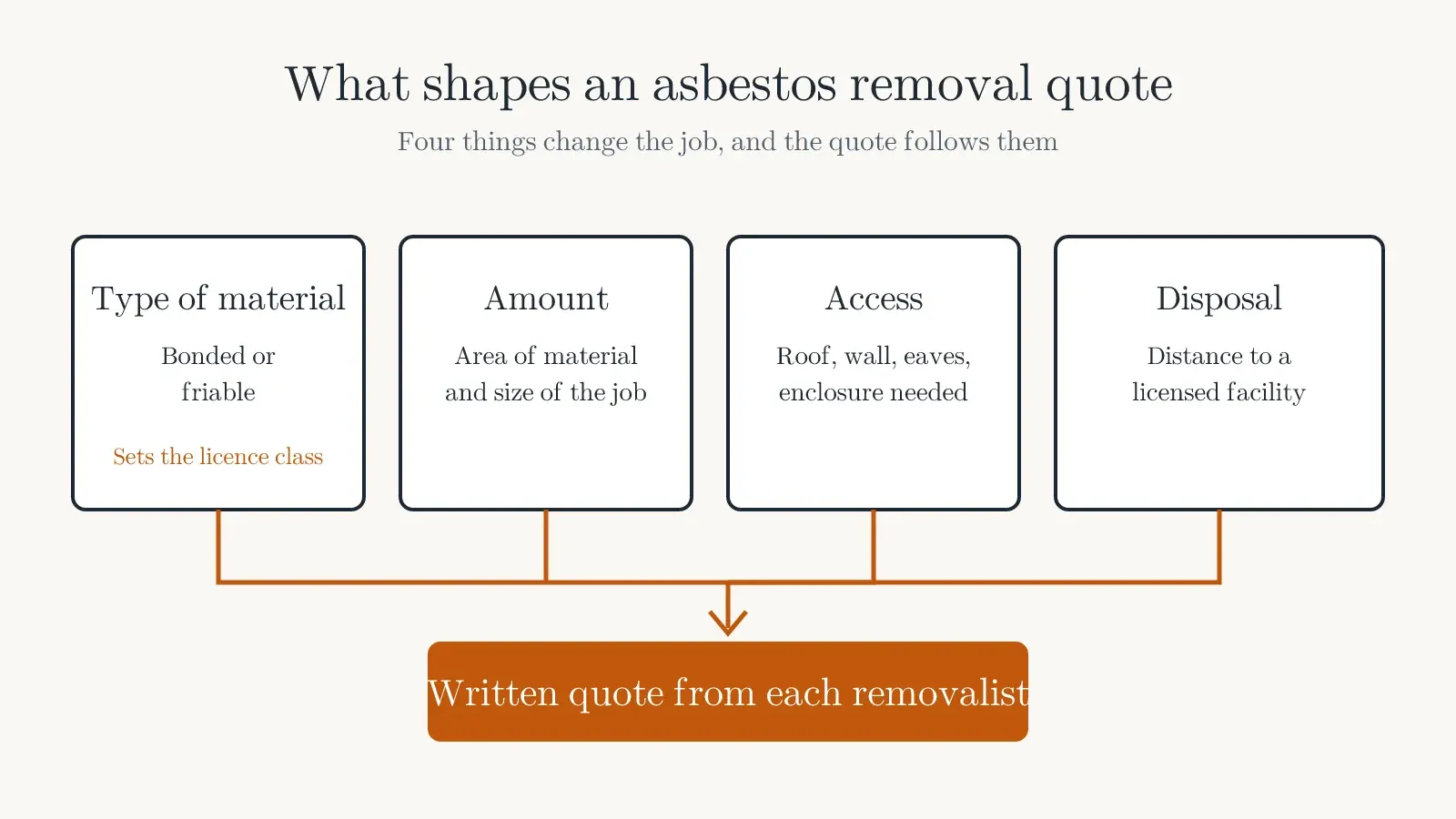
Usually, different assumptions about the same house. These are the variables that move a quote:
- Friability: whether the contractor assumed friable or non-friable material, and on what evidence.
- Quantity: square metres measured on site, or estimated from a phone description.
- Access and height: eaves, roof sheeting and upper-storey cladding may need scaffold or an elevated work platform.
- Disposal: how far the waste travels to a facility licensed to accept it.
- Air monitoring and clearance: whether an independent assessor is included in the price or left for you to arrange.
- Occupancy: whether the house stays lived in during the work, which changes how much of it has to be sealed off.
As an illustration rather than a real job, picture three quotes for one fibro laundry. One contractor assumed non-friable sheeting and nothing else. One allowed for scaffold to reach the eaves above it. One priced disposal to a licensed facility 60 kilometres away. None of them is wrong, and none of them can be compared with the others.
Ask each contractor to state in writing what they assumed about friability, quantity, access and disposal, and whether clearance is included. Then compare like with like. Comparable quotes start from the same list of materials, and a pre-purchase report from Owner Inspections records suspect materials by location with photographs, so each removalist can be handed the same scope to price.
Is it worth removing asbestos?
Often, not yet. Non-friable asbestos that is sealed, undamaged and left alone is generally managed in place rather than removed, and that is the usual advice from state asbestos authorities. Removal disturbs the material deliberately, and asbestos poses increased health risks when it is disturbed, for example during removal.
Removal is the right call when the material is damaged or deteriorating, when it is friable, or when planned work such as a renovation, a demolition or a new opening in a wall is about to disturb it.
If you leave it in place, write down where it is, keep it sealed and unbroken, and tell anyone working on the house before they drill, cut or sand near it.
Do you have to pay to get rid of asbestos?
Usually, yes. Asbestos waste can only go to a facility licensed to accept it, and a licensed removalist will normally build lawful disposal into the quote. Some councils run collection or drop-off arrangements for small household quantities, with conditions that vary, so ask your council before assuming either way. Disposal rules are set by each state: NSW, Victoria and South Australia each publish their own.
What are the first signs of asbestos in a house?
The first sign is the age of the house or its last renovation, not anything you can see. Homes built or renovated before 1990 are the practical risk group, and the material type matters more than its appearance: fibro sheeting on eaves and walls, wet-area linings, the backing under vinyl flooring and old pipe lagging. Looking cannot confirm it. Our guide on how to identify asbestos in your home covers where it hides and how testing works.
Can you remove asbestos yourself?
Not friable asbestos in NSW or Queensland, where any amount must be removed by a Class A licensed removalist. The Northern Territory sets no limit on the amount or type of asbestos a homeowner removes from their own house, but it recommends a licensed removalist for all domestic removal work. For non-friable material, some states allow an unlicensed person to remove a limited quantity under set conditions, but the quantity, the conditions and whether the work must be notified differ between states and territories. Check the rule with your state regulator rather than relying on a figure you read online.
Owning the material is not where the risk lies. The risk starts the moment someone cuts, drills, sands, snaps or water-blasts it. If the job involves any of those, it is work for a licensed removalist.
What if I removed asbestos without knowing?
Stop work and leave the area. Do not dry-sweep, use a household vacuum cleaner (even one with a HEPA filter) or use high-pressure water, because each of those can release asbestos fibres into the air. Close the area off, keep children and pets out, and contact your state asbestos regulator or a licensed assessor about what to do next.
What happens if I breathe in a little bit of asbestos?
We are not a medical provider, and there is no exposure level anyone can tell you is safe. What inhaled fibres mean for you, and whether your body clears them, is a question for your GP, who can record the exposure and advise you. You can also record it on the National Asbestos Exposure Register, maintained by the Asbestos and Silica Safety and Eradication Agency, so it is on file if it is ever needed.
Can asbestos be 100% removed?
From the area being worked on, that is the aim, and a clearance inspection is how it is checked. A clearance confirms that the work area is free of visible asbestos residue and, where air monitoring was carried out, that the readings were acceptable. It says nothing about the rest of the building, and material hidden in wall cavities or under later floor coverings may not be found until those are opened.
Clearance is required after friable removal. For other work, what is required depends on the job and on your state, so ask each removalist whether the quote includes an independent clearance, who issues it and what it covers.
Do I need an inspection before I get removal quotes?
Not every job needs one, but it is what makes the quotes comparable. A removalist quoting from a phone call is quoting blind, and the quotes that come back will each describe a different job.
Pre-purchase building inspection reports generally do not cover asbestos, and a specific asbestos assessment may be needed. Only scientific testing of a sample by a NATA-accredited laboratory can confirm asbestos, and the NSW and Victorian asbestos authorities recommend that a professional, such as an occupational hygienist, takes the sample. For the scope of the standard report, see what a standard building inspection covers.
Get suspect materials recorded before you collect quotes
A building and pest inspection documents materials that appear to contain asbestos, with locations and photographs, so each removalist prices the same job.
Frequently Asked Questions
Does home insurance cover asbestos removal in Australia?
Should I get more than one asbestos removal quote?
Can I put asbestos waste in a skip or the household bin?
References and Resources
- Asbestos and Silica Safety and Eradication Agency, asbestos identification, removal and disposal, including that a licensed removalist usually includes lawful disposal in the removal cost
- Asbestos and Silica Safety and Eradication Agency, on removal licence classes and the National Asbestos Exposure Register
- NSW Government asbestos information
- Victorian Government asbestos information
- South Australian Government asbestos information
Related Articles
How to Identify Asbestos in Your Home
You cannot identify asbestos by looking at it, only a NATA-accredited lab test can confirm it. This guide covers the age and material clues worth checking, where asbestos hides in an Australian home, and what a building and pest inspection does and doesn't cover.
Asbestos Inspections: Identifying Health Hazards in Australian Homes
Asbestos inspections identify hazardous asbestos-containing materials in properties built before 2000. This guide covers the health risks, Australian legal requirements, inspection processes, and safe removal practices to protect occupants.
Insurer denied my claim because of asbestos: what now?
Insurers rarely deny a claim simply because a home contains asbestos. They deny it under a specific clause, and which clause it is decides whether the decision can be overturned. This guide explains the four common grounds and how to challenge them.