
This guide is for homeowners who built or bought new in the last 6–18 months and are approaching the defects liability or maintenance period in their contract. It focuses on the practical decision: book an independent inspector, do it yourself, or use a hybrid approach that still produces a builder-ready defects list.
Quick Answer
- It is worth booking a private inspector when the issues are technical or high-risk: water ingress, wet areas, roof leaks, drainage and surface falls, or movement cracks that keep changing.
- It is often not worth it when the builder is responsive and you only have obvious, low-impact items like minor paint touch-ups or a loose door handle.
- Best timing: book before your contract maintenance window ends, leaving time for inspection, submission, builder scheduling, and a re-check if needed.
- A private report does not force a builder to agree, but it usually improves evidence quality, makes the list clearer, and reduces back-and-forth.
- Use your contract and specifications as the baseline, then use standards and tolerances guides as a reference point for common finish disputes. The NSW guide, for example, is a general reference and does not replace the NCC or Australian Standards.
Need a Clear Maintenance Defects List?
Book a maintenance inspection to document defects with photos, locations, priorities and clear wording before your maintenance window closes.
Inspection
What a Maintenance Request Actually Is (and Isn’t)
A maintenance request is usually a contract-based defects list sent to the builder during the defects liability or maintenance period. Many new-home contracts set this period around 6 to 12 months after practical completion, but the exact timeframe depends on the contract.
It is not the same as statutory warranty rights. A contract maintenance period is agreed between the owner and builder. Statutory warranties are legal rights and the time limits vary by state.
In NSW, Building Commission NSW says the time limits to commence proceedings for breach of statutory warranty are 6 years for major defects and 2 years for all other defects. If the breach becomes apparent within the last 6 months of the statutory warranty period, homeowners may have a further 6 months after the end of that period to commence proceedings.
In Queensland, the QBCC Home Warranty Scheme has separate claim timing. Structural defect claims are linked to a 6 year and 6 month cover period, with a claim required within 3 months of first becoming aware of the defect. Non-structural defects must first be noticed within 6 months after substantial completion, and the claim must be made within 7 months after substantial completion.
Do You Need a Private Inspector for a Maintenance Request?
You do not always need a private inspector maintenance request inspection, but it can be worth it when the defect list involves water, drainage, roof leaks, recurring cracks, window seals, or anything that may get worse over time.
A DIY list can work when the builder is responsive and the issues are simple, such as paint marks, loose handles, minor cabinetry alignment, or small touch-ups.
A private inspector gives you stronger evidence, clearer wording, better photos, and a priority order. That can make the maintenance request easier for the builder to action.
The best time to book is before your contract maintenance window closes, leaving time to inspect, submit the list, get a builder response, and arrange a re-check if needed.
Why Homeowners Hire an Inspector Again
The real value is not just finding more defects. It is improving how the request is written.
A private inspector can help by:
- Recording one defect per line
- Adding room names and exact locations
- Taking clear photo evidence
- Separating urgent water or safety items from cosmetic issues
- Using neutral wording that is easier for the builder to act on
- Referring to the contract, specifications, tolerances guides, or NCC context where suitable
This matters because vague wording often creates delay.
- “Bathroom issue” is weak.
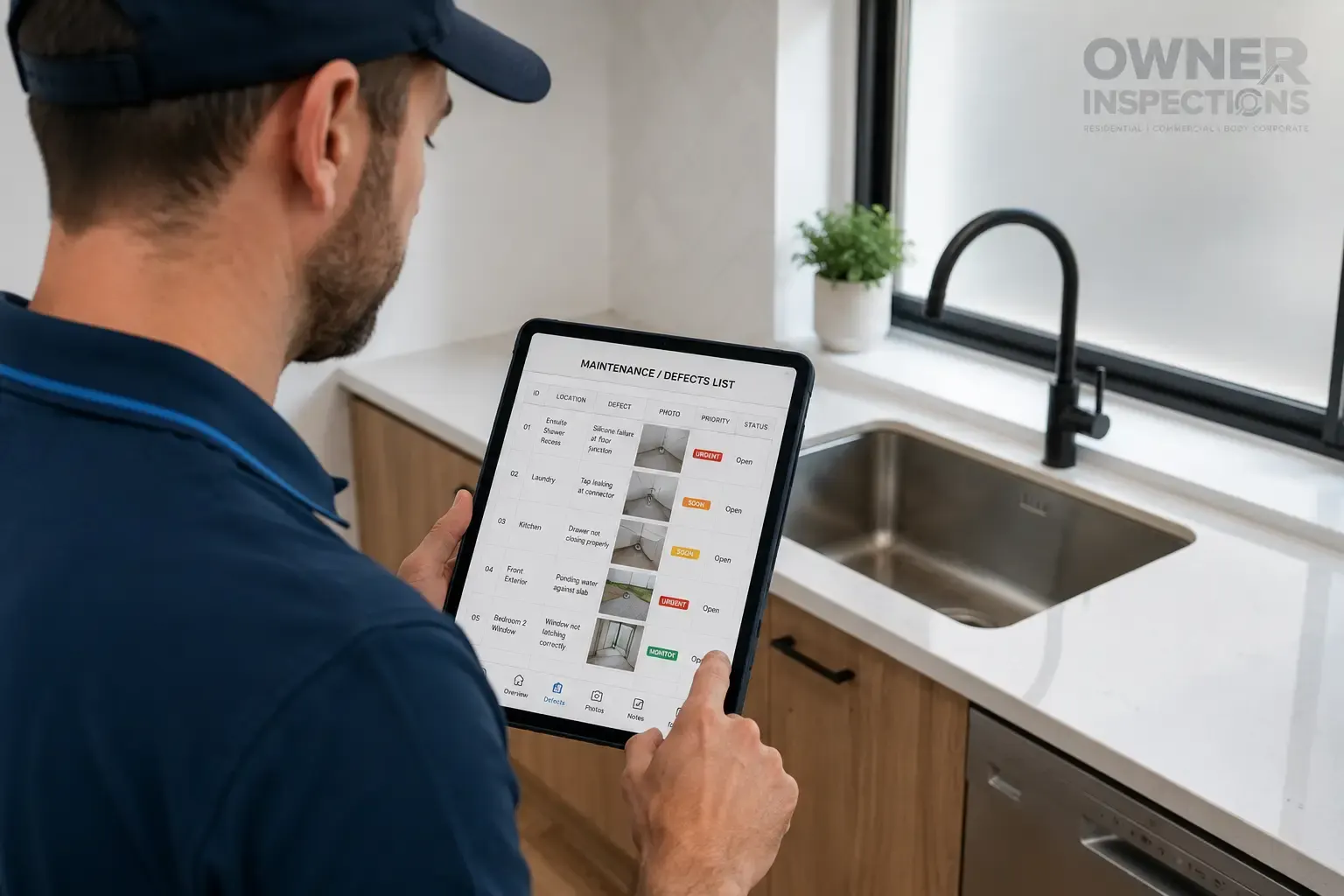
- “Ensuite shower, rear wall-to-floor junction, silicone split and lifting, water entry risk, photo Ensuite-03A and 03B, request reseal and check junction” is much stronger.
When a Private Inspector is Worth It
Re-engage a private inspector if you notice:
- Damp smells, swelling skirting, mould, loose tiles, or other wet-area warning signs
- Roof stains, ceiling marks, damp insulation, or leaks after rain
- Poor drainage falls or ponding near the slab
- Movement cracks that are growing or returning after patching
- Door alignment and window seal problems across several rooms
- Repeated builder pushback such as “that is normal settlement”
- A maintenance window that is about to close
Water-related issues deserve faster action because the cost of delay can be high.
When DIY or Hybrid Can Work
DIY can be enough when the list is short, obvious, and the builder is already responding.
A hybrid approach can also work well. For example, the homeowner can record simple items such as paint defects and minor hardware issues, while an inspector checks wet areas, roof space where safely accessible, drainage, movement cracks, windows, and doors.
This gives you professional input where the risk is highest without turning every minor mark into a paid inspection item.
Document Defects the Right Way
Learn how to record building defects with clear photos, written notes and supporting evidence if your issue may become a formal claim.
Documentation Guide
What a Good Maintenance Inspection Includes
A good maintenance and defects inspection is usually a visual inspection of accessible areas. It should be scoped clearly before booking.
A useful report should include:
- Line-item defects
- Photos
- Exact locations
- Severity or priority tags
- Clear defect descriptions
- Suggested rectification wording
- Notes on likely cause where appropriate
- A clear statement of scope and limits
The report supports communication with the builder. It is not a court finding, regulator decision, or full compliance audit unless that has been specifically agreed.
Standards, Codes and Tolerances
Your contract and specifications come first. They show what was agreed.
Tolerances guides can help when there is a workmanship dispute, but they do not replace higher-ranking documents. NSW Government says the NSW Guide to Standards and Tolerances helps homeowners understand whether work meets acceptable standards, but it is a general reference, does not offer strict rules, and does not replace the Building Code of Australia or relevant Australian Standards.
Queensland’s Standards and Tolerances Guide says building standards are mainly described in the National Construction Code Series, including BCA Volumes 1 and 2, and that Acts, Regulations, NCC requirements, Australian Standards, and manufacturer instructions take precedence where there is any difference or contradiction.
AS 4349.1 is also sometimes referenced for inspection structure, but Standards Australia lists AS 4349.1-2007 as “Inspection of buildings, Part 1: Pre-purchase inspections, Residential buildings.” That means it should not be treated as a perfect fit for every maintenance inspection unless the inspection scope explains how it is being used.
How to Write a Maintenance Request Builders Act On
Use this format:
- Reference ID: Kitchen-02
- Location: Kitchen, sink cabinet, rear left corner
- Defect: Silicone gap visible at bench-to-splashback junction
- Impact: Possible water entry behind cabinetry
- Evidence: Photo Kitchen-02A and Kitchen-02B
- Requested outcome: Reseal joint and confirm no moisture damage
- Priority: Soon
Use this 8-step method:
- Check your contract maintenance deadline.
- Walk the home room by room.
- Take one wide photo and one close-up photo for each item.
- Label every defect with a room and number.
- Write one defect per line.
- State the impact in plain language.
- Ask for a clear rectification outcome.
- Request a written response with proposed dates.
Cost vs Value Decision Guide
| Approach | Best for | Risk of missed issues | Evidence strength | Notes |
|---|---|---|---|---|
| DIY | Minor obvious defects | Medium | Medium | Works if the builder is responsive |
| Private inspector | Water, roof, drainage, movement, repeated defects | Low | High | Best when timing or technical risk matters |
| Hybrid | Homeowners with some simple items and a few high-risk concerns | Low to medium | High | Good balance between cost and coverage |
State Modules
NSW: statutory warranties overview and time periods
In NSW, statutory warranties apply regardless of whether they are written into the contract. NSW Government guidance and the Home Building Act set limitation periods that commonly appear in defect discussions:
- Major defects: 6 years from completion
- All other defects: 2 years from completion
- Extra 6 months rule: if you become aware of a breach in the last 6 months of the statutory warranty period, you generally have an additional 6 months after the end of the period to commence proceedings.
Practical tip for maintenance requests: even if you are still inside your contract maintenance period, do not assume that means you can wait. Start documenting early and keep records in case timing becomes an issue later.
QLD: QBCC scheme time limits overview
Queensland has strict notice and claim timing that can catch homeowners out, especially for non-structural issues.
QBCC guidance on time limits for cover and claims sets out that:
- Structural defects: generally must be noticed within 6 years 6 months, and the claim must be made within 3 months of becoming aware (with cover commencement day rules).
- Non-structural defects: cover is linked to becoming aware within 6 months after work is substantially complete and making the claim within 7 months after substantial completion.
Practical tip for maintenance requests: treat your 6–12 month contract maintenance window as a prompt to inspect early, not a reason to delay.
Ready to Get Your Defects List Checked?
Speak with Owner Inspections about a maintenance or defects inspection report that helps you submit a clear request to your builder.
Key Takeaways
- A private inspector is most useful for water, roof, drainage, movement cracks, and recurring defects.
- DIY can work for simple cosmetic items when the builder is responsive.
- A maintenance request should be specific, photo-based, and written one defect per line.
- Your contract and specifications are the starting point.
- Tolerances guides help with common workmanship disputes, but they do not replace the NCC, Australian Standards, legislation, or the contract.
- State time limits differ, so homeowners should check regulator guidance before deadlines pass.
Frequently Asked Questions
Do you need a private inspector for a maintenance request?
What’s the difference between a maintenance request and statutory warranty rights?
When is the best time to book a maintenance and defects inspection?
What should a private inspector include in a maintenance inspection report?
What standards are used to judge acceptable workmanship?
Does NCC compliance mean my finish quality must be perfect?
Is AS 4349.1 the right standard for a maintenance inspection?
What defects are most commonly missed without an inspector?
How do I write a maintenance request so the builder can’t dismiss it easily?
If the builder disagrees, what should I do first?
What if my contract maintenance period is over, should I still inspect?
Should I use the same inspector who did my stage inspections?
Related Articles

Can a Builder Refuse Private Inspectors During Construction? Your Rights by State
When a builder or developer refuses to allow your private inspector on site during construction stages, you have legal rights that vary by state. This guide explains the legislation protecting homeowners in NSW, VIC, QLD, SA, and ACT, plus practical strategies when builders push back.
Hiring a Private Inspector for a New House Purchase
A private building inspector provides independent assessments of new house purchases beyond council compliance checks. Learn what they cover and how to choose one.

Why Hire a Private Building Inspector in Melbourne
Hiring a private building inspector in Melbourne provides independent, unbiased property assessments that go beyond council compliance checks. Learn the benefits, costs, and how to choose the right inspector.