
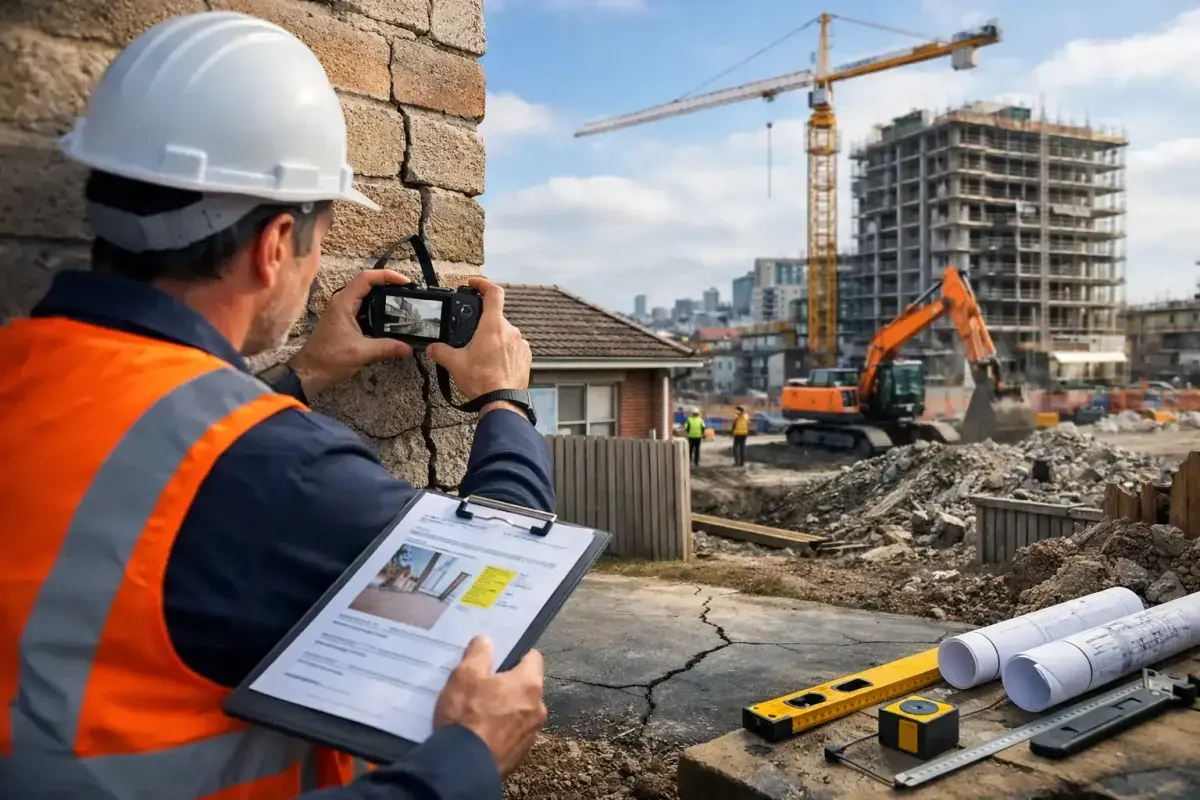
A dilapidation report is a formal record of a property's existing condition prepared before nearby construction, demolition, or infrastructure work begins. In Australia, these reports are commonly required by local councils as a condition of development approval. They protect property owners by providing dated photographic and written evidence of pre-existing defects, cracks, and structural features. If construction causes damage, the report gives you the baseline needed to prove it. Without one, resolving disputes becomes significantly harder and more expensive for everyone involved.
Construction activity across Australia continues to grow, with residential and commercial developments reshaping suburbs in every major city. The closer a building site operates to an existing property, the greater the risk of vibration damage, ground movement, and accidental impacts. Homeowners, investors, strata managers, and developers all benefit from understanding how dilapidation reports work and why they matter for property safety.
This guide covers what makes dilapidation reports so valuable, when they are required, what a thorough report includes, and how they prevent disputes before they start.
What Is a Dilapidation Report?
A dilapidation report (also called a condition report or condition survey) is an independent inspection document that records a property's physical state at a specific point in time. It is typically prepared before construction, demolition, or major infrastructure work begins near the property.
A qualified building inspector visits the property and examines every accessible area, including internal walls and ceilings, external facades, driveways, fences, retaining walls, landscaping, pools, and footpaths. The inspector photographs all visible defects such as cracks, staining, movement, corrosion, and wear. Each defect is described in writing with its location, size, and condition noted.
The completed report becomes a legal-grade document that establishes what the property looked like before construction started. It can be used to compare against a post-construction inspection to determine whether new damage has occurred.
A dilapidation report is not a structural engineering assessment. It records visible, accessible conditions and does not include destructive testing or calculations about load-bearing capacity. For structural concerns, a separate engineering assessment is required.
Why Dilapidation Reports Matter for Property Safety
Protecting Properties from Construction Impacts
Construction sites generate ground vibrations, dust, debris, and heavy vehicle movements that can affect neighbouring properties. Pile driving, rock breaking, deep excavation, and demolition are among the highest-risk activities. These forces can crack walls, shift foundations, damage plumbing connections, and worsen pre-existing defects in nearby buildings.
A dilapidation report creates the evidence needed to hold responsible parties accountable. Without a documented baseline, property owners are left trying to prove damage occurred during construction rather than before it, which is extremely difficult without photographic proof and professional documentation.
Encouraging Contractor Accountability
When builders and developers know that surrounding properties have been formally documented, they are more likely to take precautions. The existence of a dilapidation report encourages construction teams to implement vibration monitoring, use appropriate machinery, and follow best-practice site management. This accountability benefits the safety of the surrounding neighbourhood.
Identifying Pre-Existing Risks
The inspection itself often reveals defects that property owners were not previously aware of. Hairline cracks in brickwork, early signs of foundation movement, deteriorating mortar joints, and drainage problems may all be identified during the survey. While the primary purpose is to create a baseline record, the report also gives owners valuable information about the current health of their property.
- Records all visible cracks, stains, movement, and material damage across the property
- Provides dated, time-stamped photographs that serve as legal evidence
- Gives property owners awareness of pre-existing defects they may not have noticed
- Establishes a clear reference point for post-construction comparisons
- Encourages better construction practices and site management by builders
When Is a Dilapidation Report Required?
Dilapidation reports are required in a range of scenarios across Australia. The most common situations include:
Council-mandated development approvals
Many local councils require a dilapidation report as a condition of development consent. This is especially common for projects involving excavation deeper than one metre, demolition of existing structures, or construction within a set distance of property boundaries.
Large residential developments
Townhouse complexes, apartment buildings, and subdivision developments that sit close to existing homes frequently require dilapidation surveys of all neighbouring properties within a defined radius of the site.
Commercial and infrastructure projects
Road widening, rail construction, utility installations, and commercial building projects often mandate dilapidation reports for properties along the route or within the zone of influence.
Demolition work
Demolition creates significant ground vibrations and debris risk. Councils commonly require dilapidation reports before any demolition approval is granted.
Proactive property protection
Even when not required by council, property owners can commission a dilapidation report on their own initiative. This is a smart move if construction is about to start next door and no formal requirement has been imposed.
Tip
If your council has not required a dilapidation report but construction is starting near your property, consider commissioning one yourself. The cost is far less than the legal fees involved in an undocumented damage dispute.
What a Dilapidation Report Includes
A thorough dilapidation report covers far more than a few photos and a summary. The following elements are standard in a professional report prepared by a licensed inspector.
| What Is Recorded | Why It Matters | |
|---|---|---|
| Property Identification | Full address, property type, construction type, approximate age, and description of the building and its surroundings | Establishes the specific property and its characteristics for the record |
| Inspection Date and Conditions | Date, time, and weather conditions at the time of the inspection | Creates a clear timeline that can be referenced in any future dispute |
| Photographic Evidence | High-resolution photographs of every accessible room, elevation, and external area, with close-ups of all visible defects | Visual evidence is the strongest proof of pre-existing conditions |
| Written Descriptions | Detailed notes on each defect including location, type, severity, and measurements of crack widths where applicable | Provides context that photographs alone cannot convey |
| External Areas | Driveways, footpaths, fences, retaining walls, pools, landscaping, and stormwater infrastructure | External areas are often the first to show construction-related damage |
| Inspector Credentials | Qualifications, licence number, and professional indemnity insurance details of the inspector | Ensures the report carries weight in legal and insurance proceedings |
How Dilapidation Reports Prevent Disputes
Property damage disputes related to construction are common, expensive, and stressful. A well-prepared dilapidation report addresses the root cause of most disputes: the inability to prove when damage occurred.
Before Construction
The pre-construction report captures the property's baseline. Every crack, stain, and area of wear is photographed and described. This removes any ambiguity about what existed before the builder broke ground.
During Construction
If a property owner notices new damage while construction is underway, they can reference the dilapidation report to confirm whether the issue is new. Early identification allows them to raise the matter with the builder or developer while the project is still active, which is far more effective than waiting until after completion.
After Construction
A post-construction dilapidation report is carried out once building works are finished. The inspector compares the current condition against the original baseline report, identifying any new cracks, movement, or damage. This comparison report provides the evidence needed to pursue a damage claim or confirm that no new damage has occurred.
Pros
- Clear photographic baseline of property condition before construction
- Ability to prove whether damage is new or pre-existing
- Stronger position in legal proceedings or insurance claims
- Faster dispute resolution with documented evidence
- Protection for both property owners and builders
Cons
- No documented baseline to compare against after construction
- Difficult to prove when damage occurred
- Higher legal costs and longer dispute timelines
- Builders may deny responsibility without evidence to counter their position
- Risk of paying for repairs that should have been the builder's responsibility
Who Benefits from a Dilapidation Report?
Dilapidation reports are not just for property owners. Several parties benefit from having this documentation in place.
Property Owners and Homeowners
If you live next to a construction site, a dilapidation report protects your home. It gives you a formal record to fall back on if anything goes wrong during the build. Many homeowners only realise the value of this report after construction damage has already occurred, by which point it is too late to establish a baseline.
Builders and Developers
A pre-construction dilapidation report also protects builders. Without a documented baseline, neighbouring owners may blame the construction for defects that existed long before the project started. The report shields builders from exaggerated or false damage claims, saving them time, money, and reputational harm.
Strata Managers and Body Corporates
Strata buildings near construction sites face a heightened risk due to shared walls, common areas, and complex ownership structures. A dilapidation report covering the entire strata complex ensures all lot owners and common property are protected.
Local Councils and Government Bodies
Councils use dilapidation reports to manage development approvals responsibly. They provide a mechanism for holding developers accountable and protecting ratepayers from construction-related damage to public assets such as roads, footpaths, and drainage infrastructure.
Property Investors
Investment properties are financial assets. Any unresolved construction damage can reduce property value and rental income. A dilapidation report protects the investor's asset and provides documentation for insurance purposes.
State-by-State Requirements Across Australia
While there is no single national law mandating dilapidation reports, each state and territory has legislation and council-level policies that govern when they are required.
New South Wales
The Environmental Planning and Assessment Act 1979 allows councils to impose dilapidation report conditions on development consents. Many NSW councils have Development Control Plans (DCPs) that require reports for developments involving excavation over one metre deep or construction within specified distances of boundaries. NSW Fair Trading provides guidance on resolving building disputes through the NSW Civil and Administrative Tribunal (NCAT).
Victoria
The Building Act 1993 and Planning and Environment Act 1987 provide the framework in Victoria. The Victorian Building Authority (VBA) oversees building practitioners and can be involved in disputes where construction causes damage. Many Victorian councils require dilapidation reports for projects near existing buildings, particularly in established suburbs undergoing significant redevelopment.
Queensland
The Queensland Building and Construction Commission Act 1991 governs building work in Queensland. The QBCC handles complaints and disputes related to construction damage. Brisbane City Council and other Queensland councils commonly impose dilapidation report conditions for large-scale developments and projects involving deep excavation.
South Australia
The Planning, Development and Infrastructure Act 2016 provides the regulatory framework in South Australia. Consumer and Business Services SA oversees building disputes. Adelaide councils may require dilapidation surveys for developments near heritage properties or in areas with challenging soil conditions.
Australian Capital Territory
The Building Act 2004 and the Planning Act 2007 govern construction in the ACT. The ACT Planning and Land Authority and Access Canberra oversee compliance. Dilapidation reports may be required for construction near government buildings, heritage properties, or in areas with known ground stability concerns.
Requirements vary significantly between individual councils within each state. Always check with your local council directly to confirm what is required for a specific development. Do not assume that a report is only needed when a formal condition has been imposed.
What Happens Without a Dilapidation Report?
Choosing not to commission a dilapidation report before nearby construction begins is a risk with potentially serious consequences.
- No baseline evidence to prove construction caused new damage to your property
- Builders and developers can deny responsibility for cracks, movement, or other defects
- Legal proceedings become expensive and drawn out without documented proof
- Insurance claims may be weakened by the absence of pre-construction records
- Pre-existing defects may be wrongly attributed to the construction, creating unfair liability for builders
In many disputed cases that reach the courts or tribunals, the absence of a dilapidation report is cited as a major factor in the difficulty of reaching a fair resolution. The cost of a dilapidation report is minimal compared to the potential expense of litigation or unresolved damage.
How to Choose a Qualified Inspector
Not all dilapidation reports carry the same weight. The quality of the report depends heavily on the qualifications and experience of the inspector who prepares it.
An independent dilapidation report from a licensed inspector carries far more weight in legal proceedings than a report prepared by someone with a direct interest in the construction project.
Key Takeaways
- A dilapidation report creates a dated, photographic record of a property's condition before construction starts nearby.
- These reports protect property owners, builders, developers, and strata managers from disputes over construction-related damage.
- Local councils across Australia frequently require dilapidation reports as conditions of development approval, particularly for excavation, demolition, and large-scale projects.
- The report includes high-resolution photographs, written descriptions of all visible defects, measurements, and inspector credentials.
- Pre-construction and post-construction reports together provide the strongest evidence base for proving or disproving damage claims.
- Without a dilapidation report, proving when damage occurred becomes extremely difficult and expensive.
- The cost of commissioning a report is far less than the legal fees and repair bills that can result from an undocumented dispute.
- Always choose a licensed, independent inspector with professional indemnity insurance and dilapidation-specific experience.
Frequently Asked Questions
What is a dilapidation report and why is it used in Australia?
A dilapidation report is an independent document that records the existing condition of a property before nearby construction, demolition, or infrastructure work begins. It is used in Australia to protect property owners and builders by creating a dated baseline of photographic and written evidence. If construction causes damage, the report allows a direct comparison between the pre-construction and post-construction condition, making it possible to identify new defects and assign responsibility fairly.
Who pays for a dilapidation report in Australia?
In most cases, the party undertaking the construction or development pays for the dilapidation reports of neighbouring properties. This is typically a condition of the development approval issued by the local council. However, if a council has not imposed this requirement and a property owner wants to protect their own interests, they can commission and pay for a report independently. The cost is generally between $500 and $1,500 for residential properties.
When should a dilapidation report be done?
A dilapidation report should be completed before any construction, demolition, or significant ground works begin near the subject property. Ideally, the inspection takes place as close as possible to the start of construction to ensure the record is current. A second report is typically done after construction is finished so the two can be compared to identify any new damage.
Is a dilapidation report a legal requirement in Australia?
There is no single national law that mandates dilapidation reports in all circumstances. However, local councils across Australia regularly require them as conditions of development consent under state planning legislation. In NSW, the Environmental Planning and Assessment Act 1979 gives councils the authority to impose this condition. Similar provisions exist in Victoria, Queensland, South Australia, and the ACT. Even when not legally required, commissioning a report is strongly recommended for any property near an active construction site.
How much does a dilapidation report cost?
The cost of a dilapidation report in Australia depends on the property type, size, location, and urgency. Residential reports typically range from $500 to $1,500. Commercial properties may cost between $1,500 and $5,000 or more. Heritage buildings and large industrial sites attract higher fees due to the additional documentation required. You can find a detailed pricing breakdown in our dilapidation report cost guide.
What areas of a property does a dilapidation report cover?
A thorough dilapidation report covers all accessible internal and external areas. This includes walls, ceilings, floors, doors, windows, bathrooms, kitchens, garages, driveways, footpaths, fences, retaining walls, pools, landscaping, and stormwater infrastructure. The inspector documents every visible defect, crack, stain, and area of wear with photographs and written descriptions. Inaccessible areas such as roof voids or subfloor spaces may be noted as excluded if safe access is not available.
Can a dilapidation report be used as evidence in court?
Yes. A dilapidation report prepared by a licensed and insured building inspector is admissible as evidence in Australian courts and tribunals. The report's strength as evidence depends on the qualifications of the inspector, the level of detail provided, and the quality of the photographic documentation. Reports prepared by independent inspectors with no affiliation to the construction project carry the most weight.
What is the difference between a pre-construction and post-construction dilapidation report?
A pre-construction dilapidation report records the property's condition before building works start. A post-construction report records the condition after works are completed. The two reports are then compared side by side to identify any new damage that may have occurred during the construction period. Together, they form the strongest possible evidence base for proving or disproving construction-related damage claims.
Do builders benefit from dilapidation reports?
Absolutely. Dilapidation reports protect builders from false or exaggerated damage claims by neighbouring property owners. Without a documented baseline, a builder could be accused of causing defects that existed long before their project started. The report provides objective proof of pre-existing conditions, which can save builders significant legal costs and protect their professional reputation.
How long does a dilapidation inspection take?
A residential dilapidation inspection typically takes between one and three hours on site, depending on the size and complexity of the property. Larger homes, commercial buildings, and heritage properties may take longer. The full report is usually delivered within three to five business days after the inspection. Urgent turnaround options are available from some inspectors at an additional cost.
What happens if construction damages my property and there is no dilapidation report?
Without a dilapidation report, proving that construction caused the damage becomes very difficult. You would need to rely on other evidence such as personal photographs, witness statements, or expert opinions, none of which carry the same weight as a formal pre-construction condition report. The builder or developer may argue that the damage was pre-existing, and without a professional baseline record, disputing that claim is challenging and costly.
Can I get a dilapidation report if construction has already started?
You can still commission a dilapidation report after construction has begun, but its value as a baseline is reduced. The report will document the property's current condition, but it cannot confirm what existed before the construction started. If you notice new damage during construction, it is still worth getting a report to record the current state and support any future claim, but the strongest protection comes from having a report completed before works commence.
References and Resources
- NSW Fair Trading - Home Building - Guidance on building disputes and property protection in New South Wales
- Victorian Building Authority - Building practitioner regulation and dispute resolution in Victoria
- Queensland Building and Construction Commission - Construction complaints and compliance in Queensland
- NSW Legislation - Environmental Planning and Assessment Act 1979 - Framework for development consent conditions including dilapidation report requirements
- Consumer and Business Services SA - Building dispute resolution in South Australia
- ACT Planning - Development approval and compliance in the Australian Capital Territory
Related Articles
Ultimate Guide to Dilapidation Reports
Dilapidation reports document a property's condition before nearby construction begins. This guide covers their purpose, process, and how they protect property owners from construction-related damage claims in Australia.
Dilapidation Report Cost: Factors That Affect Pricing
Dilapidation report costs vary based on property size, location, scope, and urgency. This guide breaks down pricing factors across Australian cities and helps you budget for pre-construction property documentation.
Who Needs a Pre-Construction Dilapidation Report?
Pre-construction dilapidation reports document existing property conditions before nearby construction activities commence. Learn who needs one and why.
Protect your property before nearby construction begins. Owner Inspections provides independent dilapidation reports prepared by licensed building inspectors across NSW, Victoria, and Queensland. Our reports are accepted by councils, courts, and insurers. Request a dilapidation report quote or call us on 1300 471 805.