

Commercial real estate acquisitions are a high-stakes endeavour. Something as ordinary as a signed contract and a handshake can be the guiding hand that moves millions of dollars from one account to another.
With that being the case, agents and commercial vendors need to become exceptional at helping high-net-worth clients reach a purchasing decision and close the deal. This is easier said than done. From sales psychology to the nitty-gritty of the acquisition process, there is a lot to internalise before you become a genuinely capable commercial operator.
This article is a guide to navigating that world: how these clients think, how you earn their trust, what due diligence a commercial deal actually requires in Australia, and the order in which the steps need to happen.
Sponsored
This article is sponsored. It contains a paid link to Ardent Capital, a commercial property finance provider. Owner Inspections was paid for the placement and does not receive a commission on any loan. Ardent Capital had no involvement in the inspection and due diligence guidance below.
How Do High-Net-Worth Commercial Buyers Make Decisions?
High-net-worth commercial buyers decide on logic and analytical soundness, not emotion. They expect a quantifiable, data-driven case built on cash flow projections, occupancy, WALE, net versus gross yield and comparable transactions, delivered by someone who respects their time. Match that register and they treat you as an adviser rather than a counterparty.
High-net-worth clients are some of the busiest and most discerning people you will ever meet. Whether they have a friendly demeanour or a cold one, it is in your interest to treat them with the same professional standard either way.
They expect you to uphold that standard and not waste their time. They also do not lead with emotion. They lead with logic and analytical soundness. So present your case in a quantifiable, data-driven way.
For instance, instead of asserting that the property is in a prime location, explain how that location is positioned to keep appreciating, or how it delivers higher rental yields and lower vacancy rates than comparable stock nearby. Support the case with established financial metrics: cash flow projections, occupancy rates, WALE, net versus gross yield, and historic transactions of similar commercial buildings.
If liquidity is the constraint rather than conviction, point them toward finance early rather than late. Ardent Capital's commercial property loan services in Australia are trusted providers in that regard, and having a finance path mapped before the offer stage prevents the most common cause of a late collapse.
In short, get into the mind of these clients and match their register. Do that and they stop treating you as a counterparty and start treating you as an adviser, which is what gives them the confidence to commit.
Speak in the Buyer's Units
| Claim | Instead of saying | Say |
|---|---|---|
| Location | "It's a prime location" | "Vacancy in this precinct has sat under 4% for eleven quarters, against 9% metro-wide" |
| Tenant | "Great tenant" | "WALE of 6.2 years, ASX-listed covenant, fixed 3.5% annual reviews" |
| Condition | "The building's in good condition" | "Independent condition report, no category-one defects, $180,000 of capex identified over five years" |
| Upside | "There's upside" | "Passing rent is 12% below market on three of eight tenancies, all reverting inside two years" |
How Do You Build Trust With a High-Net-Worth Client?
You build trust with a high-net-worth client by demonstrating deep knowledge of the market and the asset, presenting openly and truthfully including the problems, and being accountable when something slips. These buyers read people well beyond the words, so evasiveness costs more than any defect you might be tempted to gloss over.
Buyers with the appetite and the balance sheet for commercial property are rare. Because this demographic appears so infrequently, every genuine lead has to be handled properly to improve your odds of getting the property off your hands and into theirs.

Demonstrate In-Depth Knowledge
These clients only want to deal with people competent enough to get them what they want, and quickly. They do not have the time to sit through a junior's wordy slide deck. They want to talk to the person who can actually answer, and you have to be that person.
So understand the market and the state of the asset deeply before you are in the room. Learn the historic and present market conditions, rental trends and local economic developments. Know the building: its structure, its services, its plans, and what the inspection and condition reports actually found. Back all of it with data you can hand over.
When you show that level of command, the client can stop auditing you and start absorbing the information. They no longer have to doubt your expertise, which makes them far more likely to reach a decision.
Practise Authenticity and Transparency
Another way onto these buyers' good side is to be open in how you present. Senior executives read people well beyond the words. Acting evasive or uneasy triggers alarm bells. Present information in a realistic, grounded and truthful way instead.
If they ask about a problem with the property, do not deflect to a different feature. Answer it. The last thing you want is a reputation ruined because you failed to disclose something the buyer needed to know before purchasing.
Silence can be misleading conduct
Under Australian Consumer Law, misleading or deceptive conduct in trade or commerce is prohibited, and that includes conduct by agents and vendors during a sale. Staying silent about a known material defect can be just as actionable as stating something false. The ACCC's guidance on false or misleading claims is worth reading in full if you have not.
The practical answer is not to hope the problem goes unnoticed. It is to get the condition of the building independently established, disclose it, and price it. A buyer who is told about a defect up front, with a costed remediation figure attached, will usually proceed. A buyer whose own consultant discovers the same defect during due diligence will re-trade the price at best and walk at worst. If a particular problem is becoming a repeat dealbreaker, the right move is to fix it or price it properly rather than keep taking it to market untouched.
Be Accountable
Finally, hold space to be accountable through the selling process. Show that you are reliable, and own the mistakes you will inevitably make along the way.
It is normal to slip or to fall short of something you promised. Rather than brushing it aside, acknowledge it, then rectify it on your own terms.
Remember they are putting a great deal of money on the line. It is normal for their emotions to run high at points. You should be the calm baseline by comparison. That is what makes you look dependable and professional over time, and it is how relationships get repaired and rebuilt across a career.
What Due Diligence Does a Commercial Acquisition Actually Need?
A commercial acquisition in Australia needs due diligence across building condition, title and planning, tenancy and income, compliance, environmental history, and tax structure, all completed before contracts are exchanged. Commercial property is largely buyer-beware: the statutory protections and cooling-off rights of residential sales generally do not apply, so the investigation cannot wait until after exchange.
This is where most first-time commercial buyers, including very wealthy ones, are exposed, and where a good agent adds the most defensible value.
Commercial property in Australia is largely a buyer-beware market. The statutory warranties and disclosure regimes that protect residential purchasers are much thinner on the commercial side, and the cooling-off rights that apply to residential sales generally do not extend to commercial transactions. In practice that means the investigation has to be finished before contracts are exchanged, not after.
A defensible due diligence file usually covers:
- Building condition and defects. An independent commercial property inspection establishing the current state of the structure, roof, facade, services and any defects, with remediation costed rather than merely noted.
- Title and planning. Zoning, permitted use, easements, caveats, heritage overlays and whether the buyer's intended use is actually allowed.
- Tenancy and income. Lease audit, rent roll verification, outgoings recovery, bank guarantees, make-good obligations, WALE and expiry profile.
- Compliance. Essential safety measures, fire services certification, disability access, and any combustible cladding exposure.
- Environmental. Contamination history, asbestos register, and the site's prior industrial use.
- Tax and structure. Stamp duty, land tax, and whether the sale qualifies as a going concern for GST purposes. The ATO's guidance on GST and property is the starting point, and a tax adviser is the finishing point.
Important
Owner Inspections is an inspection and reporting firm, not a law or accounting practice. An inspection establishes the physical condition of the asset and what remediation will cost. The contractual, tax and title questions belong with the buyer's solicitor and accountant, and any commercial deal of scale needs both.
Know the Building Before the Buyer's Consultant Does
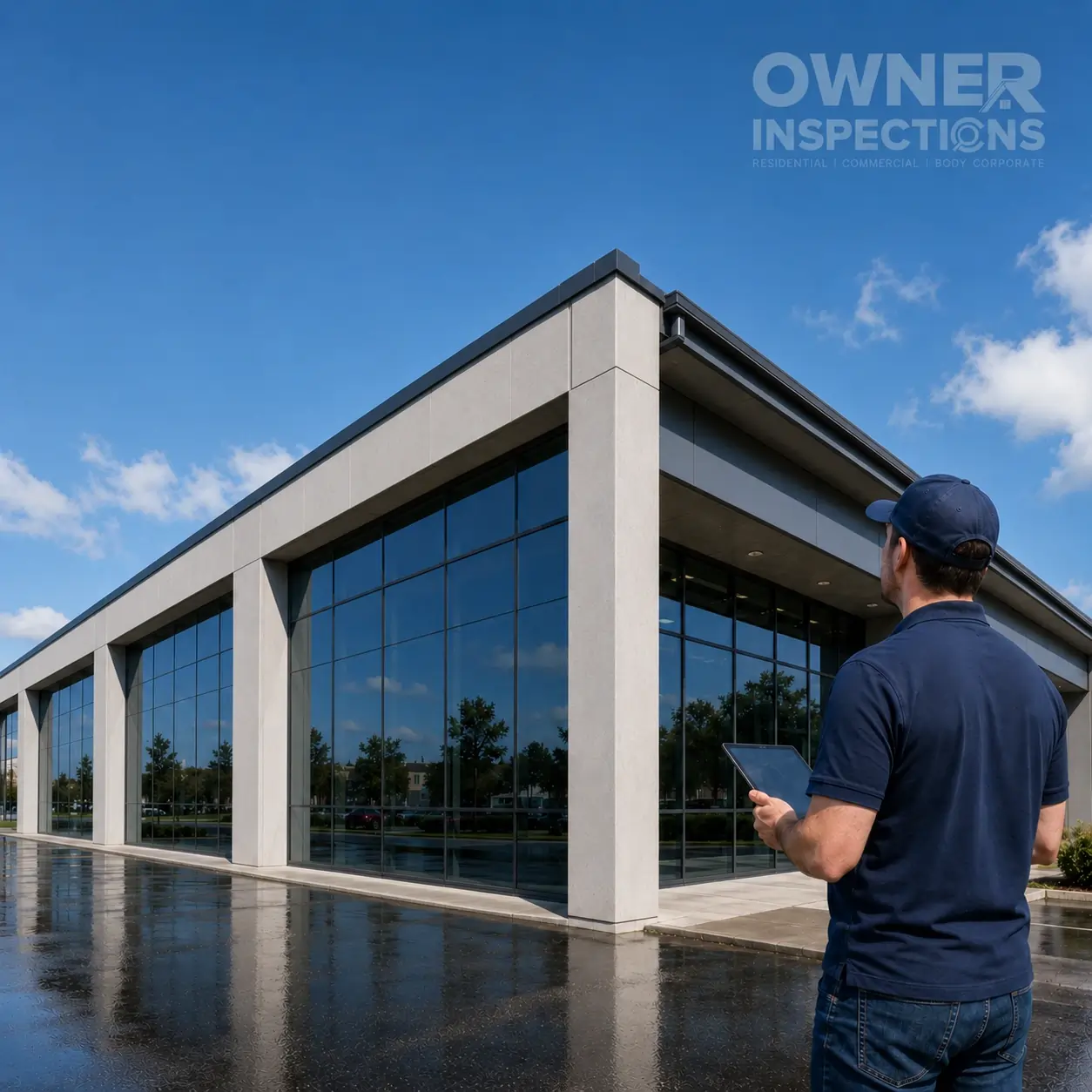
An independent commercial building inspection establishes condition, defects and remediation cost in writing, so a problem becomes a priced item in the negotiation rather than a reason the deal collapses at week six.
Property Inspection
What Is the Process for Guiding a Client to a Commercial Purchase?
Guiding a client to a commercial purchase runs from clarifying their objective, through shortlisting, independent inspection and adviser coordination, to offer, finance approval and post-settlement handover. Finance is scoped at the first step, not the last, because valuation shortfalls and slow credit are among the most common late-stage killers.
Behaviour and first impressions are one thing. Actually moving a client to a completed purchase is a different skill set, spanning legal, financial and regulatory ground.
Clarify the client's objectives
Understand what they want the asset to do: owner-occupation, passive yield, land banking, or repositioning. Everything downstream depends on this.
Identify suitable properties
From your portfolio, put forward the best-aligned asset rather than the one you most need to move.
Arrange inspections
Present the property well, and separately arrange the independent technical inspection. These are two different exercises and conflating them costs deals.
Coordinate legal and financial advisers
Bring in solicitors, accountants, finance brokers, lenders and tax advisers early. These professionals prepare the documents that get the deal in order.
Talk with the client
Present the property and the findings together, including what the inspection found.
Prepare and negotiate the offer
Build the quote and negotiate, using costed defects as a legitimate lever rather than a surprise.
Manage finance approval
Work with the lender and structure the facility to the client's capacity. Valuation shortfalls and slow credit approval are two of the most common late-stage killers, which is why finance should be scoped at step one, not step seven.
Oversee the transition
After settlement, assist with handover, tenant novation and building records so the client becomes the fully informed owner, and so the relationship survives the transaction.

Why Do Commercial Deals Fall Over Late?
Commercial deals fall over late because of undisclosed defects found in the buyer's own due diligence, valuations that land under the contract price, leases that do not match the rent roll, compliance surprises such as cladding and essential safety measures, and use rights that do not support the plan. Every one of these is findable before exchange.
Late-stage collapse is expensive for everyone, and the causes are repetitive:
- Undisclosed defects found during the buyer's own due diligence. The single most common cause, and the most preventable. It costs the vendor twice: once on price, once on credibility.
- Valuation coming in under the contract price, which reopens the finance structure at the worst possible moment.
- Lease documentation that does not match the rent roll, so the income the buyer underwrote turns out not to exist on those terms.
- Compliance surprises, particularly essential safety measures and cladding, which convert into six-figure capital items overnight.
- Use rights that do not support the client's plan, discovered after exchange rather than before.
Frequently Asked Questions
Do commercial property buyers in Australia get a cooling-off period?
Does a commercial property need a building inspection, or is that only a residential thing?
Who pays for due diligence on a commercial acquisition?
What has to be disclosed to a commercial buyer?
How long does commercial due diligence usually take?
Related Articles
What Hidden Commercial Building Defects Do Inspections Miss?
Hidden commercial defects sit behind clean finishes, roof spaces and exterior surfaces. Understand the risk before small issues become major repair costs.
Insurance Inspection for Commercial Buildings: Affecting Premium
How an insurance inspection of a commercial building is conducted and how its findings affect the premium you pay.

Fact Witness vs Expert Witness: What Property Owners Need to Know
Fact witnesses describe what they observed while expert witnesses provide professional analysis. When to use each in Australian proceedings.