
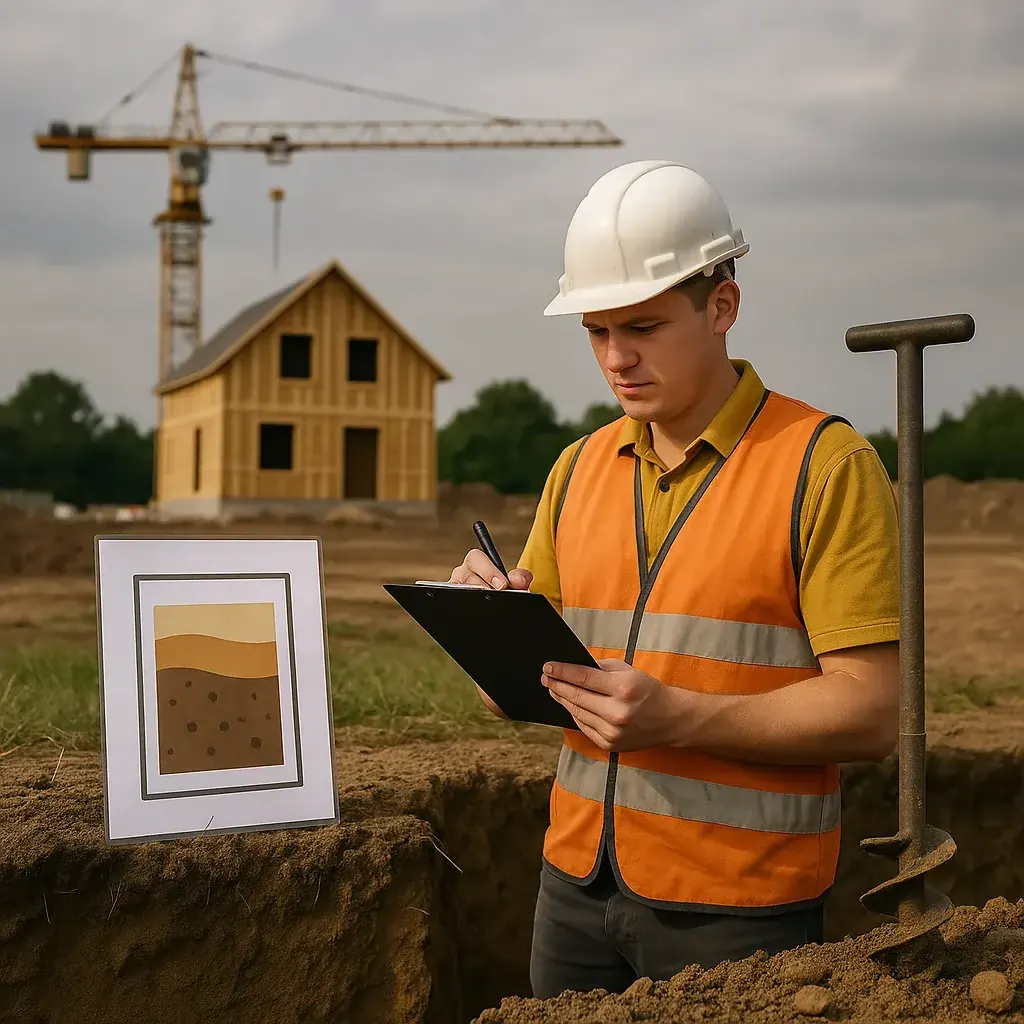
Soil testing for construction checks the ground conditions on a building site so engineers can design footings and slabs that suit the actual soil. In Australia, site classification and footing design are closely linked to AS 2870 Residential slabs and footings, which sets requirements for classifying a site and designing footing systems for single dwellings.
A soil test can show whether the site has reactive clay, fill, soft ground, drainage risks, high moisture variation, or other conditions that may affect the build. The Victorian Building Authority says a soil test classifies how reactive the soil is and helps determine how much the soil may shrink and swell with moisture changes.
Need Defects Properly Documented?
If cracking, leaks, waterproofing failures or incomplete work may become a formal claim, start with an independent defect investigation report that records the visible issues clearly.
Investigation
Quick Answers About Soil Testing for Construction
| Question | Short Answer |
|---|---|
| What is soil testing in construction? | It is the assessment of ground conditions so engineers can design suitable footings, slabs, and site works. |
| Do I need a soil test before building? | For most new homes and many extensions, a site classification or geotechnical report is requested by the builder, engineer, certifier, or council. |
| How much does a soil test cost? | Published Australian provider prices vary, but many standard residential soil tests or site classifications sit in the few-hundred-dollar to low-thousand-dollar range, depending on site conditions. |
| Is a soil test required for a building permit? | Requirements vary, but permit pathways may require an AS 2870 site classification report. Queensland plumbing and drainage permit documents, for example, can require a site classification report complying with AS 2870. |
| What does a soil test report include? | It usually includes site classification, soil profile notes, borehole information, soil reactivity, moisture and plasticity data, and recommendations for engineering design. |
What is Soil Testing in Construction?
Soil testing in construction is the process of checking the soil and ground conditions where a building will sit. It helps confirm whether the soil can support the proposed structure and what footing or slab design may be needed.
For residential projects, this usually leads to a soil test report, soil site classification report, or geotechnical report. A soil site classification report is often prepared under AS 2870 and gives the site class used by engineers, designers, builders, and owners for planning and footing design.
Three standards often appear in soil testing for building construction:
| Standard | What It Covers | Why It Matters |
|---|---|---|
| AS 2870 | Site classification and footing systems for single dwelling houses | Helps guide slab and footing design for residential sites. (Standards Store) |
| AS 1289 | Methods of testing soils for engineering purposes | Covers soil testing methods, including moisture, compaction, density, bearing, and classification tests. (Standards Store) |
| AS 1726 | Geotechnical site investigations | Provides requirements for geotechnical investigations and soil, rock, and groundwater descriptions. (Standards Store) |
A simple way to understand it is this:
- AS 1726 guides how the ground is investigated
- AS 1289 covers many test methods
- AS 2870 links site classification to residential footing and slab design
A geotechnical report produced from these tests is typically required by your local council or private certifier before construction approval is granted. The report answers three key questions:
- Will the soil support the weight of the proposed building?
- How will the soil behave during wet and dry conditions (particularly with reactive clays)?
- Is there contamination that could pose a health or environmental risk?
Why Pre-Construction Soil Testing Matters Before You Build
Pre-construction soil testing helps builders, designers, engineers, and homeowners avoid guessing what is below the surface.
Reactive clay is one of the biggest concerns for residential construction. The VBA explains that the more reactive the soil is, the greater the possibility of excessive footing movement, and excessive moisture changes around a home can cause footings to move and damage the building.
Soil testing helps answer practical questions before work starts:
- Can the soil support the proposed home or extension?
- Is the site affected by reactive clay, fill, soft soils, or slope issues?
- Will the footing system need deeper beams, piers, stiffer slabs, or special drainage?
- Is the site class A, S, M, H1, H2, E, or P?
- Are there signs that extra geotechnical soil testing may be needed?
This is why soil testing for building a house should happen early, not after excavation starts. When the soil report is delayed, the design, engineering, permit, and construction program can also be delayed.
Got Your Soil Report? Check the Build Before Work Gets Covered
Owner Inspections does not perform soil testing. However, our construction stage inspections can help check visible building work against approved plans, engineering details, and accepted construction standards during key stages such as slab pre-pour, frame, lock-up, fixing, and handover.
Stage Inspections
Do You Need a Soil Test for a Building Permit?
Many people search for soil test for building permit, soil test building permit, and building permit soil test because they want to know whether it is optional.
The safe answer is: check with your builder, structural engineer, private certifier, building surveyor, or local council before lodging documents.
Requirements vary by state, council, building type, and permit pathway. In Queensland, for example, plumbing and drainage permit documentation for certain buildings can require a site classification report complying with AS 2870, and H, E, or P sites may need extra sanitary drainage articulation design.
A site classification report can also help the structural engineer design the footings. The VBA says once the soil has been classified, the designer or engineer designs the house footings so they can cope with the soil classification and likely movement.
Soil Testing is Often a Requirement, Not an Optional Extra
Soil testing supports three things buyers, owners, and builders care about.
Compliance and approvals The NCC requires site classification in accordance with AS 2870 for footings. Some councils and permit pathways also state that a soil report is required for building permits in their area, particularly for houses, extensions, garages, and structural changes.
In Queensland, even plumbing and drainage permit documentation can require an AS 2870 site classification report, and extra drainage design detail if the site is H, E or P.
Foundation design that matches the ground Soil class influences whether a standard slab works or whether the design needs stiffer beams, deeper edge footings, piers, bored piers, screw piles, drainage controls, or other engineering measures.
Fewer surprises during construction A proper report can flag fill, soft ground, groundwater, slope instability, aggressive soils for concrete, and drainage risks early, when changes are cheaper.
Black soils in Queensland swell and shrink significantly with moisture changes, requiring specific foundation solutions. Sandy soils in Western Australia may need compaction or stabilisation. Each soil type demands a different engineering approach, and the soil test tells you which one.
Soil Test Report for Construction: What Should It Include?
A soil test report for construction gives the engineer and builder information about the ground below the proposed building area.
A soil site classification report normally provides a site classification to AS 2870 and contains information for planning, designing, costing, constructing, and maintaining footings, but it is not the same thing as a footing design.
A useful soil report for construction may include:
| Report Item | Why It Matters |
|---|---|
| Site classification | Gives the engineer a starting point for slab and footing design. |
| Borehole logs | Show the soil layers found during drilling or probing. |
| Moisture and plasticity data | Helps assess how soil may shrink or swell. |
| Compaction or density information | Helps assess fill, earthworks, and preparation needs. |
| Bearing information | Helps engineers understand support conditions. |
| Groundwater notes | Helps with drainage, excavation, and construction planning. |
| Problem-site flags | Fill, soft soil, slope instability, abnormal moisture, or previous site disturbance may lead to Class P. |
| Recommendations | Helps the engineer, designer, and builder plan the next steps. |
NATA’s accreditation scope examples show soil testing can include soil classification, moisture content, sieve analysis, linear shrinkage, compaction characteristics, field density, bearing properties, pH, and permeability testing under AS 1289 and related methods.
Key Soil Tests and What They Reveal
| Purpose | Application | |
|---|---|---|
| Standard Penetration Test (SPT) | Measures soil resistance and bearing capacity | Determines foundation strength and depth recommendations |
| Cone Penetration Test (CPT) | Evaluates soil stratification without drilling | Used in soft soils and for deep foundation assessment |
| Atterberg Limits | Determines plasticity and shrink/swell potential | Particularly important for reactive clay soils |
| Moisture Content | Shows water content in the soil | Influences stability predictions, especially in wet/dry climates |
| Permeability Test | Assesses how water flows through the soil | Important for drainage design and site planning |
| Compaction Test | Determines optimum moisture for soil densification | Guides site preparation and backfilling operations |
| pH and Contamination Testing | Detects chemical suitability and hazards | Required for former industrial or agricultural sites |
Soil Testing vs Geotechnical Report vs Compaction Test
These terms are often used together, but they do not always mean the same thing.
| Term | What It Usually Means |
|---|---|
| Soil testing | Broad term for field and lab testing of ground conditions. |
| Soil test report | Often used for residential site classification or soil report. |
| Geotechnical report | Broader report that may include subsurface conditions, groundwater, slope, excavation, retaining, and foundation advice. |
| Site classification report | Report that classifies the site under AS 2870 for residential footing design. |
| Compaction test | Test used to assess density or compaction, often for fill or earthworks. |
NATA’s soil testing laboratory scope includes dry density and moisture relationship tests, field density, compaction control, and other AS 1289 methods, which shows why a compaction test is different from a general soil report.
Unsure if the Defect Falls Under Warranty?
Learn how construction warranty defect reports help document faults, clarify builder obligations and support stronger evidence before the matter escalates.
Defect Guide
The Problems Soil Testing Helps Prevent
Skipping soil testing does not guarantee failure, but it increases the chance of choosing the wrong footing system or missing conditions that need extra design work.
Common issues tied to ground conditions include:
- Slab heave or settlement that shows up as cracking
- Uneven floors or doors that start sticking
- Drainage and water management problems that keep feeding moisture changes under the slab
- Extra costs when fill or poor soils are discovered after work starts
A useful reminder is that soil testing is only part of the story. The Victorian Building Authority investigated slab heave in Melbourne’s west and found the key issues were linked to stormwater drainage deficiencies, even where geotechnical investigation and slab designs met the regulatory process.
Site Classification: What A, S, M, H1, H2, E and P Mean
Most homeowners first notice the site class when the report arrives.
The VBA lists common reactivity levels from A for non-reactive through S, M, H1, H2 and E, with higher reactivity linked to greater possible movement.
| Site Class | General Meaning | What It Can Mean for the Build |
|---|---|---|
| A | Non-reactive or very stable ground | Lower expected movement from moisture changes. |
| S | Slightly reactive | Slight movement may be expected. |
| M | Moderately reactive | Footings need to allow for moderate ground movement. |
| H1 | Highly reactive | Higher movement risk and more careful footing design. |
| H2 | Very highly reactive | Stronger design and drainage control may be needed. |
| E | Extremely reactive | High level of engineering care needed. |
| P | Problem site | Site-specific engineering is needed because of fill, soft soil, abnormal moisture, slope, trees, or other constraints. |
A Class P result does not mean the site cannot be built on. It means the site does not fit the normal classes and needs project-specific engineering judgement. McClellands states that Class P can relate to fill, abnormal moisture, vegetation, services, former buildings, drainage problems, slope instability, soft soils, or collapsing soils.
Risks of Skipping Soil Testing
The consequences of bypassing soil testing are real and well-documented across Australian construction.
- Poor foundation design: Without knowing the soil type, the wrong foundation may be laid, resulting in slab heave, structural movement, or complete failure
- Permit delays: Councils in VIC, NSW, and QLD often mandate soil reports before issuing building approvals. A missing report can stall your entire project
- Long-term damage: Soil movement can cause visible cracks in walls, uneven floors, doors and windows that no longer close properly, and in extreme cases, tilting structures
A residential build in western Sydney experienced slab cracking within 12 months due to reactive clay soils that were not properly assessed. The repair cost exceeded $40,000, a problem that could have been avoided with a $600 soil test before construction began.
Building on Reactive or Problem Soil?
A geotechnical report tells your engineer what foundation design may be needed. An independent construction stage inspection helps check the visible work during the build, including reinforcement placement, vapour barriers, slab penetrations, drainage set-up, and other stage-specific items before they are covered.
Inspection
Costs and Long-Term Value
$300 to $900
Typical cost of residential soil testing in Australia
$10,000+
Common structural repair cost when soil conditions are not assessed
Up to 80%
Of structural problems in Australian homes linked to soil conditions (CSIRO)
The return on investment from soil testing is significant:
- Avoids structural repair costs that commonly exceed $10,000
- Increases property value through proper compliance and documentation
- Reduces home insurance risks by demonstrating that foundations were designed for the specific soil conditions
According to CSIRO research, soil-related damage contributes to millions of dollars in property loss annually across Australia. A small investment upfront protects your largest asset for its entire lifespan.
Soil Testing Cost in Australia: What Affects the Price?
There is no single national price because each site is different. Published Australian provider prices show that simple residential site classifications may start in the hundreds of dollars, while broader geotechnical reports can cost more when extra boreholes, deeper testing, density tests, salinity, slope stability, or acid sulfate soil assessments are needed.
| Cost Driver | Why It Changes the Price |
|---|---|
| Number of boreholes | More boreholes mean more fieldwork and more lab testing. |
| Borehole depth | Deeper testing takes longer and may need different equipment. |
| Site access | Tight, steep, or blocked sites can increase fieldwork time. |
| Soil type | Reactive clay, fill, soft soil, or groundwater can require extra checks. |
| Report type | A basic site classification is usually simpler than a detailed geotechnical report. |
| Council or DA conditions | Salinity, slope stability, acid sulfate soil, or contamination checks can add scope. |
| Turnaround time | Priority reporting may cost more. |
Typical timeframes
Some providers describe a timeline where lab testing and report preparation can take several business days after the site work, with total turnaround often around a week, depending on site and workload.
The final soil test cost depends on site access, borehole depth, number of tests, location, and the type of report required. Pre construction soil testing cost is usually lower for simple residential blocks and higher for complex sites that need deeper investigation, compaction checks, or a full geotechnical report.
Who Performs Soil Testing?
Soil testing is carried out by geotechnical engineers (or geotechnical consultants) working with specialised drilling contractors and NATA-accredited laboratories. They collect samples on-site, run field tests, and complete laboratory testing to classify the soil and confirm its bearing capacity, reactivity, and contamination risks.
A proper geotechnical report typically includes:
- Soil classification and site investigation notes
- Recommended footing and foundation systems based on the engineer's assessment
- Test results such as SPT/CPT data where relevant
- Moisture, compaction, and plasticity information for slab and footing design
Soil Test Before Buying Land: When Should You Book It?
A soil test before buying land can be useful when the site has signs of fill, steep slope, drainage issues, nearby cracking, large trees, old structures, or known reactive soil in the area.
NSW Government advises buyers to inspect a property carefully before buying and look for defects, structural problems, damp, cracking, drainage issues, and other warning signs.
For vacant land, a soil test can help you understand possible footing costs before you commit to a design. It may also help reveal whether the site needs extra engineering, drainage planning, retaining walls, or further geotechnical investigation.
Book the soil test before these milestones:
How Long Does a Soil Test Take for Building?
Timeframes vary by provider, weather, access, lab workload, and report scope. McClellands states that most soil site classification reports are aimed for issue within 8 to 10 business days after acceptance, with shorter turnaround sometimes available.
A basic process usually looks like this:
| Step | What Happens |
|---|---|
| Booking | The provider confirms address, access, scope, and building type. |
| Site work | Boreholes, probing, sampling, or field tests are carried out. |
| Lab testing | Samples may be tested for moisture, plasticity, shrinkage, compaction, pH, or other properties. |
| Engineering review | The geotechnical professional reviews the results. |
| Report issue | The soil report or site classification is sent to the client, builder, designer, or engineer. |
What to Do After You Receive Your Soil Report
A soil report is only useful if the right people use it.
Give the report to your structural engineer, designer, builder, and certifier or building surveyor. The VBA says the designer or engineer uses the soil classification to design footings that suit the soil and likely movement.
Ask these questions before work starts:
- Has the footing design been prepared using the soil report?
- Does the building permit match the engineering drawings?
- Is the builder aware of site class H, E, or P conditions?
- Has drainage been designed to move water away from the slab and footings?
- Are slab penetrations, vapour barriers, reinforcement, and set-out ready for inspection before the concrete pour?
Moisture changes around foundation soil can contribute to cracking of walls and floors, so drainage and site maintenance should be taken seriously after construction.
Where Owner Inspections Fits In After Soil Testing
Owner Inspections does not perform soil testing or prepare geotechnical reports. That work should be handled by a qualified geotechnical engineer, consultant, or testing provider. Instead, we help clients make informed decisions by:
- Encouraging clients to confirm soil report requirements with their builder, certifier, structural engineer, or geotechnical consultant.
- Helping clients understand how independent building inspections fit in after soil testing, engineering design, and construction documentation are prepared.
- Suggesting that clients engage a qualified geotechnical engineer or consultant where soil testing is required.
- Combining this guidance with construction stage inspections so you understand both the structure and the site risks
Owner Inspections helps once the report, engineering details, and construction documents are ready. Independent building inspections can check visible work during key stages such as slab pre-pour, frame, lock-up, fixing, handover, reinspections, and defect investigations where relevant.
If defects are found, a reinspection can help confirm whether the builder has addressed the listed issues. For concerns that appear after work is complete, a defect investigation report may be more suitable.
Getting the Most Value from Your Home and Building Investment
Soil testing before construction helps set the footing design, highlights site risks early, and supports smoother approvals. It also gives a clearer picture of what the build may need around drainage and moisture control on reactive sites.
Planning a new build or extension? Owner Inspections does not carry out soil testing or foundation design but provides independent building inspections across NSW, Victoria, and Queensland once your project reaches visible construction stages.
Need the Right Inspection After Soil Testing?
Owner Inspections does not carry out soil testing, but we can help with independent building inspections once your project moves into visible construction stages. Explore our inspection services for new builds, pre-purchase properties, defect concerns, reinspections, and handover checks.
Services
Key Takeaways
- Soil testing before construction evaluates bearing capacity, reactivity, moisture content, and contamination under Australian Standard AS 1289.
- Costs range from $300 to $900 for residential sites, a fraction of the $10,000 to $40,000+ repair costs caused by untested soil.
- Poorly understood ground conditions can contribute to slab movement, cracking, drainage issues, and unexpected construction costs. Soil testing helps reduce those risks by giving engineers better information before footing and slab design begins.
- Councils across NSW, VIC, and QLD typically require a geotechnical report before issuing building permits.
- Reactive clay soils, common in Victoria and Queensland, demand specific foundation designs that can only be determined through testing.
- Owner Inspections does not perform soil testing. We provide independent building inspections during visible construction stages after the required reports, plans, and engineering details are prepared.
- Soil testing should be done before buying land, before applying for a building permit, and before any structural changes or extensions.
Need Help Preparing Defect Evidence?
Speak with Owner Inspections about defect investigation reports, expert witness reports or inspection support for a building dispute, insurance matter or legal claim.
Frequently Asked Questions
What is soil testing in construction?
How much does a soil test cost in Australia?
Do I need a soil test for a building permit?
What is included in a soil test report for construction?
What is AS 1289 in soil testing?
How long does a soil test take for building?
Should I get a soil test before buying land?
Does Owner Inspections provide soil testing?
Related Articles
Structural Defect Inspections to Prevent Future Problems
Approximately one in five Australian homes experience structural issues. Learn how structural defect inspections can prevent expensive repairs and ensure safety.
Top Warning Signs of Structural Defects in New Builds
Nearly 70% of newly built Australian homes show major defects. Learn the eight key warning signs of structural issues and how to protect your investment.