
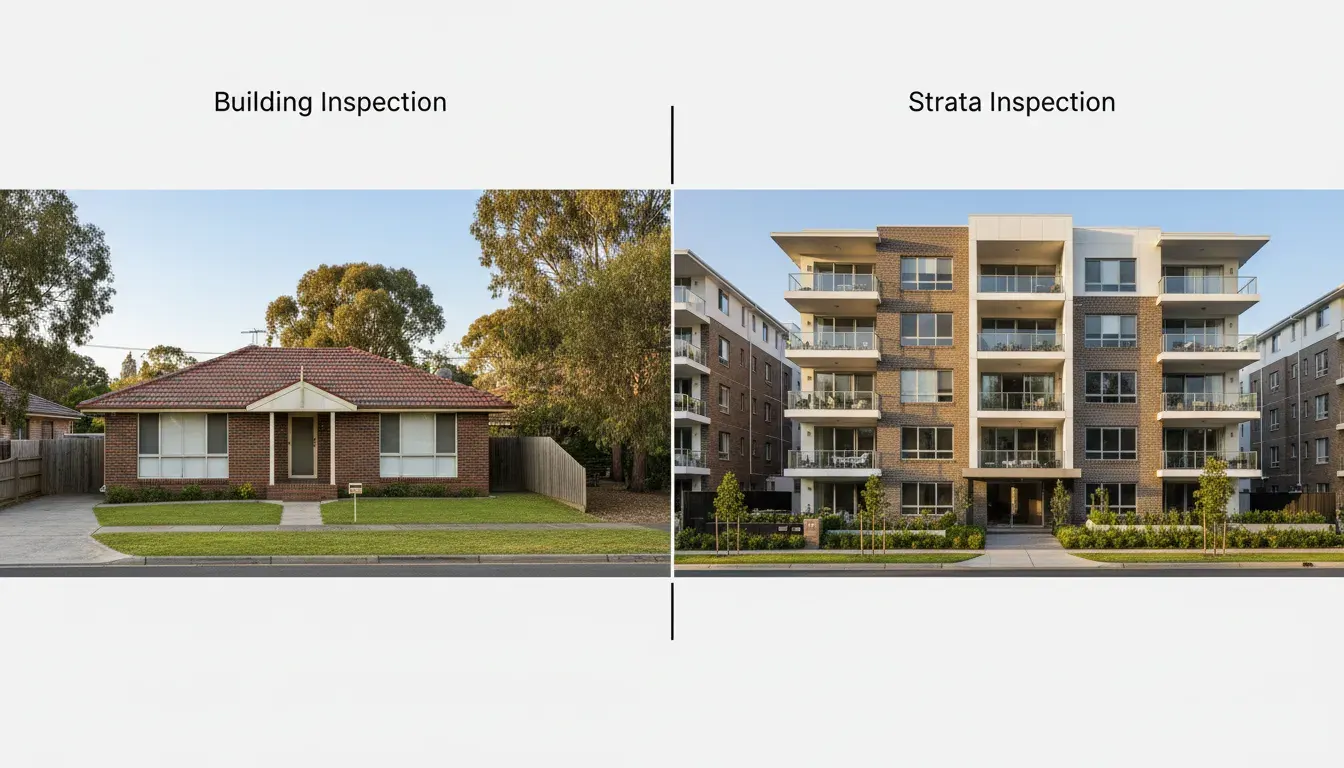
A building inspection is a physical examination of the apartment you are buying, carried out on site by a licensed inspector who looks for defects, water damage and safety hazards inside your lot. A strata inspection is a desktop review of the owners corporation's records, carried out by a strata searcher who reads the financials, meeting minutes and correspondence for the whole building. One tells you the condition of the property. The other tells you the condition of the money and the management behind it. Neither substitutes for the other, and an apartment purchase normally needs both.
The distinction matters because the two most expensive surprises in strata buying sit on opposite sides of it. A failed shower membrane in your bathroom will never appear in a strata search. A $60,000 special levy for facade remediation will never appear in a building report. Buyers who commission one and skip the other are usually protected against exactly half of what can go wrong.
What Is the Difference Between a Strata Report and a Building Inspection?
A building inspection is physical and covers your lot. A strata inspection is documentary and covers the scheme. A building inspector attends the property and reports on what can be seen and accessed. A strata searcher never visits the property and reports on what the owners corporation has written down about the building's finances, disputes, insurance and planned works.
| Aspect | Building inspection | Strata inspection |
|---|---|---|
| Method | Physical examination on site | Document review, no site visit |
| Scope | Your lot and accessible adjacent areas | The whole scheme's records |
| Carried out by | Licensed building inspector | Strata searcher or conveyancer |
| Australian Standard | AS 4349.1 | No equivalent standard |
| Finds | Defects, water damage, movement, safety hazards | Levies, arrears, disputes, planned works, insurance |
| Misses | Anything financial or administrative | Anything physical inside the lot |
| Typical cost | $400 to $700 | $200 to $400 |
| Typical turnaround | 1 to 3 days | 3 to 10 business days |
| Required by law | No, but strongly recommended | The seller's disclosure documents are required in most states |
The last row is the one people misread. In most states the law does not require you to commission a strata inspection. It requires the seller to hand over a defined set of strata documents. Those minimum documents are a starting point, not a search. A full strata inspection goes further, into the meeting minutes and correspondence where the unpleasant news usually lives.
What Is a Building Inspection on a Strata Property?
A building inspection on a strata property is an on site assessment of the individual lot you are purchasing, reported against AS 4349.1. The inspector examines internal walls, ceilings, floors, wet areas, windows, doors and fixtures within your boundaries, plus balconies, courtyards and any accessible common property immediately adjacent to the unit. It identifies defects and safety hazards that are visible and accessible on the day.

Almost everything visible in a photograph like this is common property. Your lot usually stops at the internal face of the boundary walls, floors and ceilings, which is precisely why a unit inspection has a narrower footprint than a house inspection.
The scope limitation is structural to strata, not a shortcoming of the inspector. A building inspector attending your apartment cannot enter other lots, plant rooms, lift motor rooms, roof spaces or locked service risers. They can comment on what they observe of the building envelope from ground level or from your balcony, and a good report will do so, but they cannot certify the condition of a facade or a roof they have no access to.
Important
If the building itself is your concern rather than the unit, that is a different engagement. A building wide condition assessment is normally commissioned by the owners corporation, not by an individual buyer, and its findings should show up in the strata records where a strata search will find them.
What Is a Strata Inspection?
A strata inspection, also called a strata report or a strata search, is a review of the owners corporation's books. The searcher inspects the financial statements, budgets, levy notices, meeting minutes, insurance certificates, by-laws, correspondence and any building reports the scheme holds. The output is a written report on the financial health, maintenance history and legal exposure of the building.
It exists because a strata purchase is really two purchases. You are buying a lot, and you are buying a share of a collective liability. The second one is invisible on inspection day. A building can look immaculate while its capital works fund is empty, a defect claim against the original builder is running, and a special levy has already been foreshadowed in minutes that no marketing brochure will ever mention.
- Financial statements show current levies, arrears, the administrative fund and the capital works fund.
- Meeting minutes show disputes, deferred maintenance, quotes obtained and levies discussed but not yet struck.
- Correspondence shows complaints, insurance claims, notices from council or the regulator, and legal letters.
- The insurance certificate shows whether the building is properly covered and whether the excess has been loaded after repeat claims.
- By-laws show what you can and cannot do with pets, parking, short stay letting and renovations.
- Building reports and capital works plans show what the scheme already knows is coming.
Buying an apartment and need the records read properly?
Our strata reports go past the seller's minimum disclosure into the minutes and correspondence, so you see the levies and disputes before you go unconditional.
Is a Strata Report the Same as a Building Report?
No. A strata report and a building report are different documents produced by different people using different methods, and the words are not interchangeable even though agents sometimes use them loosely. A building report is the written output of a physical inspection of a property. A strata report is the written output of a records search on an owners corporation.
The confusion is worth taking seriously because it costs money. Buyers regularly tell us they "already have the report", meaning the strata report the agent circulated, and assume the unit has been inspected. It has not. Nobody has looked at the shower, the balcony door seal, the ceiling above the bathroom or the windows. Equally, buyers who order a building inspection sometimes believe it will surface levies, because it is the more expensive of the two. It will not.
One quick test
Ask whether anyone physically attended the property. If the answer is no, you have a strata report. If the answer is yes but nobody read the minutes, you have a building report. If you want protection on both fronts, you need both answers to be yes.
What Does Each Inspection Actually Cover?
A building inspection covers the physical fabric of your lot in four zones: internal areas, external areas attached to the lot, roof and ceiling space where accessible, and subfloor where accessible. A strata inspection covers seven document categories, none of which describe physical condition inside your unit.
Building inspection inclusions
Internal areas
Walls, ceilings, floors, doors, windows, wet areas and fixtures within your lot. The inspector checks for cracking, water damage, movement, mould and non compliant work.
External areas attached to the lot
Balconies, courtyards, balustrades and the external face of your unit where it can be reached safely. Balcony waterproofing and drainage are common failure points.
Roof and ceiling space
Where your unit has direct roof access, which in practice means top floor lots and townhouse style schemes, the inspector examines roofing, insulation and structural timbers.
Subfloor areas
Ground floor lots with subfloor access are checked for moisture, ventilation and structural condition.
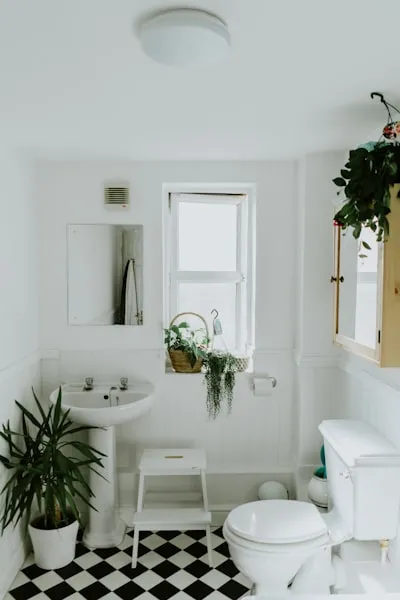
Wet areas do more damage in strata than anywhere else, because a failed membrane on level six leaks into level five and turns a private repair into a dispute between two lot owners and the owners corporation. This is the single most valuable thing a physical inspection buys you in an apartment.
Strata inspection inclusions
| Document category | What it reveals |
|---|---|
| Financial statements | Current levies, arrears, administrative and capital works fund balances |
| Meeting minutes | Disputes, deferred maintenance, planned works, levies under discussion |
| Correspondence | Complaints, notices, insurance claims, legal matters |
| Insurance certificate | Coverage, excesses, claims history and any exclusions |
| By-laws | Rules on renovations, pets, parking and short stay letting |
| Building and engineering reports | Known defects, remediation scopes and capital works plans |
| Levy and special levy notices | Amounts already struck and major expenses on the horizon |
Do You Need Both Inspections?
For almost every apartment, unit or townhouse purchase, yes. The two reports answer different questions and the gap between them is where losses happen. The only common exception is a survey strata lot in Western Australia with no common property and no shared building, where there may be very little scheme to search.
There is one order that works better than the other. Get the strata search moving first, because it depends on a third party responding and can take up to ten business days, then book the building inspection, which is normally available within a few days. Buyers who do it the other way round routinely run out of cooling off period waiting on a strata manager.
What Do They Cost and How Long Do They Take?
A building inspection on an apartment typically costs $400 to $700 and is delivered within one to three days of the site visit. A strata inspection typically costs $200 to $400 and takes three to ten business days, because the searcher depends on the strata manager granting access to records. Combined, you are looking at roughly $600 to $1,100 to cover both sides of a purchase worth several hundred thousand dollars or more.
$400-700
Building Inspection
$200-400
Strata Inspection
3-10 days
Strata Report Turnaround
The strata timeframe is the one that breaks contracts. Access to records is a statutory right rather than a favour, but it still runs on the strata manager's queue, and some managers charge for urgency. If your contract has a short cooling off period, order the search on the day you sign, not the day you get around to it.
What Are the Rules in Each State?
Every state requires a seller of a strata lot to disclose certain scheme documents, and every state gives an interested person a right to inspect the records for a fee. What differs is which document, which form and how much of the picture it contains. In no state does the mandatory disclosure amount to a full strata search.

Assessments like this one are commissioned by the owners corporation, not by an individual buyer. Their findings sit in the scheme's records, which is why a strata search is often how a buyer first learns that the building has a known defect.
| State | Key disclosure document | What to know |
|---|---|---|
| NSW | Section 184 certificate under the Strata Schemes Management Act 2015 | Sections 182 and 183 also give an interested person the right to inspect the records for a fee. From 1 April 2026 the certificate must also disclose embedded network utility arrangements, orders and compliance action against the owners corporation, and meetings held in the past year or coming up. |
| QLD | Form 2 seller disclosure statement plus a body corporate certificate | Since 1 August 2025 the Property Law Act 2023 requires the seller to give the buyer a Form 2 before the contract is signed, with a Form 33 body corporate certificate attached (Form 34 for two lot schemes). The body corporate must allow an inspection of records within 7 days of a written request and payment of the fee, with copies at 70 cents a page. |
| VIC | Owners corporation certificate under the Owners Corporations Act 2006 | The certificate must be attached to the section 32 vendor statement. It shows fees, the maintenance plan status, insurance and any current proceedings. |
| WA | Strata company disclosure under the Strata Titles Act 1985 | Note the built strata versus survey strata distinction below, because it changes how much scheme there is to search at all. |
| SA | Vendor's Form 1 statement | Strata and community corporation details are disclosed through the Form 1 rather than a separate strata certificate. |
| ACT | Units plan documents under the Unit Titles (Management) Act 2011 | The owners corporation must provide a section 119 certificate on request. |
Important
The NSW change taking effect on 1 April 2026 is genuinely useful to buyers. Embedded utility networks and unresolved compliance orders were previously things you had to go hunting for in correspondence. If you are buying in NSW after that date, check the certificate actually carries the new fields rather than assuming it does.
What Is the Difference Between Strata and Survey Strata?
Built strata and survey strata are two different forms of subdivision in Western Australia. In a built strata scheme, at least one building is shown on the plan and lot boundaries are defined by reference to that building, usually the internal faces of walls, floors and ceilings. In a survey strata scheme, no buildings are shown on the plan at all, and lot boundaries are surveyed on the ground by a licensed surveyor, much like an ordinary freehold subdivision.
The practical consequences run right through both inspections:
- In a built strata scheme, the building shell is common property, so the strata company is responsible for the roof, the facade and the structure. A building inspection of your lot has a narrow footprint, and the strata search matters enormously.
- In a survey strata scheme, you generally own the whole building on your lot. A building inspection therefore looks much more like a standard house inspection, covering roof, structure and exterior.
- Unit entitlement is calculated differently. Built strata entitlements take account of the capital value of buildings. Survey strata entitlements are based on the unimproved site value and ignore any buildings.
- Survey strata schemes may have little or no common property, which is why some have minimal records and low levies.
The commonly cited disadvantages of survey strata are the flip side of that ownership. There is no strata company maintaining your roof and no collective insurance covering your building, so repairs and building insurance fall to you personally. Some survey strata schemes also have restrictive management statements, and where there is no common property there may be no functioning strata company at all to resolve a dispute with a neighbour.
Can Strata Inspect Your Property?
An owners corporation generally can enter a lot, but only in defined circumstances and usually with notice. The typical grounds are to inspect or carry out work on common property that runs through your lot, such as pipes or wiring, to investigate a defect or a leak affecting other lots, or to comply with a statutory duty. In an emergency, entry without notice is normally permitted.
This is a right of access, not a right of general inspection. An owners corporation cannot decide to walk through your apartment to see how you keep it. Notice periods, permitted purposes and dispute pathways are set by each state's strata legislation, and if a request for entry seems to be going beyond those grounds it is a question for a solicitor or the relevant tribunal rather than for a building inspector.
Where it becomes relevant to buyers is leak investigation. If minutes show repeated access to a lot to chase a leak, that lot has a live problem, and it may be the one you are buying.
Red Flags in a Strata Report
The clearest warning signs are an underfunded capital works fund, a pattern of reactive special levies, high levy arrears, live disputes and an insurance claims history that has loaded the excess. Any one of these can be explained. Two or three together usually mean the scheme is deferring maintenance it cannot afford, and a new owner inherits that.
- A capital works fund well below what the scheme's own maintenance plan says it should hold.
- Special levies raised repeatedly for reactive repairs rather than planned works.
- Levy arrears across a significant share of lots, which shifts the burden onto the owners who do pay.
- Unresolved proceedings, whether owner against owners corporation, or the scheme against the original builder.
- Repeat water ingress claims, especially facade or balcony related, which are the most expensive class of strata defect.
- By-laws that conflict with your plans, such as bans on short stay letting or hard flooring.
- Minutes recording a quote for major works with no levy yet struck to pay for it.
If a strata search turns up a defect claim or a remediation scope, that is usually the point to get a physical assessment of the affected work rather than relying on the paperwork alone. Owner Inspections reports on what is physically there and what it will take to put right. Whether a claim, a levy or a contract term is enforceable is a legal question, and a strata title solicitor should answer it.
Frequently Asked Questions
Can I skip the building inspection if I get a strata inspection?
Is a strata report the same as a building report?
Does a building inspection cover common property?
What is a special levy and how do I find out about one?
How long does a strata inspection take?
Who conducts a strata inspection?
What Australian standard applies to building inspections?
Can strata inspect your property?
What is the difference between strata and survey strata in WA?
Should I get a building inspection on a brand new apartment?
Who pays to fix defects in common property?
Is a strata inspection legally required?
Key Takeaways
- A building inspection is physical and covers your lot. A strata inspection is documentary and covers the scheme
- Neither can find what the other finds, so an apartment purchase normally needs both
- Order the strata search first, since it can take up to ten business days and depends on the strata manager
- Mandatory seller disclosure is a minimum, not a search. The minutes and correspondence hold the expensive news
- From 1 April 2026, NSW section 184 certificates must also disclose embedded utility networks, compliance orders and recent or upcoming meetings
- Since 1 August 2025, Queensland sellers must give a Form 2 with a body corporate certificate before the contract is signed
- In WA, survey strata usually means you own the whole building, which widens the building inspection and shrinks the strata search
- Combined cost is roughly $600 to $1,100, against a liability that can run to tens of thousands per lot
References and Resources
- Section 184 certificate, strata schemes (NSW Government)
- Buying a strata property (NSW Government)
- Accessing body corporate records (Queensland Government)
- Buying a body corporate property (Queensland Government)
- Owners corporation records and certificates (Consumer Affairs Victoria)
- Owners Corporations Act 2006 (Victorian legislation)
- Strata in WA, built strata and survey strata (Landgate)
Related Articles

Pre-Sale Strata Inspection for Apartments and Units
What a strata inspection covers before you list, and how sellers use one to head off buyer objections.
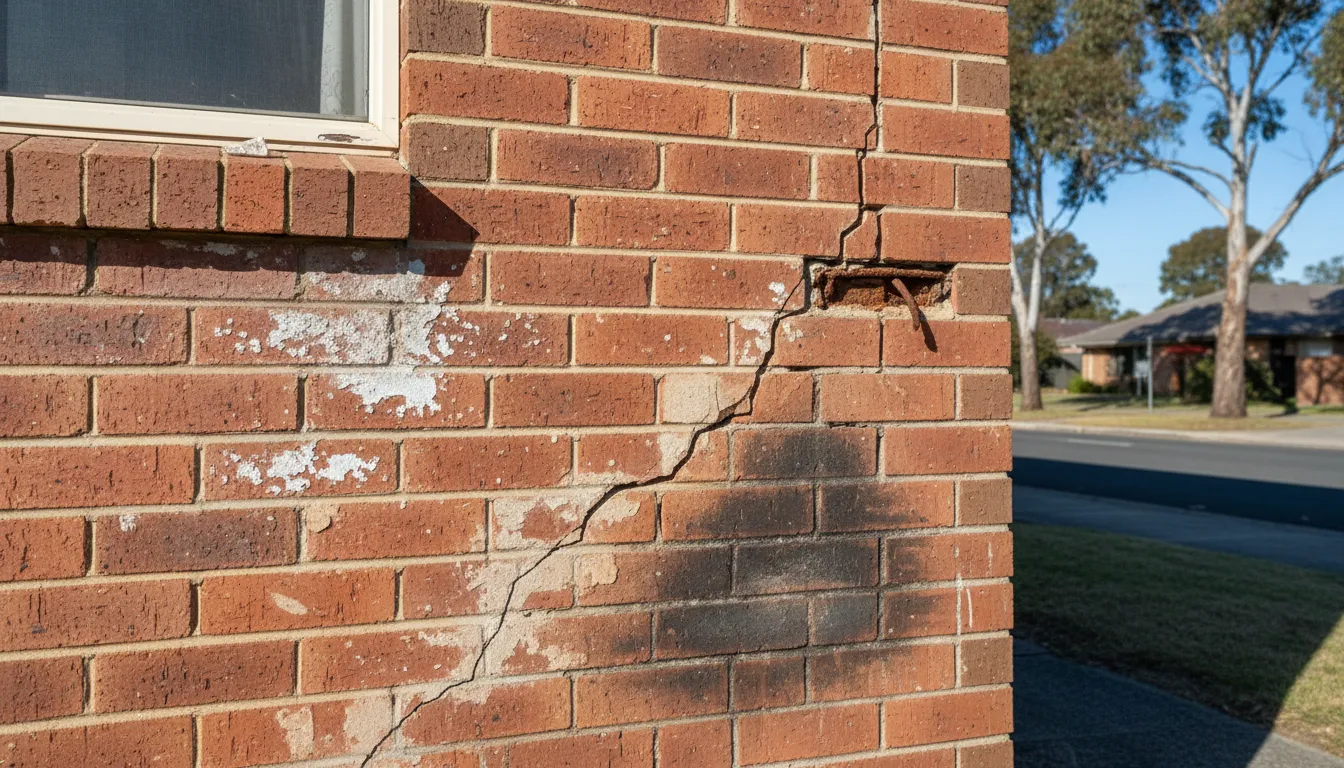
What's the Difference Between Cosmetic Issues and Structural Concerns in Unit Blocks?
How to tell a cosmetic blemish from a structural problem in a unit block, and when to get it assessed.

How to Make a Warranty Claim for Defects in Your Apartment
The steps and evidence needed to claim on statutory warranties when defects appear in a new apartment.