
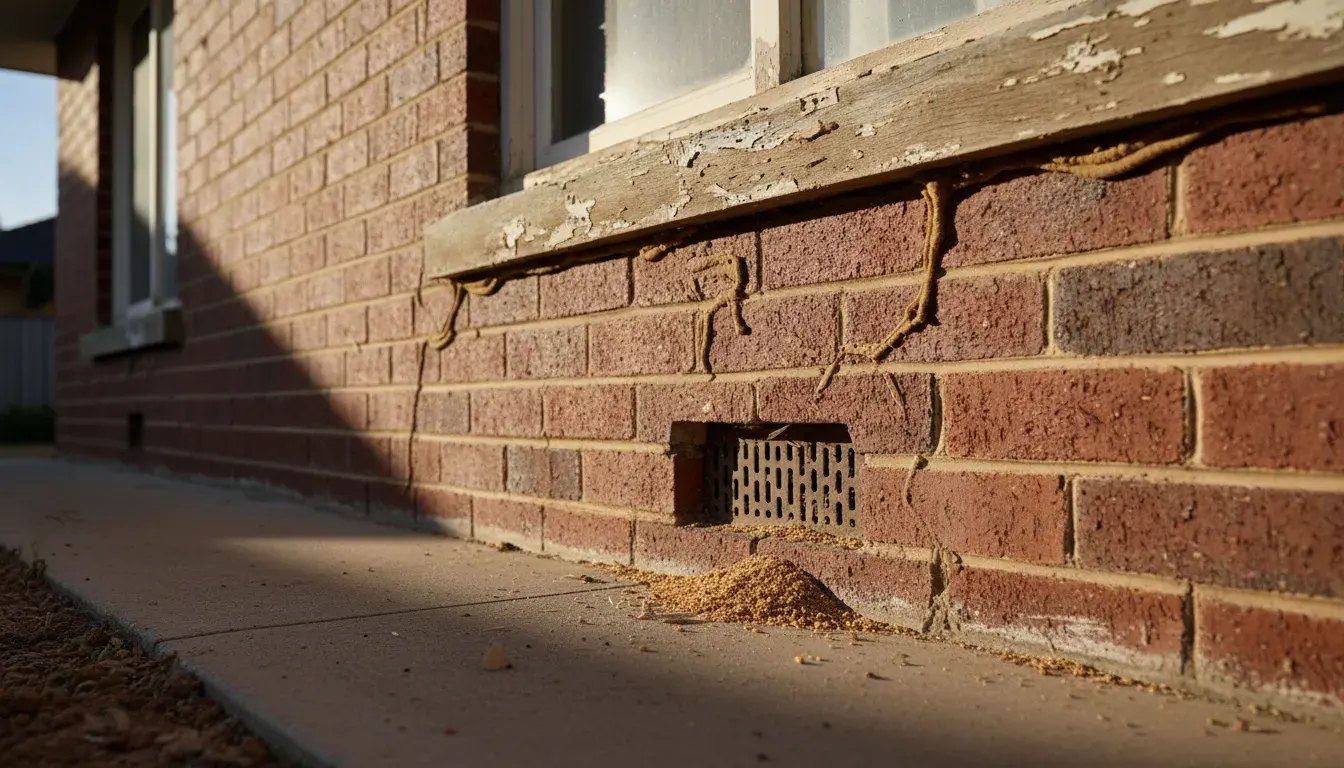
Many homeowners assume that once a treatment is done, the problem is solved. That is not always the case. Termite colonies are large, can number in the millions, and often have multiple entry points into a structure. A failed or incomplete treatment leaves the colony intact and the property at ongoing risk.
Knowing what to look for after treatment is just as important as the treatment itself. The earlier a failure is detected, the less structural damage occurs.
What’s the #1 Sign it Hasn’t Worked?
The clearest sign termite control hasn’t worked is new, fresh termite activity after treatment, like active mudding or live termites in or on the building, especially around entry points or the perimeter.
Top 5 red flags to act on right away:
- New mud tubes or fresh mudding after treatment
- Live termites anywhere in the house, subfloor, or perimeter
- Damage that is still progressing (new hollowing, new crumbling timber)
- Swarmers (alates) indoors more than once, or repeatedly around lights
- You cannot confirm what was installed (no durable notice, no map, no records)
Immediate next action
Do not disturb the area. Take photos, note locations and dates, and organise a professional inspection, ideally an independent timber pest inspection..
$1.5B
Annual termite damage in Australia
1 in 4
Australian homes affected by termites
3 months
Typical post-treatment monitoring window
Signs the Treatment Has Failed
The most reliable indicator of a failed treatment is continued termite activity. Here is what to watch for:
Live Termites or New Mud Tubes
Mud tubes are the highways termites use to travel between the soil and your timber. If new tubes appear after treatment, or existing tubes are rebuilt, the colony is still active. Break open a tube carefully. If you see live, pale insects inside, the treatment has not eliminated the infestation.
Fresh Timber Damage
Timber that sounds hollow when tapped, or surfaces that bow and crack without explanation, suggest active feeding. Run a screwdriver along skirting boards, door frames, and floor joists. If it sinks into soft, damaged wood, termites are still present.
Termite Swarms (Alates) Inside the Home
Winged termites, called alates, emerge when a colony is mature and looking to expand. Swarms appearing inside a treated property after treatment suggest the colony was not fully eradicated or a new one has moved in from a neighbouring source.
Do Not Disturb Active Termites
If you find live termites after treatment, do not spray them with retail insecticide. Disturbing the colony causes it to scatter, making it far harder to locate and treat effectively. Contact your pest controller and arrange a re-inspection immediately.
Barrier Gaps or Chemical Breakdown
Chemical soil barriers have a defined lifespan, typically 8 years for products like Termidor, but this depends on soil type, rainfall, and how well the original application was conducted. If the perimeter was not fully treated or gaps exist around pipes and footings, termites will find the path of least resistance.
Bait Station Inactivity After Initial Activity
If bait stations showed feeding activity and then went quiet without a confirmed dead colony, the termites may have found an alternative food source rather than consuming enough bait to collapse the colony. This is a subtle but important red flag.
How Termite Control is Supposed to Work in Australia
Termite control is not one thing. In Australian homes you’ll usually see one (or a mix) of these approaches.
Chemical systems and reticulation
A chemical soil treatment or external perimeter treatment is designed to reduce the risk of concealed termite entry. In new building work, termite management systems referenced by the NCC are commonly aligned with AS 3660.1 pathways. The NCC also ties chemical use to the relevant pesticides register and label information.
What “success” looks like:
- The chemical zone is continuous where it needs to be.
- Records exist (product used, date, label directions, and expected life).
- The perimeter and inspection zones remain visible and accessible over time.
Reality check:
- Chemicals have a limited effective life, and site conditions matter.
- A chemical system can be defeated if termites find an untreated path or if the system gets bridged.
Baiting systems
Baiting aims to reduce colony pressure by getting termites to feed on bait and share it through the colony. It relies heavily on correct placement, regular monitoring, and adjusting stations based on activity.
What “success” looks like:
- Stations are in place and easy to locate.
- Monitoring is happening on the schedule recommended for that system and risk profile.
- There is a clear service record showing checks, hits, re-baiting, and outcomes.
Reality check:
- Baiting usually takes time and depends on termites finding the stations.
- Missing checks is one of the fastest ways for baiting to underperform.
Physical barriers and termite management systems
Physical systems (like certain meshes or graded stone systems) are designed to force termites into the open or prevent concealed entry. The NCC termite risk management provisions reference compliance pathways using AS 3660.1 or testing under AS 3660.3.
What “success” looks like:
- The barrier is installed correctly and remains intact.
- Inspection zones remain visible so termite activity is forced into view.
Reality check:
- Physical systems still depend on access and visibility. A blocked inspection zone can remove your early warning advantage.
Termite Control Red Flags: The Non-negotiables
These are the signs that should trigger documentation and a professional assessment. Use the symptom and pattern, not just one clue.
| Red flag | Likely meaning | Urgency | Do this next (safe actions) |
|---|---|---|---|
| New mud tubes / fresh mudding after treatment | Active subterranean termites are still foraging, and a path may bypass the treatment zone | High | Photograph, mark location, avoid disturbing, book inspection |
| Live termites (inside or at perimeter) | Active infestation or active entry point | High | Keep people away from the area, document, arrange inspection fast |
| Damage still progressing | Termites may still be feeding, or a second colony is present | High | Document “before/after” areas, avoid repairs until assessed |
| Swarmers indoors repeatedly | Colony is nearby, or there is an internal nesting source | Medium to high | Capture a sample if safe, photograph swarm points, book inspection |
| Fresh frass (pellets) | Possible drywood termite activity, which needs a different control approach | Medium to high | Photograph and collect a small sample in a sealed bag, book inspection |
| Repaired or bypassed tubes near treated zones | Termites are adapting around barriers or finding alternate routes | High | Document, avoid sealing or painting over, get assessed |
| New sticking doors/windows + wavy paint in timber areas | Could be moisture, movement, or termite damage. Needs confirmation | Medium | Note when it started, check moisture sources, book inspection |
| No proof of what was installed (no map, no durable notice, no records) | You cannot verify coverage, life expectancy, or future inspection needs | Medium | Request documents, then organise independent verification |
| Landscaping or renos removed inspection zone or created bridging | Termites can bypass the system unnoticed | Medium to high | Photograph changes, clear access where safe, book inspection |
What Failure Looks Like by Treatment Type
Chemical barrier / reticulation
- Activity concentrated at one side of the house or around penetrations (suggests a gap).
- No documentation of product, date, or expected service life.
- Perimeter levels changed since treatment (paths may now bypass the zone).
Baiting
- Stations not being checked, moved, or recorded.
- New activity far from any station line, with no adjustment to the programmeme.
- “Set and forget” messaging with no monitoring trail.
Physical barriers
- Inspection zones covered by paving, garden beds, cladding, or renovations.
- Attachments (decks, steps, ramps, services) built without maintaining inspection access.
Why Termite Treatments Fail
Treatments fail for several reasons, and not all of them are the pest controller's fault. Understanding the cause helps prevent a repeat.
Pros
- Properly applied chemical barriers last 8 or more years
- Bait systems can eliminate entire colonies when used correctly
- Follow-up inspections catch failure early
Cons
- Incomplete barrier application leaves entry points
- High rainfall can dilute or displace chemical barriers
- New colonies can establish from neighbouring properties
- DIY treatments rarely penetrate deep enough to reach the queen
Common causes include incomplete soil treatment around footings, pipes, or service penetrations; high water tables or clay soils that reduce chemical uptake; and properties where the original infestation was not fully mapped before treatment began.
Annual Inspections Are Not Optional
Australian Standard AS 3660.2 recommends termite inspections at least every 12 months in high-risk areas. After a known infestation, 6-monthly inspections are advisable until the property is confirmed clear.
What to Do Next
If you suspect a treatment has failed, do not wait. The steps below give you a clear path forward.
Step 1: Don’t disturb the evidence
- Keep pets and kids away from the area.
- Avoid spraying household insecticides on the activity.
- Avoid breaking tubes or pulling off skirting boards to “look”.
Step 2: Document what you can see
- Take clear photos and short videos.
- Include a wide shot (shows location) and close-ups (shows detail).
- Note the date, time, and exact location (room, wall, external corner).
- Track whether signs reappear after rain or heat changes.
Step 3: Gather your paperwork fast
Look for these items:
- Treatment type: barrier, reticulation, baiting, physical system.
- Treatment map and site diagram (where coverage was applied).
- Warranty terms and maintenance conditions.
- Chemical product name and registration details (if used).
- Service records for bait station checks and replenishment.
If the home is newer, also check the durable notice, which the NCC requires to state the system type, install date, chemical life expectancy (if chemical), and future inspection scope and frequency recommendations.
Step 4: Book an independent timber pest inspection
If you want clarity, independent timber pest inspection is the cleanest next step because it separates diagnosis from treatment sales.
What to ask for:
- A timber pest inspection and report aligned to AS 4349.3 (minimum requirements for visual inspection and reporting).
- A clear call on active vs past activity.
- Identification of conducive conditions and likely entry points.
- Annotated photos and prioritised next actions.
Step 5: Ask the right questions
Questions to ask your pest controller or verifier:
- What evidence shows activity is active, not historic?
- Where is the most likely entry point, and what makes you think that?
- Does the inspection zone remain intact and visible? If not, what is blocking it?
- What type of system is installed and where is it documented?
- If chemicals were used, what is the product and what does the APVMA label say about use conditions and life expectancy?
- What owner actions could void warranty or reduce system performance?
Costs, Documentation, and Why Speed Matters
Termite issues get expensive when they go undetected.
One widely cited Australian estimate, referenced in an ACCC determination, states 650,000 Australian homes were infested over five years, with the cost of treatment and repair estimated at $3.9 billion.
That same determination also references studies with repair ranges and average costs, showing why prompt detection and good records matter.
Why documentation helps:
- It supports warranty discussions.
- It creates a timeline of activity versus treatment dates.
- It helps an independent inspector identify likely failure points faster.
If you are buying a property where a termite treatment has been carried out, always ask for documentation of the treatment type, date, products used, and warranty. A pre-purchase building and pest inspection will give you an independent view of whether the treatment remains effective.
Frequently Asked Questions
How long after treatment should I see results?
With chemical barriers, activity should cease within 3 to 6 weeks as termites contact the treated zone. Bait systems can take 1 to 3 months to collapse a colony depending on its size.
If significant activity continues beyond these timeframes, contact your pest controller. The absence of visible activity does not always confirm the colony is eliminated, which is why follow-up inspections are important.
Can termites come back after treatment?
Yes. A treatment may eliminate one colony, but new colonies from neighbouring properties can establish over time, particularly once a chemical barrier degrades.
This is why annual inspections are recommended even after a successful treatment. Termite pressure in Australia is persistent, especially in coastal and subtropical regions.
What does a failed termite barrier look like?
You cannot see a chemical barrier directly, but signs of failure include new mud tubes along the foundation, termites entering through areas around pipes or expansion joints, and fresh timber damage near the perimeter.
A licensed inspector using moisture meters and thermal imaging can often identify active termite movement even where physical signs are not yet visible.
Is a pest controller liable if the treatment fails?
Liability depends on the terms of the warranty, whether the treatment was applied according to the product label and Australian Standard AS 3660.1, and whether the homeowner met any maintenance obligations.
If you believe the treatment was deficient, obtain an independent inspection report as evidence. State regulators such as NSW Fair Trading and the QBCC can assist with disputes involving licensed contractors.
How often should I inspect after a termite treatment?
After a confirmed termite infestation, inspections every 6 months are advisable for at least the first two years. After that, annual inspections align with AS 3660.2 recommendations.
High-risk properties, those with previous infestations, significant timber framing, or proximity to bushland, warrant more frequent monitoring regardless of treatment history.
Key Takeaways
- Live termites, new mud tubes, or fresh timber damage after treatment are clear signs the infestation has not been resolved
- Termite swarms inside a treated home indicate the colony is still active or a new one has established
- Common causes of treatment failure include incomplete barrier application, soil type, high rainfall, and missed entry points
- Do not disturb live termites with retail sprays as this scatters the colony and makes re-treatment harder
- An independent timber pest inspection under AS 4349.3 is the most reliable way to confirm whether a treatment has worked
- Most licensed pest controllers offer warranty periods, so notify them in writing if you suspect failure
- Annual inspections remain essential even after a successful treatment, as new colonies can establish over time
References and Resources
Concerned Your Termite Treatment Has Failed?
Book an independent timber pest inspection with Owner Inspections. Our licensed inspectors provide a thorough assessment under AS 4349.3 so you know exactly where you stand.