

An expert witness report is written as evidence for a court or tribunal, and a routine inspection report is written for the person who paid for it. That single difference drives everything else: the expert owes their paramount duty to the tribunal rather than to their client, the report must carry formal declarations and reasoning that the rules of evidence demand, and it costs several times more because the investigation behind it is far deeper. A routine inspection report cannot be reformatted into an expert report after the fact, which is why choosing the wrong one at the start is expensive.
If you are buying, selling or maintaining a property, a routine inspection report is the right document. If you are heading to NCAT, VCAT, QCAT or a court, it is not.
What Is a Routine Inspection Report?
A routine inspection report is a standard building assessment prepared for a private client so they can make a decision about a property. It documents visible defects, safety hazards and maintenance issues in accessible areas, usually in line with AS 4349.1. It is written in plain language for a buyer or owner, not for a tribunal, and it carries no formal evidentiary declarations.
Pre-purchase inspections, defect assessments and periodic maintenance reports all fall into this category. The inspector examines what can be seen and reached on the day, and the report states clearly what was not accessible.
Common types of routine inspection report include:
- Pre-purchase inspections for residential and commercial properties
- Pre-settlement inspections verifying completed construction
- Defect assessment reports documenting building issues
- Periodic maintenance reports for property managers
- Dilapidation reports recording property condition before nearby construction
For a broader overview of what building inspections involve, see our comprehensive guide to house inspections.
What Is an Expert Witness Report?
An expert witness report is a formal document prepared for legal proceedings, giving an independent technical opinion to help a court or tribunal decide a building dispute. Its defining feature is that the expert's paramount duty is owed to the tribunal, not to the party paying the fee. Every opinion must be supported by stated facts, assumptions and reasoning, because the author can be cross-examined on all of it.

An expert report is built from documents as well as site observations. Contract drawings, engineering details, variation records and prior correspondence all inform the opinion, and the report has to show that reasoning rather than assert a conclusion.
Expert witness reports in building disputes typically address:
- Identification and classification of defects against the applicable codes and standards
- Causation analysis explaining why each defect occurred
- Compliance with the National Construction Code, Australian Standards and state regulations
- Quantification of rectification costs with detailed costings
- Whether the work meets an acceptable standard of workmanship
For a deeper look at what separates a persuasive expert report from a weak one, read what makes a strong expert witness report.
A routine inspection report tells you what is wrong with a property. An expert witness report tells a tribunal why it is wrong, who is responsible, what it will cost to fix, and provides the evidence to prove it.
Detailed Comparison Table
The two reports differ on almost every dimension that matters: who they serve, how deep the investigation goes, whether they can be admitted as evidence, and what happens to the author afterwards. The table below sets out the practical differences side by side.
| Aspect | Routine Inspection Report | Expert Witness Report |
|---|---|---|
| Objective | Inform the client about property condition | Assist the court or tribunal in understanding technical matters |
| Audience | Property buyer, seller, or owner | Judge, tribunal member, arbitrator, or mediator |
| Depth of analysis | Visual assessment of accessible areas | Comprehensive investigation including invasive testing where required |
| Legal standing | Limited; not prepared for legal proceedings | Admissible as expert evidence in courts and tribunals |
| Timing | Before purchase, settlement, or as needed | During or in preparation for legal disputes |
| Author requirements | Licensed building inspector | Qualified expert with relevant experience, accepted by the court as an expert |
| Duration to prepare | 1 to 3 business days | 2 to 6 weeks depending on complexity |
| Report format | Standardised template per AS 4349.1 | Structured to comply with court practice directions and rules of evidence |
| Duty owed to | The client who commissioned the report | The court or tribunal, regardless of who engaged the expert |
| Cross-examination | Inspector is not expected to give oral evidence | Expert must be available for cross-examination |
| Methodology disclosure | General description of inspection process | Full disclosure of methodology, qualifications, assumptions, and limitations |
Depth of Investigation
A routine inspection is a visual assessment of accessible areas at a single point in time, with defined limitations for anything concealed or unreachable. An expert investigation goes further: invasive testing, specialist subconsultants, multiple site visits and a review of the construction documentation, because the findings have to survive cross-examination rather than simply inform a purchase.
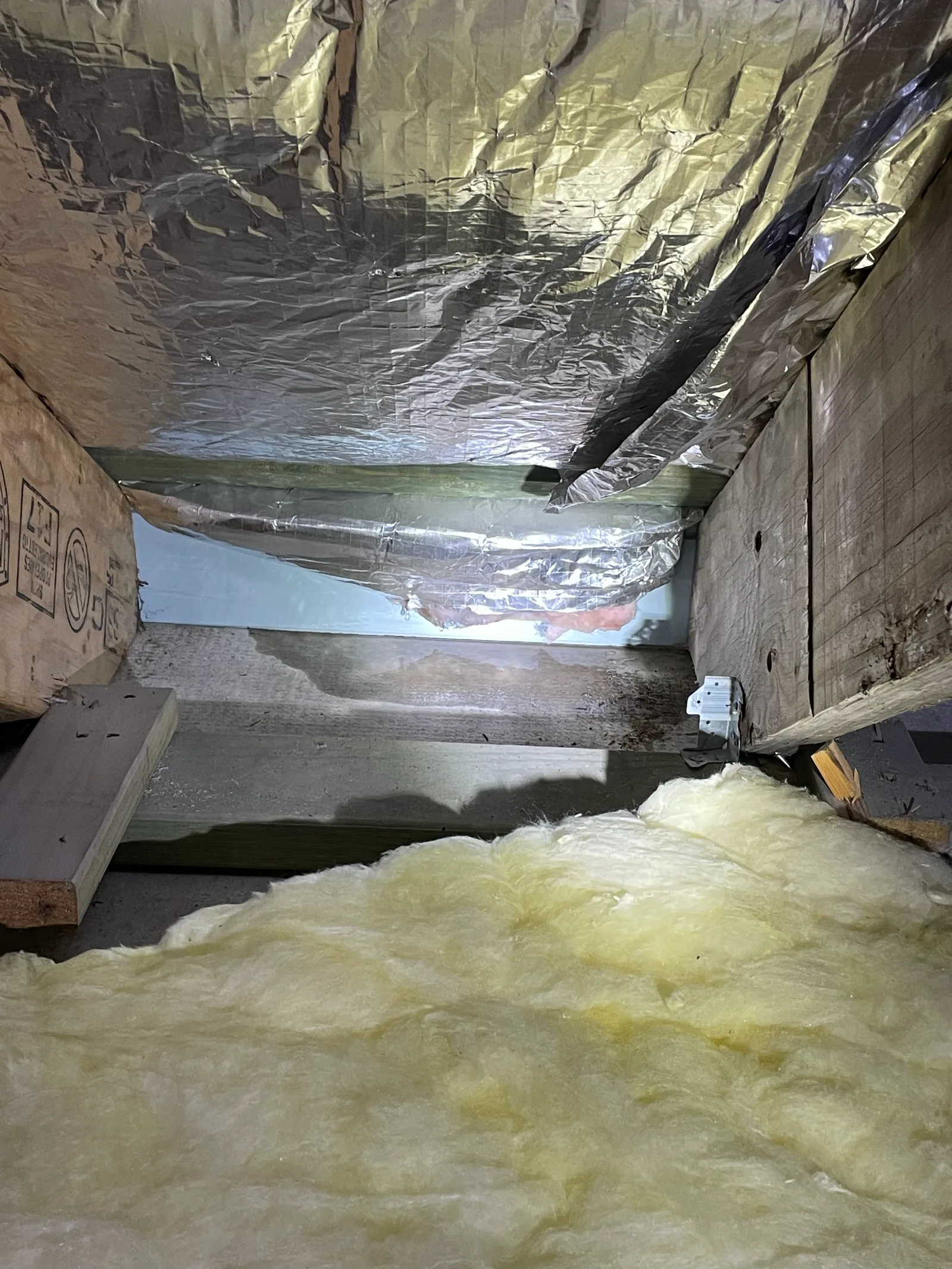
A roof space like this one illustrates the gap. A routine report records that the sarking is displaced and the insulation disturbed. An expert report has to establish when it happened, whether the installation ever complied, which party was responsible for that trade, and what rectification will cost.
What Is the Difference Between Expert Evidence and an Expert Witness?
Expert evidence is the opinion itself, the material a tribunal is asked to accept about a technical matter outside ordinary knowledge. An expert witness is the person who gives it. The distinction matters because evidence can be excluded while the witness remains qualified: if the report fails the formal requirements, the opinion never reaches the decision-maker no matter how competent its author.
This is the trap that catches homeowners who arrive at a hearing with a good inspection report from a genuinely experienced inspector. The inspector is credible. The document is not evidence.
Why a Routine Report Is Not Admissible as Expert Evidence
A routine inspection report is not admissible as expert evidence because it lacks the acknowledgment the rules require. NCAT Procedural Direction 3 obliges any party retaining an expert to bring the experts' code of conduct to that expert's attention, and the report must record that they have read it and agree to be bound. The equivalent rule for NSW courts sits in Schedule 7 of the Uniform Civil Procedure Rules 2005, where a report without that acknowledgment is not validly served and cannot be admitted.
That is a formal requirement, not a matter of quality. Beyond it, routine reports typically also lack:
- A declaration of the expert's paramount duty to the tribunal
- Disclosure of qualifications and experience relevant to the issues in dispute
- Detailed reasoning linking each observation to each conclusion
- Consideration of alternative explanations for the defect
- A statement of assumptions and limitations in the form the rules require
Do Not Rely on Routine Reports in Legal Proceedings
Routine inspection reports are not prepared to meet evidentiary requirements. Submitting one as expert evidence in NCAT, VCAT, QCAT or a court may result in the evidence being rejected or given little weight, which can damage your case before it is heard.
When to Use a Routine Inspection Report?
Use a routine inspection report whenever the purpose is commercial rather than legal: you need to know the condition of a property in order to buy it, sell it, accept a handover or plan maintenance. There is no dispute on foot, nobody is going to cross-examine the inspector, and paying for court-grade evidence would be wasted money.
- Buying a property. A pre-purchase inspection identifies defects and safety issues before you commit.
- Selling a property. A pre-sale inspection lets vendors address issues before listing.
- New construction handover. A pre-settlement inspection checks the builder has completed the work properly.
- Ongoing maintenance. Periodic inspections catch problems before they become expensive.
- Insurance documentation. Recording condition for insurance purposes or after a weather event.
When Do You Need an Expert Witness Report?
You need an expert witness report once a dispute has reached, or is realistically heading to, a tribunal or court. If you have filed at NCAT, VCAT or QCAT, received directions to serve expert evidence, or been told your claim will be defended, a routine report will not carry you. Engage the expert early, because a rushed report is the one that gets picked apart.
Common triggers include:
- Building defect claims against a builder or developer for defective work
- Strata and body corporate disputes over common property defects
- Insurance claim disputes where the insurer and policyholder disagree on cause or extent
- Contractual disputes between builders, subcontractors and clients
- Neighbour disputes involving damage from adjoining construction or tree roots
For guidance on tribunal disputes in NSW, see our article on NCAT building disputes.
Heading to NCAT, VCAT or QCAT?
Our expert witness reports are prepared to the applicable tribunal's practice direction, with the code of conduct acknowledgment, the reasoning and the costings a hearing requires. Tell us about your dispute and we will confirm which report you actually need.
What Do Australian Tribunals Require From an Expert?
Every Australian tribunal requires the same three things: an acknowledgment of the expert's overriding duty to the tribunal, disclosure of the qualifications and experience that make them an expert on the issues, and the facts, assumptions and reasoning behind each opinion. The instrument that imposes them differs by state, and so do the rules on conferring with the other side's expert.

NCAT (New South Wales). Expert evidence is governed by NCAT Procedural Direction 3, which contains the experts' code of conduct. Any party retaining an expert must bring the direction to that expert's attention. Where NCAT appoints its own expert, you cannot call your own or tender another report without leave. See also NCAT's guidance on evidence and witnesses.
VCAT (Victoria). Practice Note PNVCAT2 Expert Evidence applies to any evidence given by an expert witness. The expert must state that they have read it, and the report must be filed and served at least ten business days before the hearing, mediation or compulsory conference at which it is relied on. VCAT also publishes plain-language guidance on expert reports.
QCAT (Queensland). Practice Direction 4 of 2009 governs expert evidence, and QCAT publishes separate guidelines for experts in building disputes. In building matters the experts are usually sent to a conclave, a private meeting chaired by a QCAT member with no parties or lawyers present, after which they file a joint report setting out what they agree on, what they do not, and why.
The conclave is worth understanding before you engage anyone. Your expert will have to defend their opinion to an opposing expert in a room where nobody is there to help them. An opinion that was written to please the client rarely survives it.
Important
Owner Inspections prepares reports, not legal advice. Which tribunal to file in, what to claim and how to run the case are questions for a solicitor. We can tell you what an inspection establishes and put it in the form the tribunal requires.
How Is an Expert Witness Discredited?
An expert is discredited by showing they strayed outside their expertise, argued for the party paying them, relied on assumptions they did not disclose, or reached a conclusion the evidence does not support. Cross-examination rarely attacks the qualifications. It attacks the gap between what the expert observed and what they concluded.
The most common failures in building matters are practical ones:
- Advocacy. An expert who reads as the client's champion has their evidence discounted or excluded, whatever its technical merit.
- Undisclosed assumptions. If a costing assumes full replacement where repair was possible, and the report never says so, the whole figure is in doubt.
- Scope creep. A building consultant opining on structural adequacy without engineering qualifications invites the obvious question.
- Inconsistency with the joint report. Positions taken at a conclave and then abandoned at hearing are damaging.
This is the practical reason the two report types cannot be merged. A routine inspection is not written to be defended, so its shortcuts become liabilities the moment someone tests them.
The Role of Scott Schedules
A Scott Schedule is a table that lists each alleged defect as a numbered item, with columns for the claimant's position, the respondent's position and the expert's assessment. Tribunals commonly direct parties to use one in building disputes so that findings can be made defect by defect rather than on the claim as a whole.
Expert witness reports feed directly into this format. The expert numbers each defect, describes it, states which standard or code it breaches, and estimates rectification cost. Routine inspection reports group findings by location or severity instead, so they need substantial reworking before they fit.
For a detailed guide, see our article on how Scott Schedules strengthen construction dispute cases.
What Does Each Report Cost?
Across the Australian market, routine inspection reports generally fall between $300 and $600, while expert witness reports for building disputes generally start around $1,500 and run to $4,000 or beyond. The gap reflects work, not margin: one is a single site visit and a templated report, the other is a documented investigation whose author may spend a day in a witness box defending it.
$300-600
Routine report, typical market range
$1,500-4,000+
Expert report, typical market range
1-3 days
Routine report turnaround
2-6 weeks
Expert report turnaround
An expert witness fee covers reviewing instructions and background documents, one or more detailed inspections, specialist subconsultants where required, research into the applicable codes, the written report, detailed rectification costings, and availability for conferences, mediations and hearings. Attendance at a hearing is usually charged separately, as is any supplementary or joint report.
Whether the higher cost is justified depends on the amount in dispute. In a defect claim worth tens of thousands, an expert report is a small fraction of the exposure and frequently the thing that produces a settlement, because it gives both sides an independent view of the merits. Commissioning one when no dispute exists is simply an expensive inspection.
Choosing the Right Professional
For a routine inspection, engage a licensed building inspector who works to AS 4349.1 and holds the right licence for your state: NSW Fair Trading in New South Wales, registration as a building practitioner in Victoria, a QBCC licence in Queensland. For an expert report, licensing is the starting point rather than the test, because the tribunal decides whether someone qualifies as an expert on the issues in dispute.
When engaging an expert witness, check:
- Relevant qualifications. The expertise must match the issues. Structural questions need an engineer, not a general inspector.
- Experience giving evidence. Writing reports and being cross-examined are separate skills. Ask which tribunals they have appeared before.
- Independence. No conflict of interest with any party, and no prior involvement in the work being assessed.
- Availability. Hearings, conclaves and mediations are scheduled with limited notice, and an absent expert is a wasted report.
Important
Confirm before you engage that your expert is willing to attend a hearing. An expert report has limited value if its author cannot be cross-examined on it.
Frequently Asked Questions
Frequently Asked Questions
Can a routine inspection report be used as evidence in NCAT or VCAT?
It can be tendered as a document, but it will not be treated as expert evidence. Routine reports lack the code of conduct acknowledgment, the declaration of duty and the reasoning that tribunal rules require, so a member will give it little weight against a properly prepared expert report.
The point is formal rather than discretionary. NCAT Procedural Direction 3 requires the experts' code of conduct to be put to any retained expert, and the NSW court rules go further still: without the acknowledgment required by Schedule 7 of the Uniform Civil Procedure Rules 2005, service of an expert report is not valid. If your matter is before a tribunal, budget for a proper expert witness report rather than hoping the inspection report you already have will carry the weight.
What qualifications does an expert witness need in Australia?
Australian tribunals do not prescribe a fixed qualification. The expert must show specialised knowledge from training, study or experience that is relevant to the specific issues in dispute. For building matters that usually means trade or professional qualifications plus substantial industry experience.
The practical test is whether the expertise matches the question being asked. A building consultant with twenty years of defect experience is well placed to give evidence on waterproofing or workmanship, and poorly placed to give evidence on structural adequacy. Tribunals notice when an expert reaches beyond their field, and it undermines the rest of the report.
How long does it take to prepare an expert witness report?
Two to six weeks is typical, depending on complexity. The time covers reviewing instructions and documents, site inspections, engaging subconsultants, researching the applicable standards and writing the report. Matters with many defects, large buildings or specialist testing take longer.
Allow more time than you think you need. VCAT requires expert reports to be filed and served at least ten business days before the relevant hearing or conference, and other tribunals set their own timetables in directions. Rushed reports are where errors and unstated assumptions creep in, and those are exactly what opposing counsel looks for.
Can the same inspector prepare both types of reports?
Sometimes, but the skill sets differ. Preparing an expert report requires understanding practice directions, the rules of evidence and the duty to the tribunal, plus the ability to withstand cross-examination. Confirm an inspector has actually given evidence before engaging them for that purpose.
Ask directly which tribunals they have appeared before and how recently. An inspector who has written reports but never been cross-examined has not been tested, and a building dispute is an expensive place to find out. There is no shame in a good inspector saying the matter needs someone else.
What is a Scott Schedule and which report type uses it?
A Scott Schedule is a table used in tribunal proceedings that lists each alleged defect as a numbered item, with the claimant's position, the respondent's position and the expert's assessment side by side. Expert witness reports are structured to feed it. Routine reports are not.
NCAT, VCAT and QCAT commonly direct parties to prepare one in building matters, because it lets the tribunal make findings on each defect separately rather than on the claim as a whole. A routine inspection report groups findings by location or severity, so converting it into schedule items is a substantial piece of work in itself.
Do I need an expert witness report for a small building dispute?
If the matter is going to a tribunal, expert evidence will materially strengthen it whatever the amount. For very small claims, weigh the report cost against the sum in dispute: photographs, correspondence and a routine report may be proportionate where a few thousand dollars is at stake.
NCAT has a simplified process for home building claims under $30,000, and other tribunals have their own thresholds and procedures for smaller matters. Ask your solicitor whether expert evidence is expected in your division before assuming it is optional, because the answer varies by tribunal and by claim type.
What happens if an expert witness is biased?
Their evidence may be excluded or given reduced weight. An expert who argues for the party paying them has breached the paramount duty to the tribunal, and in serious cases can face adverse costs orders or referral to their professional body. Bias damages the case it was meant to help.
This is why a good expert will tell you things you do not want to hear. A report that concedes the weak items and holds firm on the strong ones is far more persuasive than one that claims everything, and tribunal members read enough reports to know the difference immediately.
Can I upgrade a routine inspection report to an expert witness report?
No. An expert report must be prepared from the outset with the court requirements in mind, because the methodology, depth of investigation and reasoning differ throughout. A routine report can serve as useful background for an expert later engaged, but it cannot be reformatted into one.
The investigation is the problem, not the formatting. An expert report records what was tested, what was assumed and why each conclusion follows, and none of that can be added retrospectively to observations made on a different basis months earlier. Expect the expert to re-inspect.
What is the difference between expert evidence and an expert witness?
Expert evidence is the opinion itself, offered on a technical matter outside ordinary knowledge. An expert witness is the person giving it. The distinction matters because evidence can be ruled inadmissible while its author remains perfectly qualified, usually because the report missed a formal requirement.
That is the failure mode homeowners hit most often. They arrive with a thorough report from a genuinely experienced inspector, and it goes nowhere because the document was never written to be evidence. Competence and admissibility are separate questions, and the tribunal decides the second one on the face of the report.
Who pays for the expert witness report in a building dispute?
Each party pays for their own expert. If you succeed, a tribunal or court may order the other side to pay some or all of those costs, but this is not automatic. NCAT generally does not award costs in its Consumer and Commercial Division except in limited circumstances.
VCAT and QCAT apply their own costs rules, and the starting position in several tribunals is that each party bears its own costs. Discuss the realistic prospects of recovery with your solicitor before you engage an expert, so the decision is made on the actual exposure rather than an assumption that a win pays for everything.
Is an expert witness report required for mediation?
It is not required, because strict evidentiary rules do not apply at mediation. It is still worth having. An independent report gives the mediator a credible technical account of the issues and gives you a defensible number to negotiate from, which is why many disputes settle once one is produced.
There is also no waste if mediation fails. The report you commissioned for the negotiation is the report you file for the hearing, provided it was prepared to the tribunal's practice direction from the start. Preparing it as a mediation document only, and then trying to upgrade it, puts you back at the beginning.
Key Takeaways
- A routine inspection report serves the client who paid for it; an expert witness report serves the court or tribunal, whoever pays
- A report without the experts' code of conduct acknowledgment is not properly before the tribunal, however good the inspection behind it was
- Each tribunal has its own instrument: NCAT Procedural Direction 3, VCAT Practice Note PNVCAT2, QCAT Practice Direction 4 of 2009
- QCAT usually sends building experts to a conclave, where they must defend their opinion to the opposing expert and file a joint report
- Routine reports cost $300 to $600 across the market and take 1 to 3 days; expert reports run $1,500 to $4,000 or more over 2 to 6 weeks
- Scott Schedules present defect claims item by item, and expert reports are structured to feed them
- Experts are discredited on advocacy, undisclosed assumptions and scope creep, not usually on qualifications
- A routine report cannot be upgraded into an expert report after the fact, so choose the right one at the start
References and Resources
Related Articles
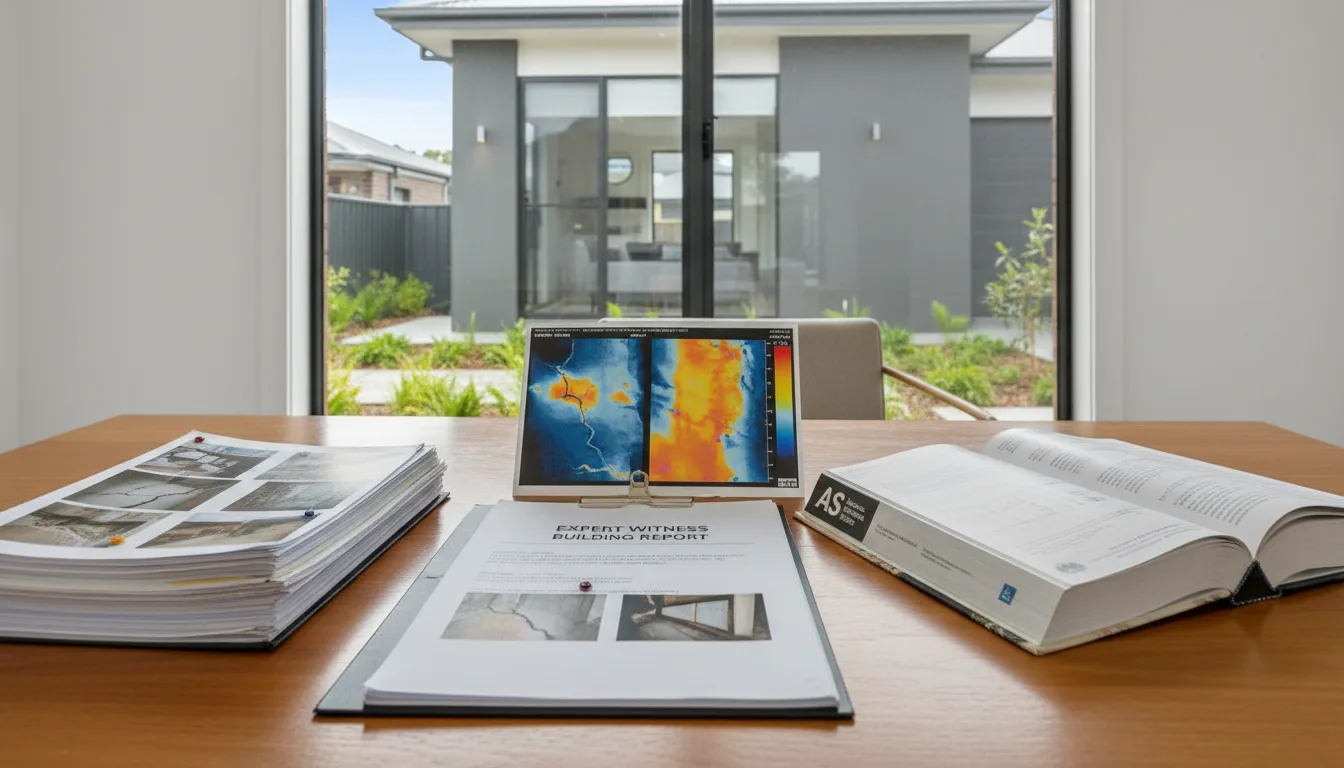
What Makes a Strong Expert Witness Report?
The elements that separate a persuasive expert report from one a tribunal discounts, from stated assumptions to defensible costings.

How Do Scott Schedules Strengthen Construction Dispute Cases?
How the item-by-item schedule format works, why tribunals ask for it, and how to prepare one properly.
How Can Expert Witnesses Help You Win NCAT Building Disputes?
When to engage an expert for a NSW building dispute, how they prepare, and what makes their evidence land at NCAT.